- Search
- 1.877.235.1004
- Contact Us



- Design 1st
- Resources
- Hardware Product Development Trends for 2026
10 Product Development Trends for 2026, Backed by 100+ Hardware Projects

Design 1st
Estimated Reading Time:
Table Of Contents
- Introduction
- 1. Regulatory Front-Loading
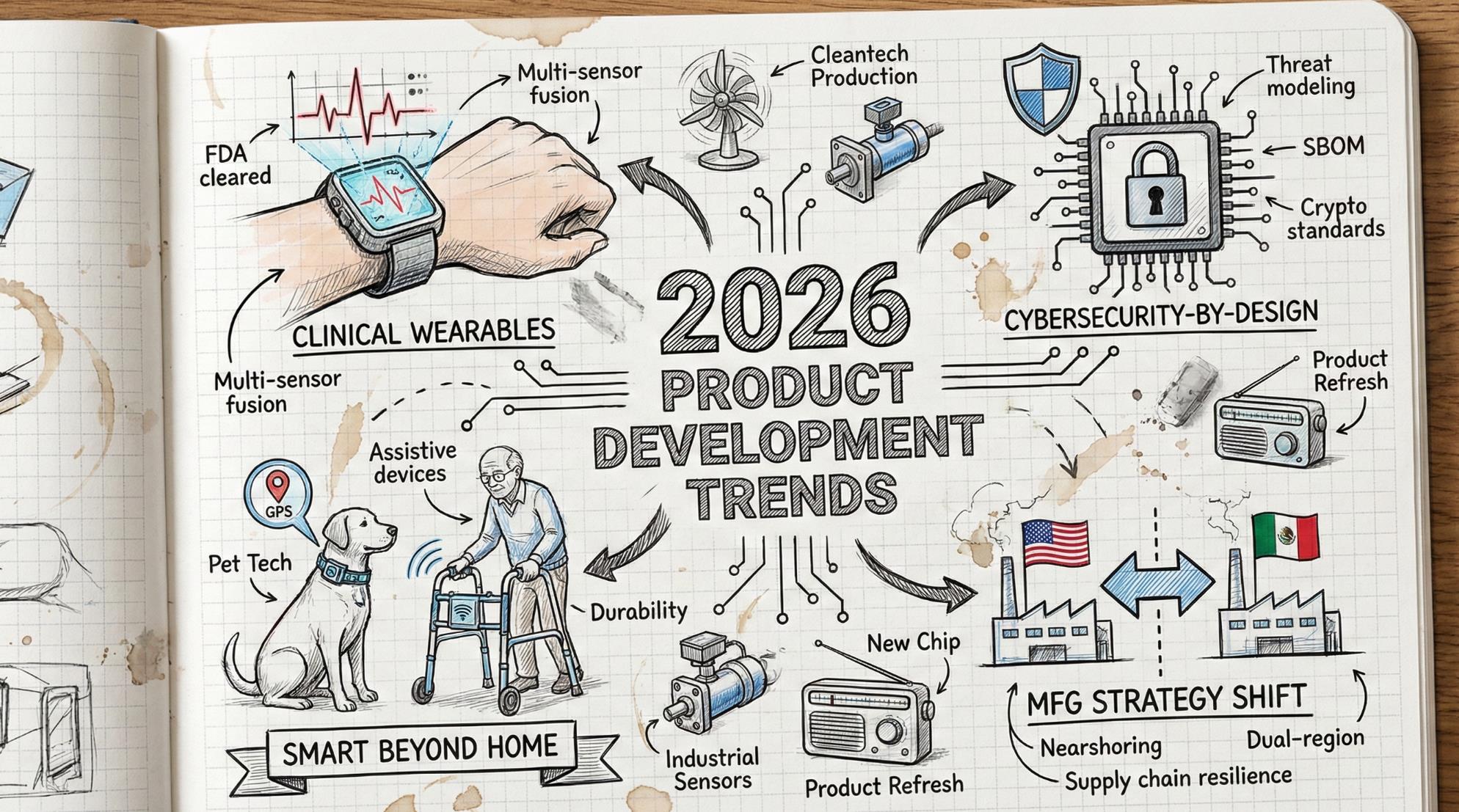
- 2. Wearables Crossing the Clinical Threshold
- 3. Cybersecurity-by-Design
- 4. Wireless Power Goes Infrastructure
- 5. DFM-First Development
- 6. Smart Products Beyond the Home
- 7. Manufacturing Strategy Shift
- 8. Cleantech Moving From R&D Lab to Production
- 9. Industrial Equipment Adding Intelligent Sensors
- 10. Old Products Getting Refreshed
- What to Watch
Introduction
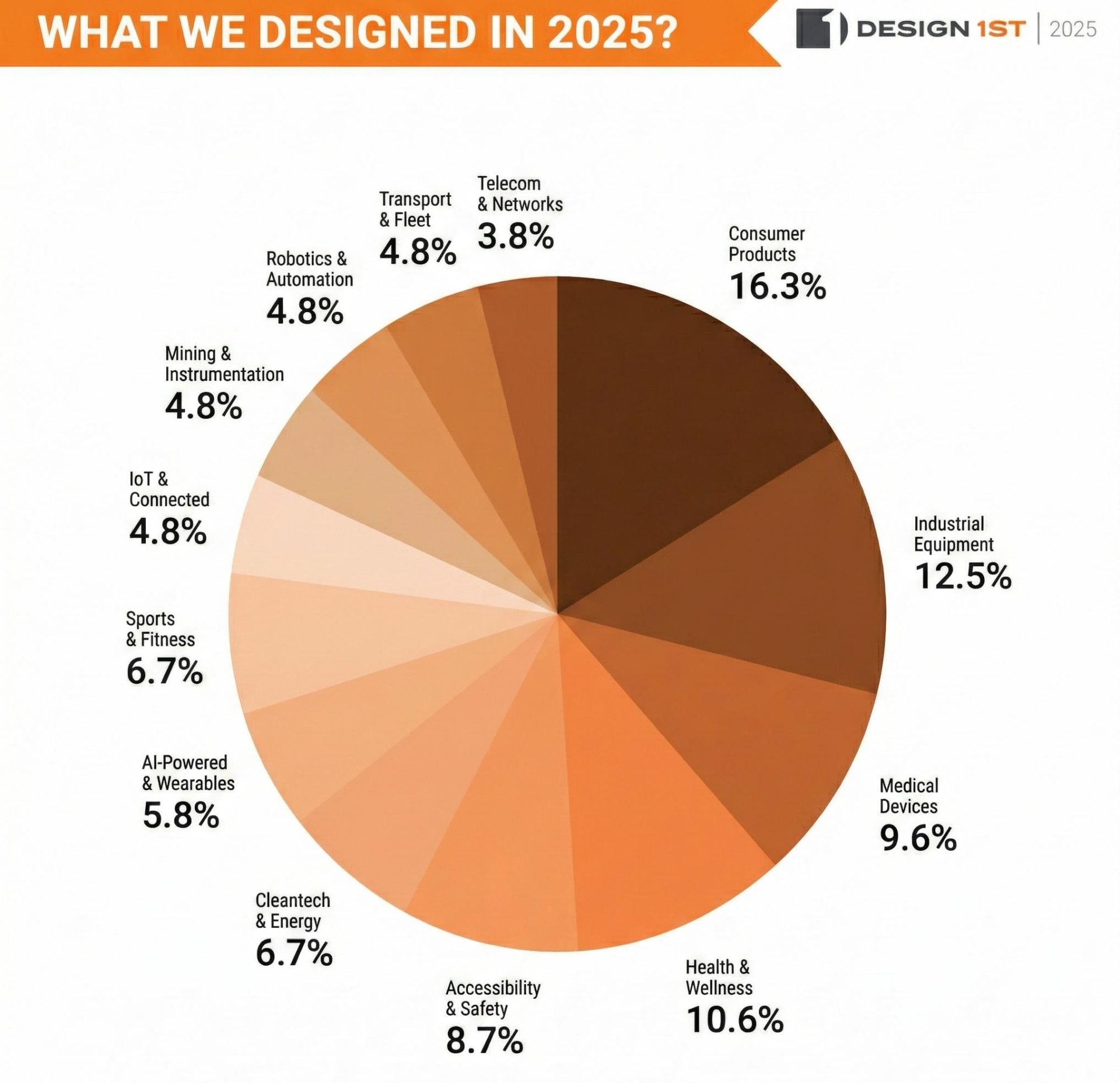
Last year at Design 1st, we worked on over 100 physical hardware projects across thirteen industries. Medical devices, consumer electronics, industrial equipment, pet tech, clean energy.
We’ve been doing product development for 30 years. What follows isn’t a forecast based on market reports. The patterns below are showing up right now in active development. Real projects. Real clients. Real engineering problems getting solved.
If you’re planning a hardware product launch in 2026, here’s what development actually looks like from inside the shop.
1. Regulatory Front-Loading
For years, compliance was the thing you figured out after the design was locked. Hire a consultant, run the tests, get the sticker. That approach is dead.
Three regulatory deadlines are converging. FDA cybersecurity guidance went final June 2025. EU Digital Product Passports standards finalized December 2025, with batteries mandatory February 2027. Right to Repair hit critical mass with five states enacted and all 50 introducing bills.
We’re seeing the shift with clients developing connected stethoscopes, bladder monitors, and implantables. Security architecture and compliance documentation now start at concept phase, not after design lock.
2. Wearables Crossing the Clinical Threshold
The FDA used to be where consumer wearables went to die. Too expensive. Too slow. Not worth the regulatory headache.
Something shifted. Samsung’s Galaxy Watch got FDA clearance for sleep apnea detection. Dexcom’s glucose monitor now integrates with the Oura Ring. CMS expanded reimbursement codes for remote physiologic monitoring in 2026.
The unlock is multi-sensor fusion. One sensor gives you consumer data. Stack multiple sensors with smart algorithms and you get prescription-grade accuracy. Our partners developing sleep apnea monitors and concussion recovery systems are building for both worlds. Consumer form factors with clinical-grade accuracy.
3. Cybersecurity-by-Design
A stat worth noting: 53% of connected medical devices have critical vulnerabilities, according to the FBI. Not minor issues. Critical.
The old approach treated security as a feature to add later. That thinking created the problem we have now. New FDA guidance makes security architecture a design-phase requirement. Threat modeling, software bills of materials, encryption standards. All documented before clearance submission.
We’re embedding security architecture at concept stage across all connected device projects. For clients building bladder monitors, connected stethoscopes, and implantables, cybersecurity decisions are part of the first engineering review. Not the last.
4. Wireless Power Goes Infrastructure
Remember when wireless charging was a gimmick? A party trick for your phone that worked half the time and overheated the other half?
That era ended. Wireless power transmission is becoming infrastructure. Room-scale charging systems, in-road EV charging, and medical implants that never need battery replacement surgery.
Medical implants are the sleeper application. Wirelessly powered implants mean no more surgeries to replace batteries. We’re working on bone lengthening devices and dental implants that draw power without wires. The engineering challenge shifted from “can we do it” to “can we do it efficiently and safely at scale.” Different problem entirely.
5. DFM-First Development
A number that should scare every product manager: 70% of manufacturing cost gets locked in during design. Not during tooling. Not during production ramp. During design.
The old model was design first, figure out manufacturing later. Run EVT. Find the problems. Fix them in DVT. Maybe do another round. That model costs months and money.
The new model brings manufacturing into the room from day one. Cloud-based tools now provide real-time feedback on manufacturability and cost drivers within CAD. Teams integrating Design for Manufacturability early are cutting entire build rounds. Single-build EVT/DVT is becoming achievable for teams willing to do the homework upfront.
6. Smart Products Beyond the Home
Smart home got all the attention for a decade. Meanwhile, smart everything else quietly became a massive opportunity.
Pet tech. Over a billion pets worldwide. More than half of all households own one. Smart collars, GPS trackers, health monitors, automated feeders. Pet owners treat animals like family and spend accordingly.
Assistive tech. The World Health Organization projects 3.5 billion people will need assistive devices by 2050. AI navigation, fall detection, drowning alerts. Features that used to require institutional equipment now fit in consumer products.
The design challenge is different than consumer electronics. Pet products get chewed. Baby products get thrown. Accessibility devices become life-critical. Durability and safety certification drive engineering decisions.
7. Manufacturing Strategy Shift
Reshoring used to be a talking point. Now it’s a line item.
Mexico is accelerating as a nearshoring hub. Dual-region sourcing is becoming standard for anyone who learned hard lessons from 2020-2022. The question shifted from “can we make it cheaper overseas” to “can we make it reliably with supply chain flexibility.”
Geography decisions now happen at design phase because they affect component selection, tooling investment, and logistics planning. Waiting until production ramp to figure out manufacturing location costs time and money. We’re setting up manufacturing across regions for clients who need both cost efficiency and supply chain resilience. The teams winning are treating manufacturing as a design partner, not a vendor to call later.
8. Cleantech Moving From R&D Lab to Production
Technologies that spent years in demonstration are finally hitting commercial deployment. Small-scale hydrokinetic turbines, solar EV charging systems, smart composting, HVAC heat recovery. Hardware engineering is catching up to climate policy timelines.
The shift isn’t about breakthrough science. The core technologies exist. The challenge is productizing them at price points that work without subsidies.
We’re working with partners on hydrokinetic turbines moving from pilot to production, solar EV chargers designed for residential installation, and thermal recovery systems for commercial buildings. The engineering focus has moved from proving concepts to solving manufacturing and installation constraints.
9. Industrial Equipment Adding Intelligent Sensors
Sensors are becoming standard in industrial equipment. Predictive maintenance, real-time monitoring, edge computing. The global pressure sensor market alone is projected to exceed $30 billion by 2032.
Industrial environments are harsh. Extreme temperatures. Vibration. Chemical exposure. Connectivity can’t come at the cost of durability.
We’re integrating sensors into hydraulic systems, industrial vacuum equipment, UV sterilization systems, and mining instrumentation. The engineering requirements go beyond adding a chip and an antenna. Sensor placement, power management, and data transmission all need to survive conditions that would destroy consumer electronics.
10. Old Products Getting Refreshed
Ground-up new builds get the headlines. But a significant portion of product development work is refreshing existing products rather than starting from scratch.
Companies are adding connectivity to proven platforms. Embedding AI capabilities into established product lines. Updating designs to meet new regulatory requirements. The economics make sense. Lower risk than new development. Existing tooling and supplier relationships. Proven market demand.
We saw a notable uptick in redesign projects through 2024 and 2025. Companies updating products for cybersecurity compliance. Adding smart features to legacy platforms. Refreshing tired designs with new manufacturing approaches. For teams facing budget pressure and timeline constraints, product refresh often delivers better ROI than starting over.
What to Watch
The pattern across all ten trends is convergence. Regulatory pressure, manufacturing economics, and technology maturity are colliding earlier in the development cycle than ever before. Decisions that used to be deferred are now irreversible after design.
For teams planning 2026 launches, three things matter most:
Compliance homework starts at concept phase. Not after design lock.
Manufacturing decisions happen during design. Not at production ramp.
Consumer expectations keep moving. Your timeline needs to account for that.
That’s not a trend. That’s the new baseline.
Share
Need help manufacturing your product idea?
We can help take you from idea to design, prototyping, and volume manufacturing.