Category: Blog

Beer Chilling – Mechanical Innovations

Beer Chilling – Mechanical Innovations

27 Years Experience

75+ Design Awards

1,000+ Manufactured Products

From Idea to Prototype in as Little as Six Weeks!

Ready to Start?

All work and no play makes anyone a dull boy, so at the end of a long day of designing, prototyping and testing new product ideas, the team at Design 1st occasionally sit back and crack a few beers. But our curiosity does not end with the work day, so when considering ways of chilling a beer, we look beyond the time-honored combination of refrigeration and patience. Here is what we’ve found…

Two mechanical engineers out of Gainesville, Florida have revolutionized the way to cool a beer can 20 times faster with their product SpinChill, pun intended. Simply by spinning the closed can at a high speed within an icy liquid, the beer within cools at a faster rate; but how does it work? As we all know, in a rotating fluid, the densest particles collect near the center by the Rankine vortex principle, which is exactly the principle used here. In this case the colder, denser particles of beer collect near the center, driving the warmer particles to the edge of the can where they make contact with the ice-water through the metal can. Because of the high thermal conductivity of metal, the heat from the warmest beer particles is quickly transferred to the icy-water.

Bottles

But what if our beer should arrive in a bottle rather than a can? The thermal conductivity of glass is much lower than that of metal, so the transfer of heat through the vessel’s walls would not be of much use. For this, there is the Chillsner.

Submerge this sub-zero product to cool down your brew as you drink. The aluminum rod is filled with a thermal gel and stored in the freezer before use, so cooling your brew from the inside-out becomes as easy as popping the cap and dropping the Chillsner. The beer is allowed to escape its glass prison through a spout in the top of the rod, so that you can drink as its temperature sinks.

There are other products out there involving small, high-powered refrigerators; but the simple elegance of these two products encapsulates the design principles that make us salivate (or perhaps it’s the beer).

All work and no play makes anyone a dull boy, so at the end of a long day of designing, prototyping and testing new product ideas, the team at Design 1st occasionally sit back and crack a few beers. But our curiosity does not end with the work day, so when considering ways of chilling a beer, we look beyond the time-honored combination of refrigeration and patience. Here is what we’ve found…

Beer cans

beer-chiller-1
spin-chill-beer-chiller-768x448

Two mechanical engineers out of Gainesville, Florida have revolutionized the way to cool a beer can 20 times faster with their product SpinChill, pun intended. Simply by spinning the closed can at a high speed within an icy liquid, the beer within cools at a faster rate; but how does it work? As we all know, in a rotating fluid, the densest particles collect near the center by the Rankine vortex principle, which is exactly the principle used here. In this case the colder, denser particles of beer collect near the center, driving the warmer particles to the edge of the can where they make contact with the ice-water through the metal can. Because of the high thermal conductivity of metal, the heat from the warmest beer particles is quickly transferred to the icy-water.

Bottles

But what if our beer should arrive in a bottle rather than a can?  The thermal conductivity of glass is much lower than that of metal, so the transfer of heat through the vessel’s walls would not be of much use.  For this, there is the Chillsner.

Submerge this sub-zero product to cool down your brew as you drink.   The aluminum rod is filled with a thermal gel and stored in the freezer before use, so cooling your brew from the inside-out becomes as easy as popping the cap and dropping the Chillsner.  The beer is allowed to escape its glass prison through a spout in the top of the rod, so that you can drink as its temperature sinks.

There are other products out there involving small, high-powered refrigerators; but the simple elegance of these two products encapsulates the design principles that make us salivate (or perhaps it’s the beer).

Share

Have a new product idea?

We can help take you from idea to design, prototyping, and volume manufacturing.

Published on: February 25, 2023

The Ottawa Maker Movement is Growing

The Ottawa Maker Movement is Growing

27 Years Experience

75+ Design Awards

1,000+ Manufactured Products

From Idea to Prototype in as Little as Six Weeks!
Ready to Start?

What do a robot bird, sky-high lego buildings and a mechanized popcorn machine all have in common?

Believe it or not, they’re  part of a rising global movement – that call themselves makers – and they came to Ottawa in droves last weekend for the annual Mini Maker Faire.

Design 1st is out every year to take in Canada’s biggest gathering of creators, makers, tinkerers, hobbyists and hackers.

It’s a chance to mingle with the minds of creators and see up and coming talent who celebrate the fusion of art and science.

The talent pool gets bigger every year, as more and more people are finding out that Ottawa is also a creative capital. The weekend had an estimated crowd of more than 6500.

ottawa-mini-maker-faire-sign-300x223

It’s come a long way in four years, when Ottawa became the first Canadian city to host the maker extravaganza. Since then, several other Canadian cities have tagged onto the creator craze, like Toronto, Montreal, Calgary and Vancouver.

Design 1st has watched it grow, a sponsor since 2013.

“We want to inspire young makers and let them know that there is a large community of support to help them be successful,” says Kevin Bailey, owner of Design 1st.

It’s one of the reasons we’ll keep coming back.

With more than 50 exhibitors, our heads are still spinning from all the highlights, but we were able to replay some of the action from our experience at the Ottawa Mini Maker Faire in a video by fellow maker and life long cameraman Richard Burman.

While it’s a wrap for this year, at Design 1st we’re more confident than ever that we’ve made our home in the right place, helping the multitude of Ottawa inventors making their napkin-sketch ideas or garage-bound projects a commercial reality.  And by working with local manufacturers, welding and fabrication shops and universities we feel part of a bigger ecosystem – one where innovation is not only encouraged but forged through the  passion and dedication of Ottawa’s creative many.

Share

Have a new product idea?

We can help take you from idea to design, prototyping, and volume manufacturing.

Published on: February 25, 2023

How to Design Hardware Products for New Thread Wireless Protocol

How to Design Hardware Products for New Thread Wireless Protocol

27 Years Experience

75+ Design Awards

1,000+ Manufactured Products

From Idea to Prototype in as Little as Six Weeks!
Ready to Start?

The purpose of the new wireless protocol is to help smart home automation or Internet of Things (IoT) devices talk with each other more efficiently. But what does this mean for new products currently in development or existing smart home products? Here’s what we found out:

Thread Protocol Background:

  • Thread is a new low power wireless mesh network protocol for home automation products
  • It’s backed by several big name vendors including Samsung, Nest, ARM, Freescale Semiconductor, Silicon Labs who collectively formed the ‘Thread Group”
  • Thread Group’ modeled after WiFi Alliance and will carry out product certification, testing products for compliance and interoperability in order to carry Thread Logo

How will does the new Thread network protocol apply to new & existing Products?

  • All existing device which use ZigBee/6LoWPAN (802.15.4) standard can easily migrate to Thread with the existing radios with just a firmware update. No Hardware Needed
  • While companies can support Thread and build into products Thread certification will not take place till mid-2015
  • Plan to release the Thread specification in June 2015
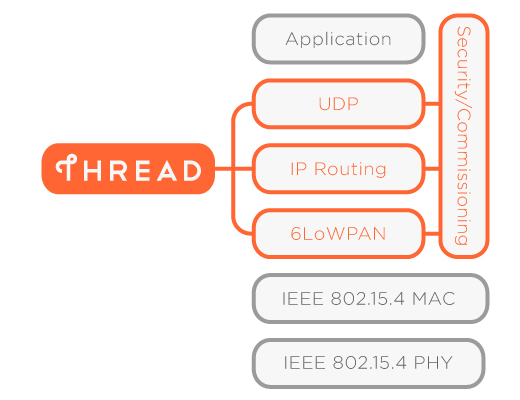
thread-wireless-protocol

The Thread Protocol and Technology:

  • Build off IEEE 802.15.4 standard that defines the PHY and MAC layers, leaving the upper layers open for development
  • ZigBee and 6LoWPAN are two specs with a custom upper layer that allow IPv6  and create a wireless embedded internet.
  • Thread will replace ZigBee or 6LoWPAN in the upper layers of 802.15.4 with Software update
  • Thread will improve wireless security, routing, setup and device wakeup that should save precious battery life

So, if you’re in development now or plan to release a new smart device or IoT hardware product make sure to include a 802.15.4 radio chip even if you’re using Wi-Fi.

This way if the ‘Thread’ protocol does take off, like it’s big-names backers say, your Smart Device will be supported.

Share

Have a new product idea?

We can help take you from idea to design, prototyping, and volume manufacturing.

Published on: February 24, 2023

eNewsletter: Nuvyyo – Cutting the Cable Cord

eNewsletter: Nuvyyo – Cutting the Cable Cord

27 Years Experience

75+ Design Awards

1,000+ Manufactured Products

From Idea to Prototype in as Little as Six Weeks!

Ready to Start?

Small, Elegant and Cool Design for Leading-Edge Consumer Electronics

“We’re extremely happy with the team’s responsiveness and the finished product, which has started shipping to customers and is getting rave reviews. Design 1st has been a great partner from the very beginning – assisting us with turning ideas into product renderings for our investment rounds, and then working with our requirements and budget to turn Tablo into a reality. We worked together through the challenges and issues that came along ultimately developing something quite unique and actually meeting our high expectations. Kevin and his team provided support and great insight into the commercialization process and delivered absolutely excellent design and engineering work.”

grant-hall-200x200

Grant Hall, CEO Nuvyyo

Cutting the Cable Cord

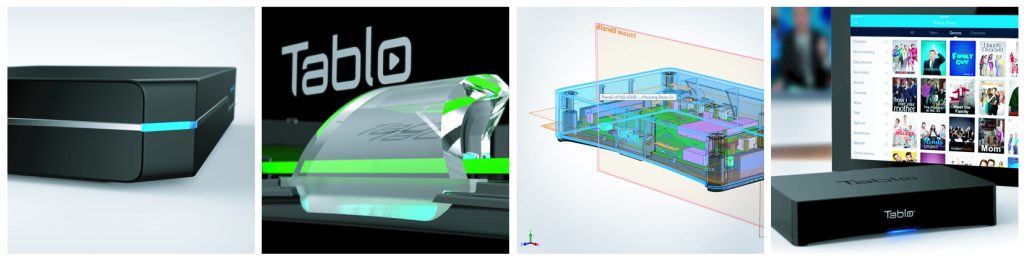
“Cutting the cord” from your cable subscription has been a subject of much interest over the last few years, and is growing ever popular with users of tablets, computers and smart devices who want to consume their favourite content anywhere, at any time. Developing an elegant solution to this problem was the vision of Ottawa-based Nuvyyo Inc., who set out to reinvent the home media experience for consumers in the US and Canada. In early 2013, Grant Hall, CEO of Nuvyyo and his team set out to create a broadcast TV system that combined the functionality of a DVR and the convenience and mobility of a tablet, letting users browse, watch, and record free over-the-air HDTV on any device, anytime, and anywhere in the world.

Meet Tablo: Unleash Your HDTV from TabloTV on Vimeo.

Armed with their idea, Nuvyyo initially worked with two industrial design firms, but after multiple attempts, still did not end up with a product that reflected their vision. Looking for some fresh ideas, and committed to working with a local partner, they approached Design 1st. It was important to the Nuvyyo team that they could easily collaborate, review prototypes and have a design team with deep consumer-goods design experience. Design 1st certainly fit the bill.

In the early stages of the project, Design 1st was instrumental in developing product concept renderings for investment presentations and crowd funding campaigns, which in turn funded the development of real product concepts and the now-shipping successful Tablo.

Design 1st Delivers On Unique and Complex Design Challenges

From the outset, there were a number of key goals set for the design process. The first, and perhaps most notable, was to design a compact and elegant product that was different from that of the competition. The device had to blend in with other set-top devices, while maintaining a sleek, professional appearance, much like the Apple TV, Roku and other everyday use home electronic devices.

From the outset, there were a number of key goals set for the design process. The first, and perhaps most notable, was to design a compact and elegant product that was different from that of the competition. The device had to blend in with other set-top devices, while maintaining a sleek, professional appearance, much like the Apple TV, Roku and other everyday use home electronic devices.

The second was to address the complex thermal and cooling challenges of a product this size packed full of leading-edge electronics. “Hot to touch” enclosures cooled by loud, large fans tend to be the norm. It takes a creative, experienced team working closely together to address this challenge and succeed. Design 1st had the skills, FEA tools and combined in-house design and engineering team to find the workable solution. Tablo needed to be small, run quietly and remain cool for both the 2-Tuner and the more complex 4-Tuner product versions while also maintaining an elegant presentation. The objective was to avoid large vents, holes and hot-to-touch metal casings for both versions by using common components for both. The team worked with a variety of thermal heat-spreading ideas, and arrived at a creative airflow management technique that allowed the DVR to maintain cool internal electronics for reliability and a warm but comfortable user handling temperature.

In March 2014, Tablo began shipping to locations across the US and Canada. Early customer feedback has been extremely positive, with great reactions on social media, in mainstream media, and from customers directly. Here’s just a few tweets popping up showing stellar feedback on the TabloTV:

Nuvyyo’s Tablo is one of the most promising over-the-air recording solutions in years
http://t.co/SuI13ACe3r 
pic.twitter.com/Bt2vK8PoAB

— CNET TV (@CNETTV) May 21, 2014

Cord-cutters take note: Nuvyyo’s Tablo is a geek-friendly DVR for over-the-air TV [review] http://t.co/FfNz1ART9N pic.twitter.com/rMbthz0z2p
— Matthew Moskovciak (@cnetmoskovciak) May 21, 2014
@TabloTV received, hooked up, rocking! WOW! Very nicely done and well polished for a first release prod. Very happy. Awesome job to u all!
— Michael Reid (@mreid910) April 25, 2014

Design 1st encourages you to cut the cord on cable – enjoy a better TV experience with Tablo. Interested in learning more about Tablo? Visit the Tablo website to purchase yours today.

Hire an Expert Design and Engineering Team


Other Design 1st Consumer Products Launched in 2014

Design 1st client K9 Clean Launches Portable Pet & Utility Shower Product
K9 Clean has launched a compact, portable pet shower created to clean dirty, muddy dogs prior to getting in to a vehicle or home.
Learn More >>

Design 1st Client SoloRolo Launches Portable Therapeutic Massage Product
SoloRolo offers for purchase online an innovative massage tool to deliver myofascial release therapy to treat muscle and joint pain from stress, tightness, or recurring injuries.
Learn More »

Design 1st Client J2Light Launches Commercial LED Lighting Product
J2Light has a LE3 lighting fixture designed to replace HID and Fluorescent products in commercial, industrial, institutional, retail, and sports lighting applications.
Learn More »

Design 1st loves working with companies on their technically challenging new product design and development projects. We provide turnkey new product design or we can be a flexible extension of your in-house team. We look to provide value at every step in the process. Our program management and senior design and engineering team enable a fast and predictable outcome.

Email us at info@www.funluv.org or call Ian Kayser at 1.877.235.1004 x228 to learn how our team and design process can turn your ideas into new products fast. Our commercialization specialists will then help you fully qualify the design with manufacturers in a controlled process ensuring a successful product launch and first sales to customers.

Share

Have a new product idea?

We can help take you from idea to design, prototyping, and volume manufacturing.

Published on: February 24, 2023

Crowdfunding 2.0 – You Can Now Micro Invest in Local Startups

Crowdfunding 2.0 – You Can Now Micro Invest in Local Startups

27 Years Experience

75+ Design Awards

1,000+ Manufactured Products

From Idea to Prototype in as Little as Six Weeks!

Ready to Start?

A couple years ago many great product ideas were sitting collecting dust in the minds, workshops and hard drives of entrepreneurs. These ideas sat behind the barrier of funding – often dismissed after the entrepreneur exhausted their bootstrap, government and private lending finance options.

But crowdfunding changed that. Using online platforms, crowdfunding meant new product ideas could be pitched to a wider global audience and funded through individual donations. These fundraising efforts have led to some pretty impressive success stories, the most notable being the Pebble Smartwatch which fundraised $10.3million using Kickstarter in 2012.

In Canada, this new finance model has spread like wildfire. In under a year Canada has gone from a crowdfunding neophyte to experienced innovator. It was only eight months ago that the largest global crowdfunding platform – Kickstarter – launched its Canadian operations. Already the tally is massive – 1,400 projects and $14 million in donations!

For people with new product ideas fundraising is quite literally at their fingertips. It only takes five simple steps. Launch a Kickstarter or Indiegogo account, tell the world why your idea is amazing, collect the donations design it and go to market.  Simple right? Not for everyone.

While this scenario may have worked for a minority of crowdfunded projects it is difficult to fund an entire startup through donations and non-monetary incentives without giving up equity.

On March 20, that all changed. The Ontario Securities Commission announced plans to open the door to equity-based crowdfunding – effectively leap frogging the U.S.’s progression in crowdfunding regulation.  This means Canadian entrepreneurs now have the opportunity to fund their new product ideas and business through two crowdfunding models which include:

 Model 1: Fundraising Based Model (Donators)

 This is the standard crowdfunding model everyone is familiar with and the mode used popular platforms Indiegogo and Kickstarter. The mechanics are straight forward: post a project set a funding goal and add some non-monetary rewards for donation levels. The main risk with this model lies with donors – there is no guarantee they will receive their reward.

For physical products, the risk is heightened. Product development doesn’t happen overnight and donors sometimes wait more than a year to reap their rewards. This was the case for the Pebble Smartwatch. Its first watch rolled off the assembly line 18 months after the Kickstarter campaign launch. On the other hand, Design 1st’s Ottawa client, Nuvvyo, used this method to fundraise over $30,000 for their Tablo DVR product on Indiegogo last fall. They cut shipping by a third, sending the first product to buyer doors only six months later.

Model 2: Equity Based Model (Investors)

This is the new innovative model already adopted by several countries including the UK, Germany and Australia. It functions similar to the fundraising model where entrepreneurs pitched their ideas online but it has one interesting caveat: it generates investments not donations. This equity model replicates the IPO process but without the red tape, accounting and legal fees which are sure to make equity crowdfunding a disruptive finance model for startups and established enterprises.

While Ontario was first in Canada to come forward with the new equity-based crowdfunding regulations, similar proposals have been drawn up in Quebec, Saskatchewan, New Brunswick, Manitoba and Nova Scotia.

Across the board the newly proposed rules limit investors to a $2,500 per venture and a total of $10,000 per year. Investors are also required to sign a “risk acknowledgment form” stating that they are aware they could lose all the money. Any online platform that adopts equity-based crowdfunding is required to have individual regulations, register with Canadian regulators and do background checks on participating companies.

This is an exciting time for Canadian entrepreneurs.  Funding is often the biggest barrier to the launch of new ideas and products. Access to equity crowdfunding is sure to disrupt the status quo. After all, not everyone can a land a deal with dragons….


Share

Have a new face mask innovation idea?

We can help take you from idea to design, prototyping, and volume manufacturing.

Published on: February 24, 2023

Cast Your Vote for Canada’s Top Immigrant Award

Cast Your Vote for Canada’s Top Immigrant Award

27 Years Experience

75+ Design Awards

1,000+ Manufactured Products

From Idea to Prototype in as Little as Six Weeks!
Ready to Start?
Rumidifer-Photo-

We’re pleased to announce that our client Jeri Rodrigs is a Finalist for the Canadian Immigrant Award!

Jeri is an Ottawa entrepreneur and inventor of the award winning Rumidifier – an Eco-Friendly Zero Energy Humidifier.

Share

Have a new product idea?

We can help take you from idea to design, prototyping, and volume manufacturing.

Published on: February 24, 2023

Insect with Mechanical Gears Found

Insect with Mechanical Gears Found

27 Years Experience

75+ Design Awards

1,000+ Manufactured Products

From Idea to Prototype in as Little as Six Weeks!
Ready to Start?


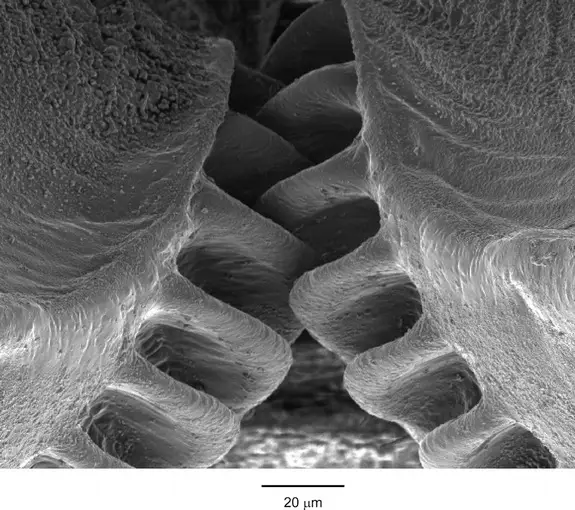
Mechanical gears are what make inspects jump, well at least one type of insect – this is what the latest evidence from science is stating. Early September scientists from the University of Cambridge revealed they found the very first example of functional mechanical gears in nature.

523336846bb3f7d870c939cc


Malcolm Burrows, the Cambridge based neurobiology professor behind the discovery said “To the Best of my knowledge, it’s the first demonstration of functioning gears in any animal”.  The functioning set of mechanical gears was exposed after Burrows captured the “Issues Coleoptratus” insect using high speed video at a rate of 5,000 images/second.The video below reveals the bug preparing to jump and the gear “teeth” of its hind legs meshing together preparing to jump:

Share

Have a new product idea?

We can help take you from idea to design, prototyping, and volume manufacturing.

Published on: February 24, 2023

Top 5 Crazy Inventions of 2012

Top 5 Crazy Inventions of 2012

27 Years Experience

75+ Design Awards

1,000+ Manufactured Products

From Idea to Prototype in as Little as Six Weeks!
Ready to Start?


Almost every day the phone rings at Design 1st with an eager inventor on the line yearning to learn more on design, patenting and prototyping their product idea. This is one of the many exciting parts of working at Design 1st – discussing new ideas and talking to passionate inventors.

Over the past year, we’ve had various inventor clients complete the product development phase and proceed to market. We’ve also come across a number of innovative product ideas that probably had many inventors thinking, “Boy, why didn’t I think of that!” Whenever we share these creative inventions with the Design 1st team, the industrial designers and mechanical engineers usually toss ideas around on how’s its manufactured and what would make it better. Lately we keep discovering new inventions and gadgets that we feel we must share, here’s a list of the Top 5 coolest ones we’ve found!

1. The Bug-A-Salt

With the Bug-A-Salt, a shotgun that fires ordinary table salt makes for a fun and easy way to take care of nasty insects around the house. With a range of around 3 feet bugs are quickly eliminated and will remain whole for easy clean up.

2. The Hot Tug:

The “Hot Tug” combines the relaxation of a hot-tub with the ambiance of a boat ride. Built to fit 6-8 people the boat holds 2000 liters’ of water that is heated up via a wooded stove located on board. Simply fire up the wood stove a few hours before you decide to ‘set sail ’, hop in and relax!

3. Spring Loaded Ice Skate:

Launch Skates are the brain child of David Blois a Toronto based inventor who had the idea to create a more efficient hockey skate using springs. The innovative skates use the force of a skater’s step to compress a spring, storing kinetic energy that is released once the skater takes a stride. David’s invention went on to win a 2012 Popular Science Invention Award.

4. Laser Gun Alarm Clock

When the first decision of your day is to hit snooze and go back sleep, more often than not you’re in for a rough morning. The innovative “Gunshot Alarm Clock” has found a creative solution to this problem by allowing you to shoot your annoying alarm back into snooze mode. When the alarm goes off, a target pops up that you have to shoot with a laser gun to turn off the alarm.

5. The KnockOut:

When sipping a beer casually just doesn’t do it for you, the Knockout is the answer. A combined beer bong and tabacco water pipe the Knockout creates a smooth, fast and effortless way to relax. Invented by a trio of Ottawa friends, the Knockout won the 2013 Munchie Award hosted by Snoop Dog and is receiving Pre-Orders today.

Share

Have a new product idea?

We can help take you from idea to design, prototyping, and volume manufacturing.

Published on: February 24, 2023

Startup to Watch: Northvu – HDTV Antenna

Startup to Watch: Northvu – HDTV Antenna

27 Years Experience

75+ Design Awards

1,000+ Manufactured Products

From Idea to Prototype in as Little as Six Weeks!
Ready to Start?
Northvu-Product

Lately it seems like every week a Design 1st client is making news headlines. This week the honor goes to NorthVu Systems, an Ottawa based startup that created the NV20 pro HDTV antenna. NorthVu was named a 2013 “Startup to Watch” by the Ottawa Business Journal.

Launched last March 2012, the NV20 Pro has travelled down the bumpy road of commercial success. Along the way they have continually racked up more and more distributors for their indoor HDTV antenna including Amazon, Home Hardware and The Source. Next stop, NorthVu hopes, is Walmart to further expand their bricks-and-motor in store presence south of border.

For more information on the NV20 Pro, how you can “Cut the Cord” and receive free HDTV television channels visit: www.Northvu.com 

Share

Have a new product idea?

We can help take you from idea to design, prototyping, and volume manufacturing.

Published on: February 24, 2023

Four Components for Determining Product Design Usability

Four Components for Determining Product Design Usability

27 Years Experience

75+ Design Awards

1,000+ Manufactured Products

From Idea to Prototype in as Little as Six Weeks!
Ready to Start?


It happens all the time. Someone thinks he has a bright idea, and a new consumer product is born. Unfortunately, not every new concept is worth putting on a retail shelf, as illustrated by this 2012 post on the “20 Useless Products No One Should Buy.”

So what factors do you need to consider when looking at product usability? Here are four components we recommend.

Reliability

When you pick up a new product, does it work? If not, consumers may think it has malfunctioned or isn’t working as planned. In our technologically focused world today, most people won’t spend much time trying to figure out how something should work.

In the article, “Americans Aren’t Just Lazy Workers, They’re Just Lazy. Period.” freelance writer Deborah S. Hildebrand suggests:

Generally, an item is returned because it doesn’t meet customer expectations. Perhaps it’s too confusing to use (68%) or the buyer returns the item due to a change of heart (26%), frequently called “buyer’s remorse.”

Her assertion is that a product must function as expected — meet the user’s expectations and goals – in order to meet the product usability demands of consumers. Otherwise, they will give up trying.

Durability

You’ve likely heard the term built in or planned obsolescence. Often consumers believe that products designed with a short life span are built this way, intentionally. The purpose, according to them, is purely profit.

Therefore, when you design a product, it is important to consider durability. This includes the impact not only on a consumer’s pocketbook, but on the environment as well.

Ease-of-Use

Generally, you measure ease-of-use in terms of the mental and physical effort. However, ease-of-use also relates to how the product helps consumers accomplish their task.

Additionally, determine learnability by considering whether occasional users remember how your product works and retain their proficiency even after long periods of disuse?

Acceptability

Before you design a product, it is important to determine if, when, and how much it will be used. Once it is on the retail shelf, you need to reassess its performance continually to determine whether consumers actually enjoy using it.

As Eric Ries suggests in his book The Lean Startup, one of the primary reasons novice entrepreneurs fail is because they launch a product no one wants.

Reis suggests you ask yourself, “Will anybody buy this?” But don’t stop there. Continue asking questions. Obtaining continuous customer feedback is the only way to know if you are going in the right direction.

If you have an product in mind and want to determine its usability, you need the assistance of expert designers and engineers. That’s where we can help. Contact us.

Share

Have a new product idea?

We can help take you from idea to design, prototyping, and volume manufacturing.

Published on: February 24, 2023