Category: Articles

The Hardware Startup Renaissance

The Hardware Startup Renaissance

27 Years Experience

75+ Design Awards

1,000+ Manufactured Products

From Idea to Prototype in as Little as Six Weeks!

Ready to Start?

The hardware startup renaissance is upon us and in a troubled market, both established companies and entrepreneurs are welcoming it with open arms.  The decade long gold rush to develop web software Apps is maturing.  Increasingly innovators are combining physical hard goods with new Apps in their product plans.  A suite of software platforms, wireless hardware modules, flexible manufacturing processes and low cost single item shipping are making the design, development and delivery of these products easier for ever smaller enterprises and virtual companies.

“It\’s a shift that Silicon Valley has taken note of in the last couple of years. Hardware startups are increasingly sharing the spotlight with software companies.” Alex Chang – Wired

It is good to see the pendulum swinging back towards an array of Gizmos, Gadgets and physical products that when combined with apps provide new ideas for smart devices that deliver great value to the user and utilize the global digital network that connects us all.

“The Hardware Renaissance” is unmissable. Paul Graham has noticed it and, certainly, my credit card has. Where once, entrepreneurs turned to software to form their ‘next big thing’, there is an increasing trend towards hardware in this space – Richard Oakley VentureBurn

There are many hardware opportunities and rich intellectual property opportunities for product ideas in a wirelessly connected world.  The last hardware revolution was the 80’s and 90’s with infrastructure build out of the landline and wireless telecom and data networks.  Once the network infrastructure and platform software was in place, the add-on product over the last decade has been mostly software apps.  These Apps were modular, simpler for smaller enterprises to build and the technically sophisticated portable hardware platforms (tablets and smart phones) were available.  As the software only opportunities mature the new value is found in combining Apps with hardware, looking at niche markets that leverage the network infrastructure and access to data in the cloud.  Product teams are designing to provide real time access for people to enhance their relationships, provide media, information and awareness of important things, in a personalized way.

Hardware is much riskier than software.  It can take significant capital, the amount depends on how much software and hardware development the new product is going to require.  With existing platforms and modular components it is getting much easier to develop hardware product.  The process does not go away as you still need to build prototype after prototype before you can go into production.  A wrong choice of features or failed prototype success can mean tens to hundreds of thousands of dollars lost. It\’s easy to take a wrong turn.  As the hardware is being completed, you have electronics and software development to do.  Hardware development also requires selecting manufacturers, designing packaging, organizing logistics, testing the product and passing regulatory compliance, then financing and managing your build inventories.

Three key enablers have come into the market in the last few years, (1) Rapid Design- Prototype – Build techniques including Crowd Sourcing of simpler products, (2) Crowd Funding ‘Kickstarters’ where individuals help fund a project for the thrill of being involved and the possible reward of being first to have the new product and (3) An increase in the number of people wanting to invent (possibly due to a troubled economy), and companies needing to take higher risk and innovate.

Design 1st is Ottawa’s largest independent hard goods product design and engineering team, inventing and developing product with R&D departments and Start Ups across North America.  Over the past 3 years we have witnessed the hardware product renaissance first hand.  Clients are asking help to put wireless devices on athletes – real time video in moving vehicles – monitor patient’s health and safety  – smart devices for home management – heart and breath belts for nutrition and fitness tracking – Security Camera control by smart phone – real time poker game dealer monitoring – hydro, heat, LED lighting and fluid monitoring for commercial spaces providing real time adjustment and alerting, and many more standalone products in widely different markets.

Development time frames to invent, test and engineer are being reduced from over a year to less than six months.  The process has evolved into smaller teams of experts, faster project times, lower R&D costs, test verifying markets quicker with prototypes and ability to commit to lower production volumes. The coming wave is a wealth of appealing high quality product that used to only be possible with larger firms.

Share

Have a new product idea?

We can help take you from idea to design, prototyping, and volume manufacturing.

Published on: June 12, 2014

The Internet of Things | Designing for Atoms & Bytes

The Internet of Things | Designing for Atoms & Bytes

Product ideas come in many forms, but they’re typically tossed into one of two baskets – hardware or software. That’s all about to change.

Now there’s a third basket – the “Internet of things” – and the still-young reality has yet to be filled with new products that the blend digital and physical experiences.

It’s a new marketplace of ideas, driven by the convergence of wireless communication, sensors and the ubiquity of the Internet. The Internet of things (IoT) means any product can have embedded intelligence, or its own unique identifier, to connect the object directly to a network and transfer data without human interference.  It’s a simple concept that envisions a future where everyday objects are connected to the Internet.

Estimates suggest that by 2020, the IoT will number 50 billion separate objects, an explosion that some would say is a long time coming. As far back as 2008, the number of connected objects outpaced the earth’s human population.

Even further back, in 1999, a British tech pioneer named Kevin Ashton gave IoT a name when it was still just a concept. In his presentation to Procter and Gamble, he described how computers, databases, and the Internet itself were all dependent on humans for information – whether it was writing code, taking photos, or scanning bar codes. Information was a one way exchange.  Although the future technologies would change this, information could come from products – in his vision, as smart barcodes (RFID tags) for tracking products.

Fast forward 15 years and now the Internet of things is the Internet of everything. But it’s only recently that the “things” capable of machine-to-machine conversation have moved beyond devices like cell phones. A “thing” has expanded to include heart monitor implants, automobile tire pressure sensors, curling brushes that measure sweeping pressure and much, much more.

Global enterprises and venture capitalists alike are taking notice too, with $3.4 Billion invested in Wireless Smart Object Startups in 2013. A number that is sure to grow even larger in 2014 given Google’s recent purchase of Nest Smart Thermostats for $3.2B in January to control your home temperature via your smartphone and an impressive cloud back office analytic engine that learns from your behavior and makes adjustments for you. Yes the systems are actually getting smart enough where you won’t be constantly frustrated by it doing something we don’t want it to do.

The first wave of products is hitting the market now and the next wave is currently in development spanning a gambit of consumer gadgets, medical devices, home automation, gear for vehicles as well as agriculture opportunities to name a few. Many of these IoT products are coming to fruition with the help of crowd-funding platforms like Kickstarter – that fund and build awareness for new products simultaneously.

But this influx of new products ideas meshing hardware and software has created new challenges for product designers. These include:

Convergence of Hardware and Software Design

But this influx of new products that merge software and hardware into the same development cycle poses new challenges for designers. Hardware and software have inherently different design and development methodologies. One discipline involves aligning atoms and the other arranges bytes.  Both want to deliver simple, easy to use product that people fall in love with.  IoT devices must include both disciplines and this requires innovators to combine and manage these two product development processes together in order to design intelligently connected experiences for people. Things to consider when bringing an IoT Product innovation to life are many and the mantra of design for users is at the core.

The Complexity of  “Simple” Products

Even simple product ideas can be complex. Especially when Hardware, Electronics and Software collide. To create a seamless product experience first pass out of the gate requires expertise in number of areas.  Common questions that should be asked prior the design of an IoT product – no matter the size – include: What elements are useable off the shelf?  What custom parts are needed? What software will need to be written? and What cloud based platform to select to manage my customers and data? Answers to these questions will make sure a new IoT product idea gets off on the right foot.

Connecting Vision to Real Customer Needs:

New product ideas are exciting, but they don’t always connect to consumer demand. Early concept design and testing the product idea with simulation and prototyping techniques allows development teams to get users to verify assumptions and business teams to quantify the demand. With 5 month product cycles, it is impossible to grow the knowledge in house and outsourcing part or all of the one-time design and development effort becomes a lower cost and higher value alternative in many cases.

Challenges aside, it’s an exciting time for companies to refresh old products and to go after new ideas to connect into the Internet of Things that is upon us.  Design 1st plans to be a one of the teams that will help innovators embrace and go after these opportunities ahead.


Share

Have a new product idea?

We can help take you from idea to design, prototyping, and volume manufacturing.

27 Years Experience

75+ Design Awards

1,000+ Manufactured Products

From Idea to Prototype in as Little as Six Weeks!

Ready to Start?

Published on: May 27, 2014

Industrial Design Visionary: Braun or Apple?

Industrial Design Visionary: Braun or Apple?

27 Years Experience

75+ Design Awards

1,000+ Manufactured Products

From Idea to Prototype in as Little as Six Weeks!

Ready to Start?

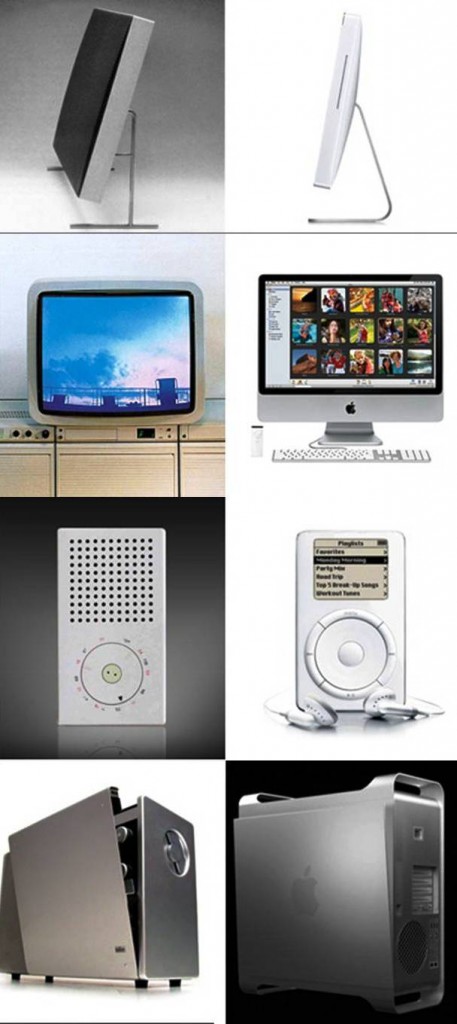
Product design plays a vital role in shaping our experiences with technology. In the realm of iconic design, two companies stand out: Braun and Apple. Braun, a German consumer products company, pioneered minimalist design principles in the mid-20th century, while Apple, an American tech giant, popularized sleek and minimalist design aesthetics in the modern era. This article explores the design differences between Braun and Apple and how Apple drew inspiration from Braun’s design philosophy.

Braun: The Pioneer of Minimalist Design:

Braun, founded in 1921, gained recognition for its commitment to minimalist design principles. Under the leadership of influential industrial designer Dieter Rams, Braun products embraced simplicity, functionality, and aesthetic appeal. Rams developed his famous “10 Principles of Good Design,” which included concepts such as “less is more” and “good design is innovative.” Braun’s products featured clean lines, intuitive interfaces, and a focus on user experience.

Apple: Building on Braun’s Legacy:

When Apple burst onto the tech scene in the late 1970s, it introduced a new era of consumer electronics. Apple’s co-founder, Steve Jobs, drew inspiration from Braun’s design philosophy and incorporated similar principles into Apple’s product lineup. Jobs admired Rams’ work and once stated, “We have always been shameless about stealing great ideas.” Apple products, like the Macintosh and subsequent devices, showcased minimalism, simplicity, and attention to detail.

Form Follows Function:

Both Braun and Apple share a common belief in the principle of “form follows function.” This design approach emphasizes that the design of a product should primarily serve its purpose and enhance its usability. Braun’s products, such as radios, shavers, and calculators, were characterized by their functional elegance and a reduction of unnecessary elements. Apple’s devices, like the iPhone, iPad, and MacBook, follow a similar design philosophy, prioritizing simplicity and user-friendly interfaces.

Simplicity in User Interface:

Braun and Apple recognize the importance of simplicity in user interfaces. Braun’s devices featured clear markings, logical layouts, and intuitive controls. Apple expanded on this concept by developing user interfaces that were visually appealing, easy to navigate, and focused on delivering a seamless user experience. The clean and minimalistic interfaces found in Apple’s iOS and macOS have become industry standards, reflecting the influence of Braun’s design legacy.

Material Choices and Attention to Detail:

Both Braun and Apple pay meticulous attention to material choices and manufacturing processes. Braun’s products often featured high-quality materials, such as brushed aluminum and matte plastics, which conveyed durability and sophistication. Apple adopted a similar approach, utilizing premium materials like aluminum, glass, and ceramic in their products. This emphasis on craftsmanship and material selection has become synonymous with both brands.


Braun’s early foray into minimalist design left an indelible mark on the world of product design. Apple, with its penchant for innovation and aesthetic refinement, built upon Braun’s legacy, ushering in an era of sleek and minimalist consumer electronics. The influence of Braun’s design philosophy can be seen in Apple’s product lineup, which continues to captivate users with its functional elegance and attention to detail. As technology continues to evolve, the enduring impact of Braun’s design principles and Apple’s refinement will shape the future of product design for generations to come.

Share

Have a new product idea?

We can help take you from idea to design, prototyping, and volume manufacturing.

Published on: January 4, 2013