- Search
- 1.877.235.1004
- Contact Us


- Design 1st
- Resources
- Crowdfunding Graveyard – What Killed 41 HW Projects?
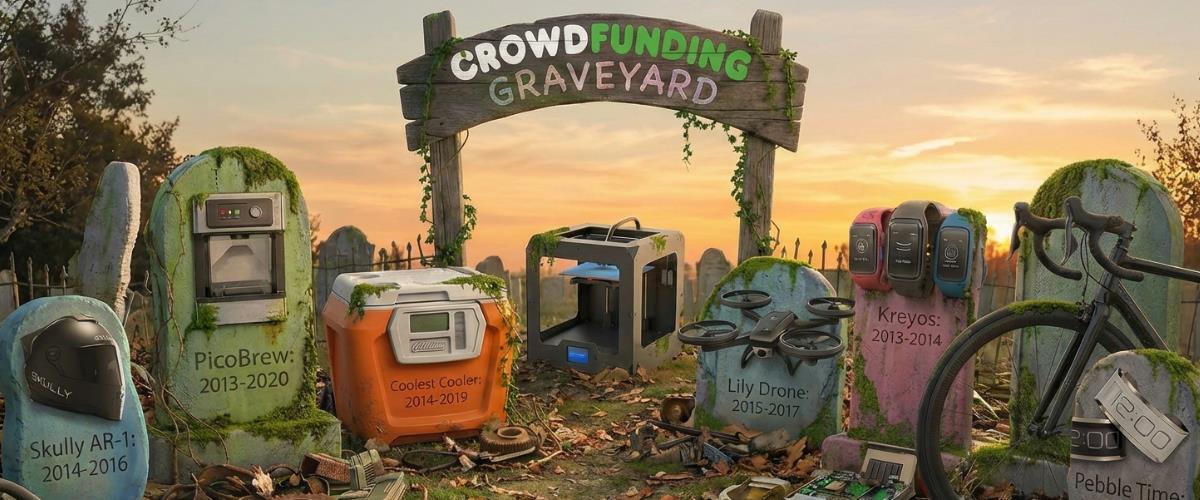
Crowdfunded Products Graveyard
What Killed 41 Hardware Projects That Raised $122.5 Million and Left Consumer Backers Empty-Handed?

Design 1st
Estimated Reading Time:
Table Of Contents
Every crowdfunding campaign for a physical product ends one of three ways.
The first outcome is simple and most common. The campaign didn’t hit its funding goal. Disappointing, but clean. No money changes hands. Everyone moves on.
The second outcome is where the magic happens. The campaign blows past its funding goal, the product ships, backers are delighted. Platforms like Kickstarter and Indiegogo have connected millions of early adopters with innovative hardware creators. Both platforms have tightened their rules over the years, requiring working prototypes and banning photorealistic renders. The ecosystem is maturing.
But then there’s the third outcome. The campaign succeeds wildly. Funding goals are crushed by 1000%, sometimes 4000%. Tech blogs gush. Waitlists grow. And then… nothing ships.
This is the outcome nobody talks about until it’s too late. The backers lose their money, and the promising new startup fails.
We didn’t set out to investigate crowdfunding failures. We’re a product development firm. But as individuals, we’re also early adopters who’ve backed our share of projects over the years. A lunchroom conversation about crowdfunding turned into a debate about which projects actually ship. That sparked the idea.
So we dug in. Our database covers 41 high-profile failures totaling $122.5 million in backer investments and leaving over 520,000 people empty-handed.
41
Failed Projects
$122.5M
Total Raised
520K+
Backers Affected
85%
Engineering Failures
The findings surprised us. The easy assumption is that these projects were cons run by bad actors looking to fleece naive consumers. A few were. But the vast majority? 85% of failures were caused by engineering problems, not fraud.
These were passionate creators and hardware startups with great product ideas and slick videos. But they were unprepared for the realities of manufacturing and oblivious to the complexities of physical product development.
At Design 1st, we’ve spent 30 years helping innovators turn ideas into real products. We know where projects go sideways. Sometimes it’s a minor adjustment to the new idea. Sometimes the whole concept needs rethinking. Sometimes the product just isn’t viable. In all cases, creators need to know early.
That’s why we built the Crowdfunding Graveyard. A free interactive database where you can explore each of these 41 product failures, see what went wrong, and learn how to avoid the same fate.
Crowdfunding remains a legitimate path to market for hardware. But it’s an opportunity for the prepared and a nightmare for those who underestimate the complexity of physical product development.
Learn from the mistakes of others. Keep your project out of the graveyard.
Everything Right but the Shipping
It’s a sunny Monday morning in Toledo, Ohio. After fixing your first cup of coffee, you sit down to sort the morning emails. You see a message about a Kickstarter project.
“Alright!” you think, with a touch of excitement. “That gadget I backed a while ago must finally be ready to ship.”
No such luck. Instead of a shipping notification, you read an apology from the creators. They ran into major technical problems on the production line. Then they ran out of money. They have decided it’s best to walk away from the project at this point in time. You won’t be getting a refund.
In the world of crowdfunding, this is a common refrain. Items like the Coolest Cooler (which raised $13 million from 62,000 believers) or the Lily Drone ($34 million from 60,000 backers) are designed for crowdfunding video appeal rather than manufacturing. When they wind up being too complex, too expensive, or simply impossible to produce at scale, they leave tens of thousands of backers out in the cold.
We researched some of the most high-profile failed Crowdfunded hardware projects. The numbers are shocking. $122.5 million in lost investments. 520,000 disappointed backers. 41 abandoned projects.
The irony here is that by every crowdfunding metric, these campaigns were successful, and by a long shot: some exceeded fundraising goals by 4000%. Media outlets and tech magazines promoted the new innovation. Consumers paid for the promised goods and some clamored to get added to waitlists.
Then, crickets.
What too many crowdfunded projects fail to realize is this simple fact: Successful crowdfunding measures demand. It doesn’t measure deliverability. In hardware, that gap is fatal, but it’s an engineering gap, not a funding gap.
Because this is such a widespread problem, we built a free interactive database. We call it the Crowdfunding Graveyard, a compendium of failed crowdfunding hardware projects. In it, every failure is classified. Every misstep is documented so that others can learn to avoid those fatal errors.
Together, we can help product innovators learn from past mistakes. We can restore trust in crowdfunding by showing what separates shipped products from abandoned ones. And we can make sure poor product development doesn’t ruin any more Monday mornings in Toledo.
How We Built the Crowdfunded Product Graveyard

To build the database, we only looked at products that ran significant (and successful) crowdfunding campaigns. And our scope was limited to physical products only: primarily connected electronics, hardware, and consumer goods.
To be included in the Graveyard, the project needed to be successfully funded 2+ years past its initial promised delivery with either no product shipped, or a catastrophic partial ship. Our research database includes projects crowdfunded between 2011 and 2024. Our sources included the archives of prominent crowdfunding sites like Kickstarter and Indiegogo. We also looked at SEC filings, court documents, FTC actions, backer forums, and news coverage.
Most projects contained multiple product development failures.
Here are the twelve failure types we used in classifying each of the projects:
12 Product Development Failure Types
Classification system used in the Crowdfunding Graveyard database
Failure Type
Description
MANUFACTURABILITY
Design works as prototype but can't be mass-produced at viable cost or quality
SYSTEM-INTEGRATION
Individual components work but fail when combined into complete product
NO-PROTOTYPE
No working prototype existed at campaign launch despite claims
SCALE-UP
Prototype worked but production failed at volume due to yields, tolerances, or complexity
PHYSICS-IMPOSSIBLE
Core product claims violated fundamental laws of physics or thermodynamics
UNIT-ECONOMICS
Bill of materials exceeded pledge price, making profitable delivery impossible
HEAT-MANAGEMENT
Product couldn't dissipate heat safely or maintain required temperatures
SUPPLY-CHAIN
Critical components became unavailable, discontinued, or prohibitively expensive
QUALITY-CONTROL
Shipped units failed in the field due to inadequate testing or QC processes
POWER-SYSTEM
Battery life, charging, or power delivery couldn't meet product requirements
REGULATORY
Failed or never obtained required certifications (FCC, CE, UL, MFi, etc.)
BUSINESS-FAILURE
Non-engineering failure: fraud, mismanagement, market conditions, or team collapse
Engineering failure (85% of cases)
Business failure (15% of cases)
Each individual failure is based on documented evidence including engineering analyses, investigative reporting, and the creators’ own admissions. This evidence is sourced and linked within the database for maximum transparency and usability.
What We Can Learn from $100+ Million in Lost Investments
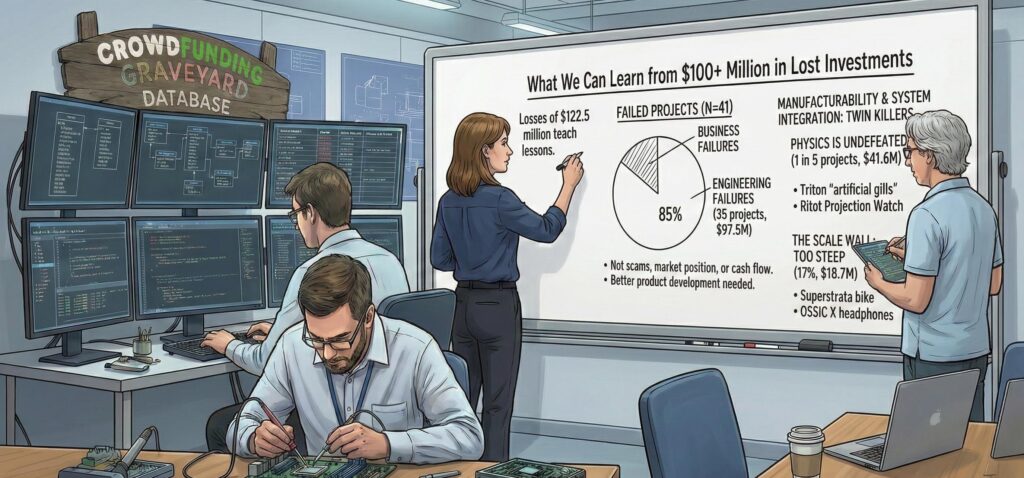
Losses of $122.5 million can teach many lessons. From our product development perspective, there were four main takeaways from the data underlying the Crowdfunding Graveyard of failed hardware projects. They are as follows:
- 85% were engineering failures. Not business failures.
For students of crowdfunding crash-and-burns, this finding might be the most surprising. By a wide margin, the failed projects in our database were not scams, poorly positioned in the market, or suffering from poor cash flow. Rather, 35 of the 41 failures had identifiable engineering failures. These projects raised $97.5 million, and the reality is that while more money would not have saved them, better product development might have. - Manufacturability & system integration: Twin killers.
The most common failure types were two massive issues in product development: manufacturability (54% of failures) and system integration (49%). In the cases of manufacturability failures, these were designs that may have worked as prototypes but ran into problems on the production line, often related to scaling. With system integration, we saw cases of subsystems working individually but failing together. - As backers of 1 in 5 projects discovered, physics is undefeated.
Maybe they were overly ambitious. Maybe the creators knew the claims were impossible. But for 7 of the projects in our database, representing $41.6 million, the underlying technology was always physically impossible. And when you go up against physics, you lose every time. Triton’s “artificial gills” fit the bill here, raising $900,000 by claiming to extract oxygen from water. The Ritot Projection Watch raised even more ($1.4M) for a pico projector which could not be visible at the claimed size and angle in broad daylight. A red flag for investors should have been no working prototype at campaign launch. Slick videos don’t cut it. - The scale wall remains too steep for many.
Finally, 17% of project failures happened during production scaling. In these cases, accounting for a combined $18.7 million, prototypes may have worked, but mass production did not. Examples include a carbon fiber bike (the Superstrata) for which 3D printing production couldn’t scale to demand, and a pair of “3D audio headphones” (OSSIC X) whose production components ended up being too expensive even for the item’s $1000 price tag. The products in this category were not vaporware, but—for reasons ranging from cost to real-world constraints—the creators just couldn’t make 10,000 of them, in a serial production environment.
Where crowdfunded hardware fails most often
46%
Manufacturability
Design can't be mass-produced at viable cost
19
41%
System-Integration
Components fail when combined
17
17%
No-Prototype
No working prototype at launch
7
17%
Scale-Up
Production failed at volume
7
17%
Physics-Impossible
Claims violated laws of physics
7
15%
Unit-Economics
BOM exceeded pledge price
6
10%
Heat-Management
Thermal issues prevented function
4
7%
Supply-Chain
Critical components unavailable
3
7%
Quality-Control
Shipped units failed in field
3
7%
Power-System
Battery couldn't meet requirements
3
7%
Regulatory
Failed certifications (FCC, UL, etc.)
3
15%
Business-Failure
Fraud, mismanagement, or market
6
Note: Projects may have multiple failure types
Analysis by Design 1st
The 5 Product Development Disciplines You Need for True Crowdfunding Success
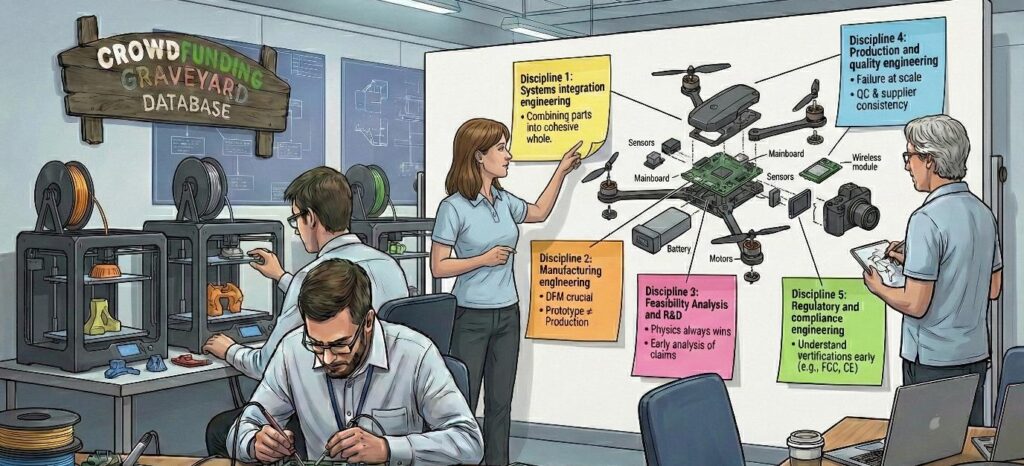
Product creators are not stupid. Rather, they were often the smartest people around in terms of their narrow specialization, whether board games, yogurt makers, or smart watches. But where they excelled in specialized intelligence, they lacked broad-based experience and expertise.
The five product development failures outlined below are stories of specialists in desperate need of experienced generalists to qualify opportunity, feasibility and risk early on.
Discipline 1: Systems integration engineering
From Silicon Valley darling to $34 million debacle
Individual parts of your product might work just fine, but combining them into a cohesive working whole requires strong systems integration engineering. This problem plagued 50% of the failures we studied.
Consider the Lily Robotics drone camera. In 2016 it was all the rage in Silicon Valley, raising $34 million in 60,000 pre-orders, along with high-profile investments from PE firms and celebrities. Within a year Lily was filing for bankruptcy and being sued for fraud by the San Francisco District Attorney.
Insider reports suggest Lily’s prototypes had basic problems such as blurry footage, a “throw-and-go” feature that did not work reliably, and software delays when the code was rewritten. These troubles were hidden in promo videos that used selective editing along with competitor devices to produce high quality drone footage.
Lily had a compelling story and components that worked in isolation. But they lacked a systems integration expert to put all the pieces together into a viable final product. As Wired noted, “there’s still something profoundly difficult about rolling out a phalanx of sleek flying drones without experience and expertise.” That is a $34 million understatement.
Discipline 2: Manufacturing engineering
How the “world’s smartest motorcycle helmet” became just another roadside distraction
Back in 2014, the Skully AR-1 was being marketed as “the world’s smartest motorcycle helmet,” earning praise from outlets like Road & Track. But despite raising $2.4 million in an Indiegogo campaign, the AR-1 never made it beyond the production of 100 units.
This company’s downfall is another story of million-dollar crowdfunding success followed by production delays and bankruptcy filing. A disgruntled employee’s lawsuit also alleged misappropriation of company funds for sports cars and strippers. Lurid details aside, the real problem for the Skully AR-1 Helmet seems to have been poor manufacturing engineering, a problem that was similarly fatal for half of all failed projects we studied.
In a 2016 letter to customers, Skully noted DFM (design for manufacturing) problems requiring a complete mainboard redesign. A few months later Skully ceased operations, leaving backers empty-handed.
As Skully and its supporters discovered, a prototype is not production. Tolerances that work at n=1 fail at n=10,000. Now that other brands of smart helmets have successfully shipped, it’s clear that Skully desperately needed a DFM review prior to the campaign launch. Or anyone in the room who’d shipped at scale before.
Discipline 3: Feasibility Analysis and R&D
You can fight with physics, but physics always wins
Certain products are simply impossible. For 22% of the projects we reviewed, the product as specified was in violation of the laws of physics. You can fight with physics, but physics wins every time. A proper feasibility analysis during the R&D phase would flag this fact from the start. Unfortunately, some products get more than a running start without subjecting their claims to such an analysis.
Take the Fontus water bottle. This concept device was created by Austrian artist Kristof Retezár. With a tagline of “never runs dry” and several slick promotional videos, the Fontus claimed to generate drinking water from solar energy and condensation at a rate of up to 1 liter per hour.
One blogger’s “back of the envelope” thermodynamics calculations showed that the claims of the Fontus were completely impossible. But that didn’t stop the device from raising $345,000 from 3,000 backers on Indiegogo—and from receiving glowing press from outlets like Business Insider and Smithsonian. In 2018, after most of the funds were gone, Fontus filed for bankruptcy.
Discipline 4: Production and quality engineering
How a 3D printer raised $3 million and still ran out of money
Your prototype works. So do the first one hundred units, giving you the greenlight to scale. But then you run into problems at unit 5,000. This sort of failure at scale can be caused by poor yield rates, quality control processes, and supplier consistency. It was a common point of failure among 19% of the cases in our database.
A prime example is the Tiko 3D Printer. Designed to be simpler and more cost-efficient than competing 3D printers, the device garnered $2.9 million from 17,000 backers on Kickstarter. But after shipping 4,000 units, buyers reported problems with stepper motor quality. Calibration broke at volume. The unibody design required custom components that made the economics unsustainable with the cost of goods at 60% of sale price.
With proper production and quality engineering expertise, test protocols should catch such failures—before they ship.
Discipline 5: Regulatory and compliance engineering
“Looking into” relevant regulations after launch is a losing strategy
The smallest failure category we detected was by no means insignificant. In 12% of cases, projects failed due to poor regulatory and compliance engineering.
One such example is ZNAPS. The Kickstarter project was a magnetic adapter for mobile phone chargers. After raising $2.3 million from 70,000 crowdfunding backers, ZNAPS became notorious for choosing not to send backers any products at all, and instead to sell directly to consumers on the company’s own website.
But while media stories focused on whether or not ZNAPS was a scam, most outlets entirely missed the larger product development failure. In their Kickstarter FAQ, the ZNAPS team noted that they were “looking into” Apple MFi (Made for iPhone) certification. They never got it.
Without the MFi designation, an accessory like the ZNAPS charger is treated by an iPhone like a potentially dangerous foreign entity, potentially resulting in error messages, battery degradation, and voiding the device’s warranty. “Looking into” relevant regulatory and compliance concerns is never a viable strategy. The regulatory roadmap must be thoroughly explored before launch.
Crowdfunding is for Demand Validation, NOT Product Development

Crowdfunding platforms like Kickstarter and Indiegogo offer inventors and entrepreneurs a remarkable opportunity. They let you test market demand, validate features, and build an audience before committing to full production. The projects in the graveyard represent a small fraction of funded campaigns. Most succeed.
The difference often comes down to working with the right partners.
Crowdfunding marketing agencies specialize in building pre-launch audiences, optimizing campaign pages, and running paid advertising during the critical first 48 hours. They help generate the demand.
Experienced physical product development firms help you meet the expectations that demand creates. They bring the engineering process, manufacturing expertise, and supply chain relationships that turn a promising prototype into a product that actually ships.
Here are two such examples.
Groove Thing
When the maker of Groove Thing, Michael Weiss-Malik, set out to create the “world’s first internal music player,” he knew he had a marketable idea. That was confirmed when Groove Thing raised $100,000 in the first 12 hours of its Kickstarter campaign, hit $110,000 by midnight, and crossed $120,000 at the 24-hour mark. With over half a million raised so far, consumers are clearly interested in a product at the intersection of high end audio and intimate toys.
But Weiss-Malik also knew that getting the product engineering right was non-negotiable, and so he partnered with Design 1st. The Ottawa-based firm has a decades-long track record in commercial product design, development, and transfer to manufacturing. Crucially, Design 1st also had direct experience developing intimate products, previously helping to develop, engineer and support manufacturing for popular products such as We-Vibe, Zumio, and vSulpt.
Groove Thing is currently moving towards volume production.
Toddler Monitor
Krista and Lisa, the two moms who created DECCO, the Toddler Monitor, had no prior experience in product manufacturing. What they had, however, was a clear problem in need of a solution: keeping tabs on toddlers trying to sneak out of their rooms during naptimes.
A Kickstarter project in 2017, the device raised over $30,000 in pre-orders. Clearly, other parents had the same problem.
No crowdfunding project wants to let down its backers with a final product that does not live up to its promises. A parenting product has additional pressure to perform, as unreliable or faulty components could compromise child safety. So Krista and Lisa turned to Design 1st for support during the design process from concept to manufacturing and commercialization. Nine years later, Toddler Monitor remains the category leader.
The (not so secret) path to success
Winning crowdfunded projects have one main thing in common: they undergo professional product development in parallel with the crowdfunding campaign launch. This means that the high level engineering, a preliminary DFM review, and a high level costing and manufacturing plan exist prior to the first backer clicking “pledge.”
As Design 1st founding CEO Kevin Bailey says, “Crowdfunding is a demand validation tool, not a product development budget. If you’re using crowdfunded backer money to figure out how to build the thing, you’re already in trouble. There are two big investments to get product shipped, the product development cost and the inventory cost to deliver the new product to your backers. A successful campaign if managed well will cover first build inventory and ship costs as first build is low batch volume (higher unit cost) and additional one time NRE costs from manufacturer.”
Whether it’s Toddler Monitor, Groove Thing, or any number of other crowdfunded projects that make it out of the concept phase and through production, the key is that they used crowdfunding to validate demand for a new product that they already knew the critical feasibility and cost attributes of, before they made the pitch and ask for money in exchange for a product to come.
Use this Pre-Launch Checklist to Keep Your Project Out of the Crowdfunding Graveyard
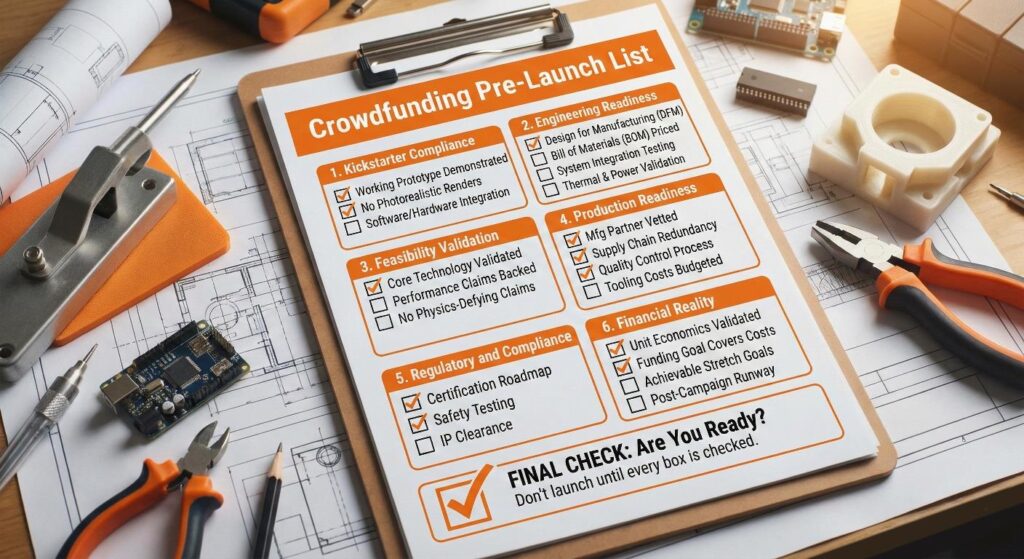
When we compiled our post-mortem on spectacular hardware product fails—despite crowdfunding success—we didn’t just want to catalog the mistakes. We wanted to make the failures actionable, to give you the tools to avoid the pitfalls of others.
To that end, here is your Pre-Launch Checklist. Check these boxes, and you are ready to chase crowdfunding glory. But if any of these are missing, you must first focus on product development—not fundraising.
Before you launch, ensure you can check all of these boxes:
- Working prototype. Not just a render. You are able to demonstrate the products core functionality in person or on camera, unedited, with a model along with visuals that resemble the final production product.
- Design for Manufacturing (DFM) assessment. Your design has been reviewed for producibility by someone with experience in manufacturing at scale.
- Bill of materials (BOM) at volume pricing. You have manufacturer quotes at your minimum order quantity (MOQ), so you won’t run into pricing problems or unit economics at scale. Make sure to have a good estimate of what the initial low volume units you will be shipping to your backers is going to cost.
- Integration testing is planned and evaluated for the high-risk elements of the design. All subsystems working together have been assessed by technical professionals for low-risk feasibility. Not just individually tested elements of a product.
- Certification roadmap. You have full visibility on all the regulatory approvals needed, as well as the timelines and costs involved.
- Thermal and power validation. Power consumption and heat dissipation are quantified by professionals to be feasible under real-world conditions.
- Supply chain redundancy. You have backup suppliers for all critical components and if there is a sole source part you have secured the supply to it.
Meeting the requirements in each of these check boxes is essential for keeping your project out of the crowdfunding scrap pile. Time and again, as seen in our database of failed Crowdfunded physical product projects, creators skipped over one of these vital steps. Their reward? Entry into the Graveyard.
Don’t be like them. Don’t cut corners or guess your way. Your great idea deserves proper and thorough product development, from concept design and engineering all the way through prototyping to commercial production. Use this Pre-Launch Checklist to set the stage for success with your crowdfunded project.
The Graveyard Doesn’t Have to Grow
Looking at the high-profile hardware project failures in our crowdfunding graveyard database, several numbers stand out. 41 projects abandoned. $122.5 million in lost investments. And, in many cases, zero products shipped.
But the number that really stings is 520,000, representing all of the individual backers who took a chance on a poorly executed idea. These were early adopters willing to fund innovation, but their trust collided with inadequate engineering and product development process.
We had those backers in mind when we built the Crowdfunding Graveyard. Not because we’re anti-Kickstarter (crowdfunding remains a legitimate and very powerful path to market for physical products), but only if you approach your project with multi-disciplinary preparation and process. Having the right disciplines in the room on Day 1 is the difference between the graveyard and success.
We encourage you to explore the interactive database. Read about the ambitious projects and learn where they went wrong.
Additionally, if you are an aspiring creator of a physical hardware product, we urge you to use our Pre-Launch Checklist . Covering seven common pitfalls of crowdfunding project failures, it is an essential pre-launch assessment giving you a much better shot at success.
And when you run into questions and problems along the way, remember you don’t have to go it alone. Reach out to experts in product development that you can trust. After three decades of product development, consulting, and helping commercialize over 1,200 physical hardware products, Design 1st has acquired the experience to turn your product idea into reality.
Share
Need help manufacturing your product idea?
We can help take you from idea to design, prototyping, and volume manufacturing.