Category: Internet of Things

Guide to Developing Products with Ultrasonic Wear Sensors

Guide to Developing Products with Ultrasonic Wear Sensors

Ultrasonic wear technology is revolutionizing how we maintain and monitor industrial machinery, employing advanced sensors to peer into the heart of equipment without ever needing to take it apart.
 
By leveraging the principles of ultrasonic testing (UT), these sensors provide crucial data that help prevent equipment failure, ensuring operational efficiency and enhancing safety across various industries.

Table of Contents

What are Ultrasonic Wear Sensors?

Ultrasonic wear sensors utilize high-frequency sound waves to detect abnormalities in materials or components, making them an indispensable tool in predictive maintenance strategies. They are especially useful in environments where precision and early detection of wear and tear can save significant resources.

  • Principle: These sensors operate based on ultrasonic testing (UT), a non-destructive testing technique that uses sound waves to detect material inconsistencies.
  • Utility: Primarily used in heavy machinery, these sensors are key to timely maintenance, helping avoid costly downtimes and equipment failures.
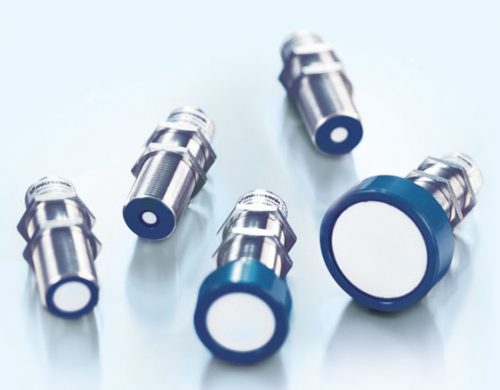
five ultrasonic wear sensors of different shapes and sizes

Why use Ultrasonic Wear Sensors?

Incorporating ultrasonic wear sensors into maintenance strategies not only extends the lifespan of equipment and ensures operational safety but also seamlessly integrates into physical products. This integration allows for real-time health monitoring of machinery, providing immediate insights without disrupting ongoing operations.

  • Seamless Integration: Ultrasonic wear sensors can be embedded directly into machinery and components, offering real-time monitoring without the need for manual inspection.
  • Proactive Maintenance: Their ability to detect early signs of wear enables proactive maintenance, drastically reducing the likelihood of unexpected downtime.
  • Safety Enhancement: The early detection capabilities of UT sensors contribute to a safer working environment by preventing equipment failures before they can cause accidents.

How Ultrasonic Wear Sensors Work

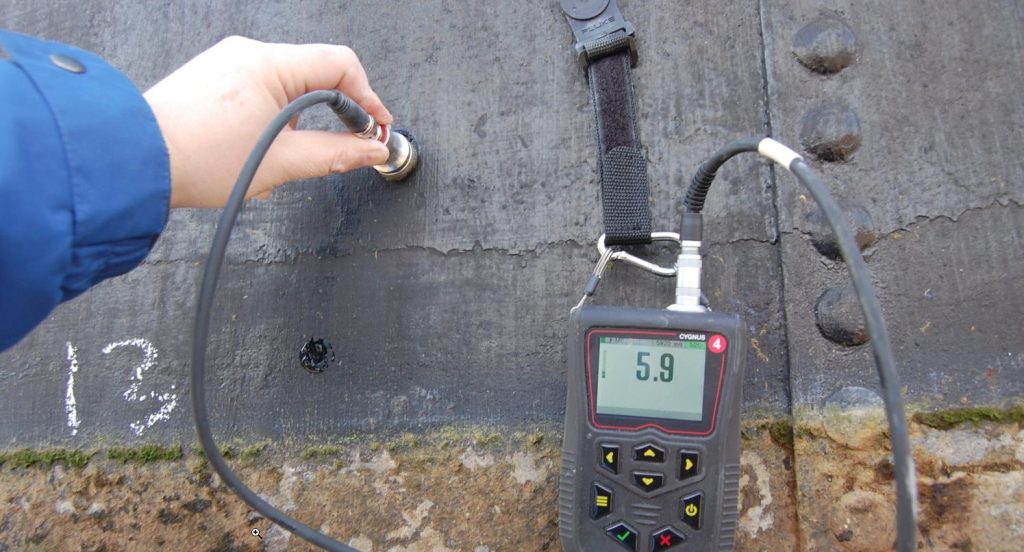
ultrasonc-wear single

Ultrasonic wear sensors work by sending out and interpreting sound waves to assess the condition of machinery without needing to touch it. Here’s a breakdown of how they do it:

  1. Emitting Sound Waves: The sensors produce high-frequency sound waves that are too high-pitched for us to hear, which can deeply penetrate the material under observation.
  2. Wave Interaction and Reflection: When these sound waves hit an irregularity, like wear or cracks, they bounce back to the sensor.
  3. Capturing and Analyzing Signals: The sensor picks up these bounced-back waves and uses advanced analysis to figure out the material’s health or thickness.
  4. Making Maintenance Decisions: By regularly or continuously checking the data, the system identifies when the wear reaches a critical level, signaling it’s time for maintenance.

Example UT Sensors in Heavy Mining Equipment

Big Dump Truck truck bulldozer vehicle

A practical application of ultrasonic wear sensors can be seen in the mining equipment industry, where heavy machinery like excavators are subject to intense wear.

Here’s how it UT wear sensors work with an excavator’s bucket, which often wears out:

  • Placement: An ultrasonic wear sensor is attached to the bucket’s edge, which is a part that gets worn down a lot.
  • Monitoring: This sensor sends out sound waves into the bucket’s edge to keep track of how thick it is and if it’s still in good shape while it’s being used.
  • Detection: The sensor figures out how worn the bucket is by looking at how long it takes for the sound waves to bounce back. The longer it takes, the more worn the bucket is.
  • Alerts: If the bucket wears down to a certain point, the sensor system will let the operators or the maintenance team know that it’s time to fix or replace the bucket before it gets too damaged.

Types of Applications for UltraSonic Sensors:

Ultrasonic wear sensors find applications in a variety of industries, demonstrating their versatility and effectiveness in monitoring equipment health.

  • Construction Equipment: Ultrasonic wear sensors are crucial for monitoring the integrity of construction equipment like crane cables and bulldozer tracks, preventing accidents and ensuring project timelines are met.

  • Mining Equipment: These sensors are used to keep an eye on the wear and tear of mining drills and earthmover tires, helping to avoid costly downtime and ensuring the safety of mining operations.

  • Medical Devices: In healthcare, ultrasonic wear sensors ensure the reliability of life-saving medical devices, such as heart pumps and diagnostic machines, by monitoring their condition for early signs of wear.

  • Smart Agriculture: Farmers use these sensors to predict maintenance for tractors and combine harvesters, optimizing harvest times and reducing the risk of machinery failure during critical agricultural operations.

  • Food Processing: In food processing plants, sensors monitor the wear on cutting blades and mixing equipment, crucial for maintaining food safety standards and production efficiency.

  • Marine Industry: These sensors play a vital role in detecting hull thinning and corrosion in ships and submarines, ensuring vessel integrity and safety at sea.

  • Rail Transport: Ultrasonic wear sensors are key to maintaining rail safety, used for inspecting the wear and cracks in train wheels and rail tracks, preventing derailments and ensuring smooth operations.

Limitations of Ultrasonic Sensor Technology:

ultrasonic-wear-sensor-failure

While ultrasonic wear sensors offer significant advantages, they also come with limitations that must be considered.

  • Surface Prep: They require clean, smooth surfaces for accurate readings, challenging in rough environments like mines or construction sites.
  • Skilled Interpretation: Data analysis demands expertise in ultrasonics, scarce in remote or technologically underserved regions.
  • Material Limits: Not effective with materials like certain composites or highly porous substances due to sound absorption issues.
  • Cost Barrier: High initial and maintenance costs make them a steep investment, particularly for smaller entities.

As an alternative, Electromagnetic Acoustic Transducer (EMAT) technology offers a solution that bypasses some of these challenges, such as the need for direct contact or extensive surface preparation, potentially providing a more versatile and less labor-intensive option in certain applications.

Ultrasonic wear sensors are transforming the landscape of industrial maintenance, offering a proactive approach to equipment management. Despite their limitations, the benefits they provide in terms of safety, efficiency, and cost savings make them an invaluable tool in the modern industrial sector.

Share

Working on a new device integrating Ultrasonic Sensor Technology?

We can help take you from idea to design, prototyping, and volume manufacturing.

27 Years Experience

75+ Design Awards

1,000+ Manufactured Products

From Idea to Prototype in as Little as Six Weeks!
Ready to Start?

Published on: November 1, 2025

How will 5G impact IoT product development?

How will 5G impact IoT product development?

27 Years Experience

75+ Design Awards

1,000+ Manufactured Products

From Idea to Prototype in as Little as Six Weeks!

Ready to Start?

Ontario’s IoT product development industry got hit with some exciting news Monday: a $400M research boost to create, the super-fast, next generation of 5G wireless networks.

Termed the “5G Corridor,” the public-private partnership plans to make Ontario a contender on the global stage for IoT development through access to a pre-commercial 5G network. 

But to understand how the 5G announcement will impact product development now and into the future, we need to answers some questions:

Table of Contents

What is 5G Wireless Technology?

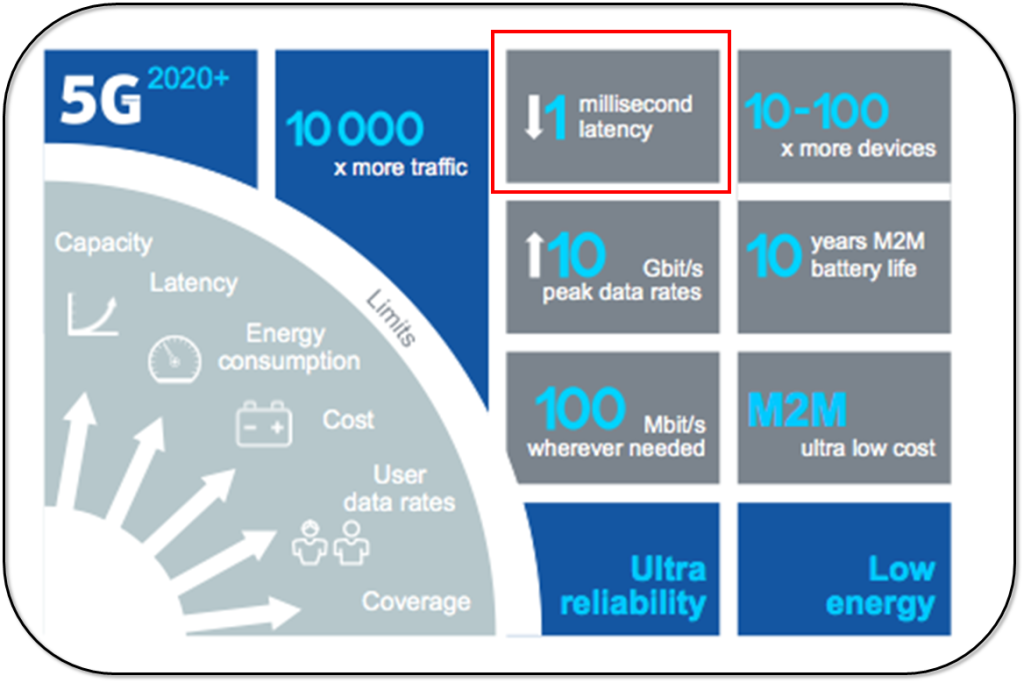
5G is not just a step up from 4G – it’s on another floor.  It provides low end-to-end latency, the ability to connect to thousands of devices at once and blazing fast speeds that can move computing and processing power away from devices and into the network.

This means future wireless IoT devices can be much smaller, sip power and scale rapidly.

Plus, 5G will become the underlying wireless infrastructure to support autonomous vehicles, VR/AR headsets and smart cities.  So, it’s not just faster download speeds: 5G will be a game changer for many industries including hardware products and IoT solutions.

“5G is the gateway to the future and we are just on the brink of this technological revolution,”  Innovation Minister Navdeep Bains said Monday at a funding announcement in Ottawa.

But to truly understand 5G, it’s important to look how far we’ve come

“The 2G networks were designed for voice, 3G for voice and data, and 4G for broadband internet experiences. With 5G, we’ll see computing capabilities getting fused with communications everywhere, so trillions of things like wearable devices don’t have to worry about computing power because network can do any processing needed,” Asha Keddy VP IoT (Intel)

Source: IEEE
What is the goal of Canada’s new “5G Corridor"?

Officially titled the ENCQOR, Evolution of Networked Services through a  Corridor in Quebec and Ontario for Research and Innovation, the new network infrastructure test bed allows startups,  government and schools to experiment with new 5G-enabled products and services.

The goal of this 5G Corridor is to provide an interim step while Canada’s three major carriers (BCE Inc., Rogers and Telus) ready themselves for a 5G rollout in two to three years.

Access to the precommercial 5G Corridor network will allow startups, companies and government to execute on visions for new IoT devices and services in a real-world environment. This will help Canada remain competitive and continue to develop global IoT solutions that scale and avoid obsolescence in the short-term. 

Will Canada be the first to rollout 5G?

No. South Korea, Japan and China are all in the race to deploy 5G networks sooner and U.S. carriers Verizon and AT&T are racing to release a small 5G rollout by the end of 2018.

In fact South Korea was the first country to debut the power of 5G networks to the world at the 2018 Pyeongchang Olympic Winter Games where they used 5G for self-driving cars and allowed viewers to access multiple camera from events, including virtual reality content.

5G network equipment at 2018 Pyeongchang Olympics
What is holding Canada back from adopting 5G sooner?

The one major hurdle is the available spectrum, referring to the band of radio waves that carry cellular services. 

5G requires a new spectrum allocation that no carrier has access to right now. The Canadian federal government is responsible for managing spectrum as a public resource and has not opened up the auction for Carriers to bid on the new spectrum bands.

According to the Globe and Mail, “The government is close to releasing final rules on an auction for radio waves in the 600-megahertz frequency, which is low-band spectrum that will help provide wide coverage in 5G networks, and it has an active consultation under way on millimetre-wave spectrum. But spectrum consultations can take months or years to wrap up and there still is no firm timeline of when auctions will be held or even in which order the spectrum will be released or reassessed”


And similar to the US, South Korea and Japan, once the government holds a spectrum auction Canada’s carriers can start rolling out their 5G networks. But with no timeline in sight, we are still a few years away from the rollout. 

In the meantime, carriers are beefing up networks, radio technology, and cell sites to accommodate increased traffic and bandwidth over 4G LTE networks.

What is the impact of 5G on IoT product development?

Right now, there will not be much change. Existing IoT devices and those in development today rely on a mix of wireless protocols each with their own benefits. These include:

  • LoRaWAN
  • Cellular (4G LTE CAT-M)
  • Cellular (4G LTE NB-IoT)
  • SigFox

We have experience using many of the above networks in IoT device development for Wide Area Network (WAN Applications). For example, we are developing a GPS anti-theft bike tracking product for a client that that leverages the 4G LTE CAT-M cellular network to relay data from the device accelerometer to the user’s app. 

But even with the modest speed, coverage and latency gains in the existing 4G LTE protocols, we still cannot take advantage of all the opportunities 5G presents.

So, while we await the gradual rollout of 5G we continue to develop IoT devices for customers around the globe using a mix of existing wireless protocols. The ones we choose are based on use-cases and trade-offs. The image chart below shows how we think about IoT devices with respect to wireless networks.

IoT device category map

As the chart above shows, right now we select IoT wireless protocols based on project requirements for the product or solution. We do this by thinking about 3 groups of networks: Personal, Local and Wide. These inputs allow us to select the optimal wireless network configuration, electronics components and battery power to develop an effective device that will not go obsolete in the near future.

But with the 5G Corridor, and countries around the globe getting ready to adopt the 5G, we are starting to envision solutions that take advantage of the high-bandwidth, low-latency network.

The evolution of the IoT will be very closely linked to the evolution of the wireless world. Changes in the WAN as seen with 4G IoT extensions and the emergence of 5G, changes in the LAN and PAN with recent updates to Bluetooth and adoption of other wireless technologies will continue to provide new challenges and opportunities to hardware developers.

We here at Design 1st are committed to closely tracking these developments to remain at the cutting edge of technology.

Share

Have a new product idea?

We can help take you from idea to design, prototyping, and volume manufacturing.

Published on: March 20, 2018

Security and Privacy Policy for IoT: Workshop Review

Security and Privacy Policy for IoT: Workshop Review

27 Years Experience

75+ Design Awards

1,000+ Manufactured Products

From Idea to Prototype in as Little as Six Weeks!

Ready to Start?
To maintain a pulse on the IoT Industry and the fast paced changing industry we often attend workshops. This past month we attended one in Ottawa.
 
Details:
Who – Fauk Khan CEO at TwelveDot Security (twelvedot.com)
What – ‘Security and Privacy for IoT: A standards Based Approach’ Presentation for the IoT Ottawa Meet-Up
Why – To make security and privacy part of your daily ritual with the aim to significantly reduce the cyber exposure of your products and solutions
 
You can view the presentation here:

It was a very good presentation at the IoT meeting last night. The speaker was Faud Khan of Twelve Dot Security (twelvedot.com). In addition to running, TwelveDot (an Ottawa based technology and security consulting practice), Faud is on the ISO standards committee for IoT applications (ISO 27000).

Faud is a great speaker and shared a good mix of information, standards discussions and horror stories (e.g., a cheap tablet with counterfeit chips which called-home once or twice a day with all of the user info, or the polycom phone in the main board room of a GoC department which, in addition to the people on the other end of the phone line, streamed all conversations in the room back to Taiwan(?), etc.)

Some gems (in no particular order):

  • 78 minutes – the average length of time required to break into a system or device
  • 177 days – the average length of time to detect a breach
  • Don’t trust any 3rd party software; especially if it comes from GitHub or similar… have it checked for back doors
  • Implement (and follow) an Information security management system (ISMS) & Systems development life cycle (SDLC)… if nothing else, it’ll demonstrate you’ve done your due diligence when a breach occurs (when, not if)
  • If you have a breach, call your lawyer first. Then have them call the experts
  • Add `thread modelling` to the design process (including personal information assessment (PIA / ISO 29134) & threat risk assessment (TRA / ISO 27005/8)
  • Know the vulnerability landscape for the software/firmware/processors in your product
  • Ensure devices/gateways have a method for infield firmware updates (see above)
  • Do not charge your devices through *any* public charging station… they are likely compromised. If you must, use a power-only USB cable rather than a sync cable.
  • Know your supply chain… be on the lookout for forged/compromised chips
Share

Have a new product idea?

We can help take you from idea to design, prototyping, and volume manufacturing.

Published on: November 27, 2016

The Hardware Design Behind IoT613

The Hardware Design Behind IoT613

27 Years Experience

75+ Design Awards

1,000+ Manufactured Products

From Idea to Prototype in as Little as Six Weeks!

Ready to Start?

Highlights from IoT613


Ottawa’s Internet of Things conference was a success by all accounts. The two-day event, drew over 300 Attendee’s and included two workshops on Designing for IoT, an expert speaker series and engaging booths from Ottawa’s most innovative startups and companies.

Check-out some of the feedback we received:

@IoT613 thanks 4 bringing a great cross-section of entrepreneurs, techies & other thinkers together yesterday. Great conversations! #IoT613

— Trajan Schulzke (@_trajan) September 26, 2015

Had an awesome time @IoT613! Made lots of new connections (in every sense) & really learned a lot. I will definitely be back next year!

— Lisa Trumbley (@welltrum) September 26, 2015

Opening keynote Leo Poll – IoT existed in previous century w/o label. Refers to state of tech vs how it\’s coming together #iot613

— Anushka S. (@anushkasamara25) September 25, 2015

The Building of the IoT613 Visuals

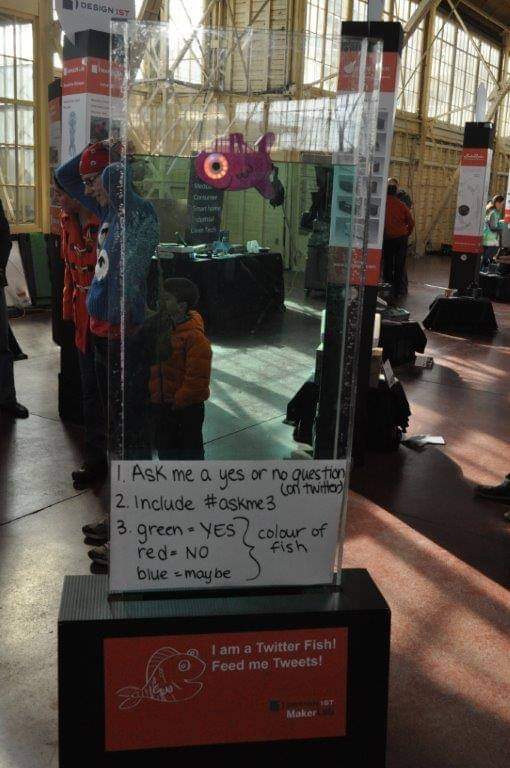
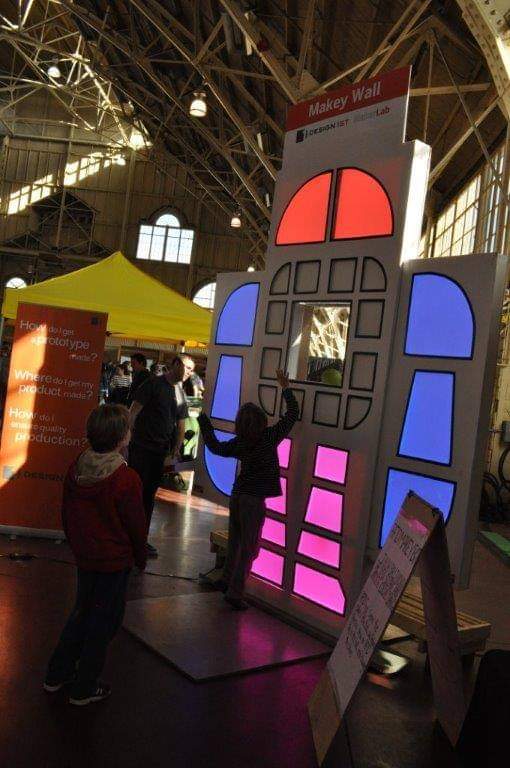
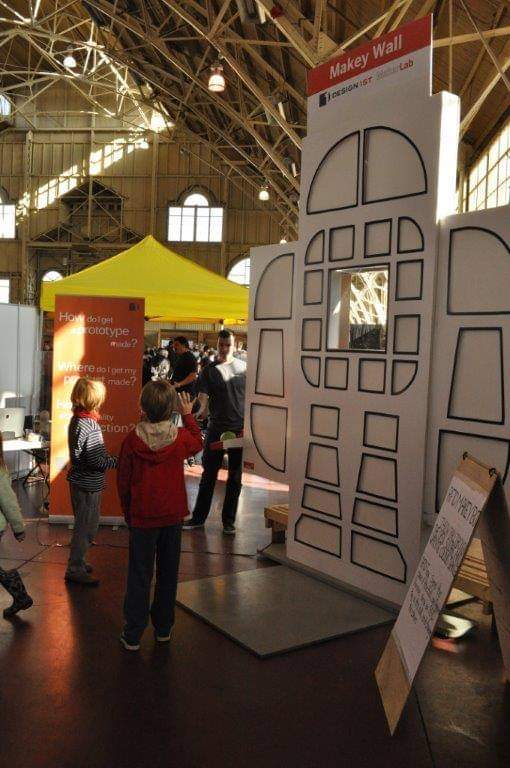
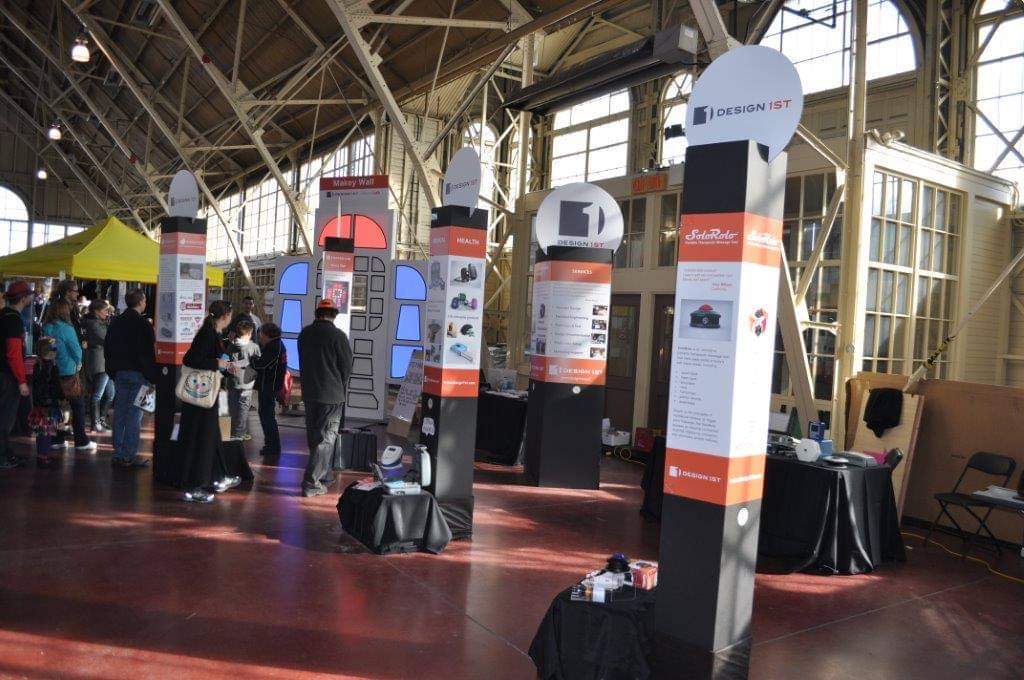
As a presenting sponsor for IoT613, we were in the trenches the week leading up to the event prepping many of the large visual attractions, including the knowledge forest, giant Makey Wall and Internet connected fish.

Each of these ideas came from the D1 Makerlab – our summer internship program, and will be featured at Ottawa’s Maker Faire as well. Check-out some of the photos from our setup for IoT613 below:

Rogers Fish TV Light
Makey Wall Lit Up
Makey Wall Lit Up
knowledge forest boxes 2
Knowledge Forest Boxes

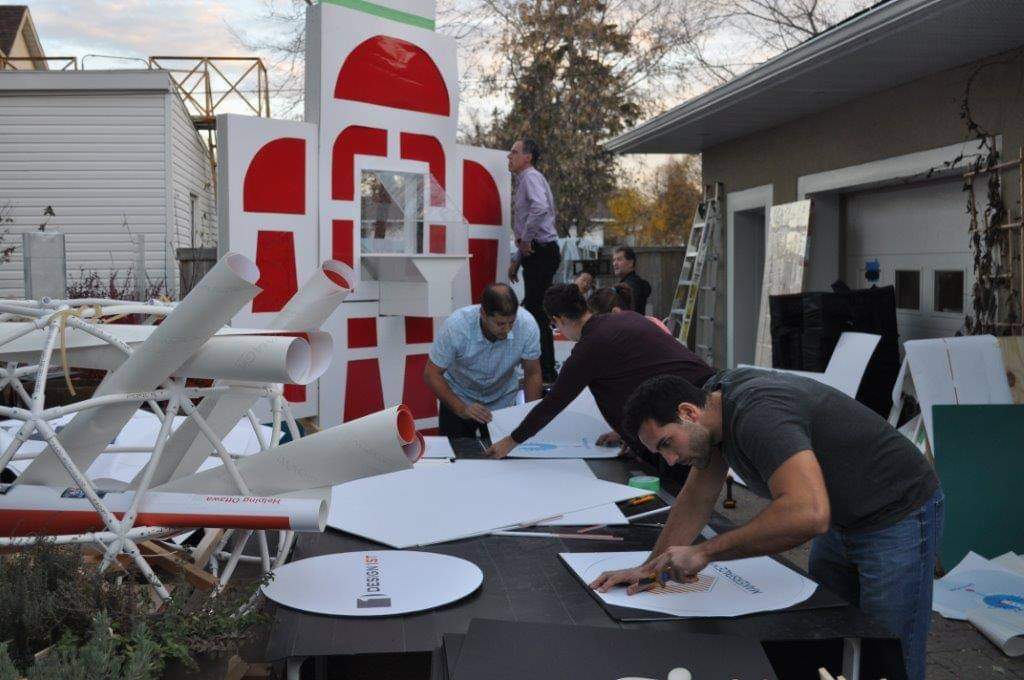
How the Makey Wall was Built:

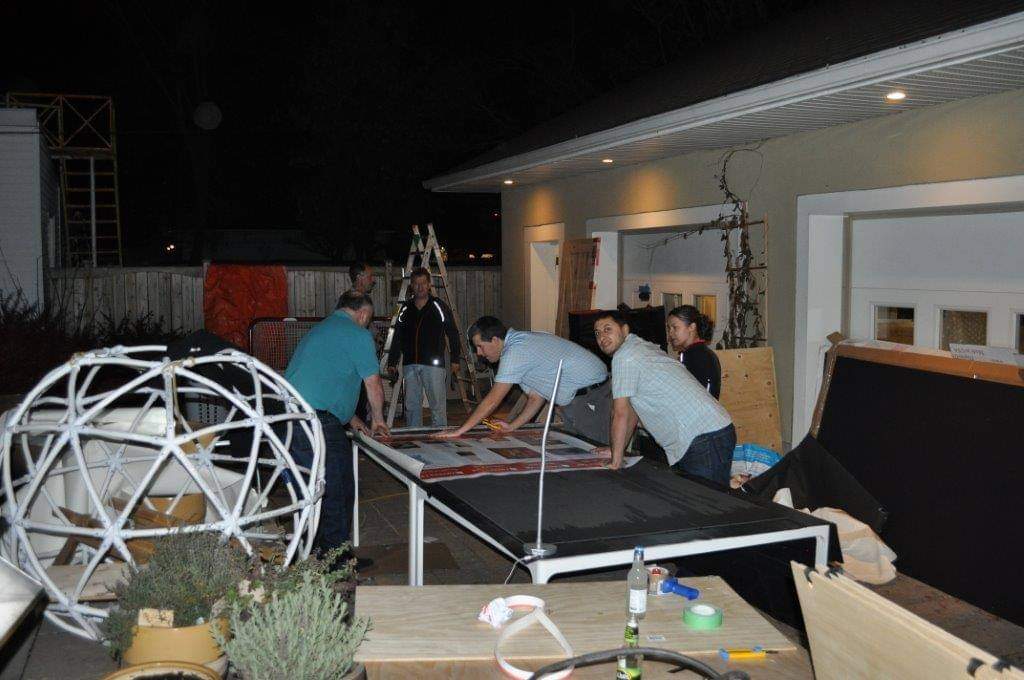
From concept to fully functioning prototype, the Design 1st and summer D1 MakerLab team worked efficiently to get the Makey Wall ready for IoT 613! Check-out some of the photos of our progress:

Designing for IoT: Workshop


Design 1st also hosted a half-day workshop at the event with UX partners Akendi called “Designing for IoT”. The workshop featured an internet connected octopus that sensed the chlorine and ph of water, and participants were worked through the entire design process. You can watch the workshop below:

Share

Have a new product idea?

We can help take you from idea to design, prototyping, and volume manufacturing.

Published on: September 30, 2015

The Internet of Things | Designing for Atoms & Bytes

The Internet of Things | Designing for Atoms & Bytes

Product ideas come in many forms, but they’re typically tossed into one of two baskets – hardware or software. That’s all about to change.

Now there’s a third basket – the “Internet of things” – and the still-young reality has yet to be filled with new products that the blend digital and physical experiences.

It’s a new marketplace of ideas, driven by the convergence of wireless communication, sensors and the ubiquity of the Internet. The Internet of things (IoT) means any product can have embedded intelligence, or its own unique identifier, to connect the object directly to a network and transfer data without human interference.  It’s a simple concept that envisions a future where everyday objects are connected to the Internet.

Estimates suggest that by 2020, the IoT will number 50 billion separate objects, an explosion that some would say is a long time coming. As far back as 2008, the number of connected objects outpaced the earth’s human population.

Even further back, in 1999, a British tech pioneer named Kevin Ashton gave IoT a name when it was still just a concept. In his presentation to Procter and Gamble, he described how computers, databases, and the Internet itself were all dependent on humans for information – whether it was writing code, taking photos, or scanning bar codes. Information was a one way exchange.  Although the future technologies would change this, information could come from products – in his vision, as smart barcodes (RFID tags) for tracking products.

Fast forward 15 years and now the Internet of things is the Internet of everything. But it’s only recently that the “things” capable of machine-to-machine conversation have moved beyond devices like cell phones. A “thing” has expanded to include heart monitor implants, automobile tire pressure sensors, curling brushes that measure sweeping pressure and much, much more.

Global enterprises and venture capitalists alike are taking notice too, with $3.4 Billion invested in Wireless Smart Object Startups in 2013. A number that is sure to grow even larger in 2014 given Google’s recent purchase of Nest Smart Thermostats for $3.2B in January to control your home temperature via your smartphone and an impressive cloud back office analytic engine that learns from your behavior and makes adjustments for you. Yes the systems are actually getting smart enough where you won’t be constantly frustrated by it doing something we don’t want it to do.

The first wave of products is hitting the market now and the next wave is currently in development spanning a gambit of consumer gadgets, medical devices, home automation, gear for vehicles as well as agriculture opportunities to name a few. Many of these IoT products are coming to fruition with the help of crowd-funding platforms like Kickstarter – that fund and build awareness for new products simultaneously.

But this influx of new products ideas meshing hardware and software has created new challenges for product designers. These include:

Convergence of Hardware and Software Design

But this influx of new products that merge software and hardware into the same development cycle poses new challenges for designers. Hardware and software have inherently different design and development methodologies. One discipline involves aligning atoms and the other arranges bytes.  Both want to deliver simple, easy to use product that people fall in love with.  IoT devices must include both disciplines and this requires innovators to combine and manage these two product development processes together in order to design intelligently connected experiences for people. Things to consider when bringing an IoT Product innovation to life are many and the mantra of design for users is at the core.

The Complexity of  “Simple” Products

Even simple product ideas can be complex. Especially when Hardware, Electronics and Software collide. To create a seamless product experience first pass out of the gate requires expertise in number of areas.  Common questions that should be asked prior the design of an IoT product – no matter the size – include: What elements are useable off the shelf?  What custom parts are needed? What software will need to be written? and What cloud based platform to select to manage my customers and data? Answers to these questions will make sure a new IoT product idea gets off on the right foot.

Connecting Vision to Real Customer Needs:

New product ideas are exciting, but they don’t always connect to consumer demand. Early concept design and testing the product idea with simulation and prototyping techniques allows development teams to get users to verify assumptions and business teams to quantify the demand. With 5 month product cycles, it is impossible to grow the knowledge in house and outsourcing part or all of the one-time design and development effort becomes a lower cost and higher value alternative in many cases.

Challenges aside, it’s an exciting time for companies to refresh old products and to go after new ideas to connect into the Internet of Things that is upon us.  Design 1st plans to be a one of the teams that will help innovators embrace and go after these opportunities ahead.


Share

Have a new product idea?

We can help take you from idea to design, prototyping, and volume manufacturing.

27 Years Experience

75+ Design Awards

1,000+ Manufactured Products

From Idea to Prototype in as Little as Six Weeks!

Ready to Start?

Published on: May 27, 2014