Category: Manufacturing

Small Shipment Strategy Guide to USA Minimize Tariffs

Small Shipment Strategy Guide to Minimize Tariff USA Impact

Estimated Reading Time:

You’ve got 500 finished products sitting in a warehouse overseas. Six months ago, importing them would cost a manageable amount in tariffs. Today? The tariff burden has increased significantly. Other companies are somehow still selling at competitive prices.

Here’s what they figured out. Instead of importing in bulk, they’re shipping directly to customers one package at a time. Same products, almost zero tariffs.

How the Under-$800 Rule Works

The US has a “de minimis” rule for shipments valued under $800. These packages don’t require formal customs processing, tariff calculations, or duty payments. They clear customs like regular mail deliveries.

This rule was designed for personal purchases and small business transactions. Companies are now using it for direct-to-consumer fulfillment to avoid bulk import tariffs.

Ship inventory in bulk and pay tariffs on the full shipment value. Ship the same products individually under $800 per package and pay zero tariffs.

When Shipping Finished Goods Made in China Individually Makes Sense

We’ve seen companies evaluate this approach over the past year. The ones who succeed share the following common characteristics.

Products hit the right price point

Products priced between $30 and $400 work best. Too cheap, and the shipping costs eat the savings. Too expensive, and you bump into the $800 limit too quickly. We’ve seen this work for consumer electronics, small appliances, and specialty tools.

Customers are patient, trading off time and cost

Direct shipping from China means 7-14 day delivery times instead of next-day fulfillment. Some customers accept this trade-off for better pricing. Others expect instant gratification and will shop elsewhere. With tariffs the trade-off balance is shifting to waiting, to save significantly on the cost.

Volumes are manageable to sell directly to consumers from a China shipping point

 Managing individual fulfillment for a few hundred customers is straightforward. Managing thousands of units per SKU and multiple SKUs requires more coordination, but it is still doable with good automated third-party logistic systems.

Finished inventory sits in China already

Goods are manufactured packaged, and ready to ship. This isn’t about restructuring production—just changing how finished goods reach customers.

Hands-off Customer Service

When packages ship individually from China, customers may call about delivery delays, customs questions, and return policies. Companies need customer service tools and trained staff to handle these calls for a positive customer and user experience.

What if the single-unit Direct to Customer Shipping creates More Problems Than It Solves

When Shipping Individual Goods From China Doesn’t Work Well

Not every company can make this work, sometimes the product or existing business operations mean direct to consumer shipping from overseas is not worth it. Here are three signs to look for:

Products are too heavy or bulky

Shipping a 15-pound piece of equipment individually from China costs more than the potential tariff savings. Physics wins this battle every time. Add in returns management and it quickly overwhelms a good business plan.

Customers expect immediate availability for the type of product and its use –

B2B customers especially want products in stock and ready to ship. They’re not waiting two weeks for individual packages from China.

Inventory management gets messy

Managing individual shipments and returns while maintaining accurate inventory counts across multiple SKUs becomes a significant operational burden.

Ways to Reduce Tariff Impact on Finished Goods

The all-or-nothing approach isn’t the only option. Smart companies are finding middle-ground strategies that capture some benefits without the full complexity.

Batch shipping to reduce complexity

Instead of shipping one unit at a time, ship 2-3 units per package order to regular customers. This stays under the $800 threshold while reducing shipping complexity.

Hybrid fulfillment models

Keep some fast-moving inventory in a US warehouse for immediate orders while shipping specialty configuration SKUs individually from China.

Third-party fulfillment partnerships

Companies that specialize in international small shipments can handle the tariff logistics complexity while manufacturers focus on their core business.

Gradual inventory movement

Instead of importing everything at once, move inventory in smaller batches over several months if the tariff code has thresholds that save costs and to wait out a changing tariff landscape. This spreads the potential tariff cost and gives time to adjust strategy as regulations are in flux.


Examples from Design 1st Clients

Based on our recent discussions with clients, we’re seeing companies take different approaches depending on their specific situations.

Some companies with finished goods have paused all shipments to the US, betting that tariff policies might change, as they sell current in-country inventory. This worked for at least one client who resumed shipping when tariffs were temporarily paused.

Others have set up distribution centers in China to ship directly to consumers, taking advantage of the under-$800 rule for individual shipments.

Companies with product still in development have more flexibility to restructure their approach, looking at assembly location, materials, components, and part suppliers to determine better tariff cost strategies moving forward.

Questions to Ask Before Deciding on Tariff Cost Mitigation Strategy

These questions help determine which approach makes sense for your specific situation and whether individual unit direct to customer shipping will solve more problems than it creates.

  1. Can the product price point absorb international shipping costs while remaining competitive? Calculate the real cost per unit including packaging, handling, and shipping.
  2. Are customers willing to wait 7-14 days for delivery? Survey them or look at current shipping patterns for clues.
  3. Is there operational infrastructure to manage individual customer relationships? Consider the customer service, returns processing, and quality control implications.
  4. What’s the plan if regulations change? The tariff cost threshold could be lowered or eliminated entirely, and tariff regulations continue to evolve. Build flexibility into the approach if possible.
  5. How does this fit with long-term business strategy? Is this a temporary measure to navigate current tariff uncertainty or a permanent shift in how products reach customers with lower handling costs?

Choosing the Right Approach to Mitigate Tariffs

Small shipment strategies work for some companies in specific situations, but they’re not universal solutions. The companies putting the tactics to good use will treat this as a legitimate business strategy, not a temporary workaround.

If sitting on finished inventory facing potential tariff increases, options are limited. Pay the tariffs, pause shipments hoping for policy changes, or explore alternative fulfillment strategies. Each comes with trade-offs in cost, complexity, and customer experience.

Choose the approach that best fits the specific situation given current trade uncertainties. Small volume shipment strategies deserve consideration for products in the right price range with patient customers, but they’re not escape hatches from broader trade complexity environments.


This article represents general educational guidance based on current regulations and industry observations. Tariff rules and rates change frequently and vary by product classification. Specific situations require consultation with customs brokers, trade attorneys, and logistics professionals. Design 1st provides product development guidance but does not offer customs consulting services.

Share

Need help manufacturing your product idea?

We can help take you from idea to design, prototyping, and volume manufacturing.

Published on: June 12, 2025

10 Steps to Finding a Manufacturer for your Product

10 Steps to Finding a Manufacturer for your Product

Estimated Reading Time:

At Design 1st, we’ve developed a proven approach to finding reliable manufacturing partners for our clients’ products. While we offer comprehensive manufacturing support services, we understand that some entrepreneurs prefer to conduct their own research.

Here’s our expert-guided process for sourcing manufacturers, refined through helping hundreds of inventors and startups bring their products to market.

Kickstart Your Manufacturer Search Here:

Start your search for manufacturers by exploring reputable platforms and directories to find suppliers. Here are five we recommended, with instructions on how to use:

  1. Panjiva: A comprehensive platform offering insights into global supply chains, enabling you to identify potential manufacturers and suppliers worldwide. Utilize detailed search filters to streamline your sourcing process and find the right partners for your project.
  2. Alibaba: One of the largest online marketplaces connecting buyers with manufacturers from around the world. Use filters to narrow down your search based on location, product type, and other criteria.
  3. ThomasNet: An extensive database of manufacturers and suppliers across different industries. Filter search results by location, capabilities, certifications, and more.
  4. MFG Manufacturer Marketplace: MFG’s database consists of manufacturing companies offering services such as machining, fabrication, and injection molding.
  5. Kompass: A global business directory offering access to a wide range of manufacturers, distributors, and service providers worldwide.

By utilizing these platforms, you can expand your search and discover a diverse range of manufacturing partners to suit your specific needs and requirements.

Next, follow these 10 steps to vet and select the best manufacturers you've found:

1. Build a list of potential manufacturers

Compile a list of potential manufacturers by conducting thorough research and utilizing online resources like Google and industry-specific directories. Seek out manufacturers aligned with your product requirements, such as those specializing in sustainable materials and production processes, to ensure compatibility with your vision. Additionally, leverage your network to gather recommendations and insights from industry professionals.

For instance, if you’re developing a new line of eco-friendly kitchenware, search for manufacturers specializing in sustainable materials and production processes.

2. Define Your Product Requirements

Clarify your product specifications, including materials, dimensions, and production quantities. Provide detailed briefs or reference materials to ensure alignment with your expectations. The more detail and information you have about your product requirements, the more efficient the manufacturing process will be.

If you’re designing a high-performance electric bicycle accessory, specify the desired materials, dimensions, and compatibility requirements to streamline the manufacturing process.

3. Assess Manufacturer Capability and Capacity

Evaluate each manufacturer’s capabilities and capacity to determine their suitability for your project. Inquire about their experience, production processes, and quality control measures.

Will the manufacturer do a low-volume production run so you can test the product quality and process? Do you have to invest significant capital in tooling and setup before production? Weigh the risks carefully. For complex products having a manufacturing partner with existing relationships can get you up and running faster and cheaper.

For instance, if you’re developing a custom-designed portable fan, ensure the manufacturer has the necessary expertise and equipment to handle complex electronic assemblies and testing procedures.

4. Request Manufacturer Quotes and Proposals

Reach out to shortlisted manufacturers to request quotes and proposals. Seek clarity on pricing, lead times, and minimum order quantities. Compare the offerings of different manufacturers to identify the best value proposition for your project.

Consider factors such as cost, quality, and flexibility when evaluating proposals. What assurances are in place that you will receive a quality product? Are there minimum production volume requirements?

For example, if you’re launching a new line of premium leather accessories for smart watches, request quotes from manufacturers specializing in high-quality leather craftsmanship. Do not go to manufacturers without significant leather experience.

5. Conduct Due Diligence on Suppliers

Perform thorough due diligence on potential manufacturers, verifying their credentials, certifications, and track record. Check for any red flags such as past disputes or negative reviews. Look for references and testimonials from previous clients to gauge their reputation and reliability.

A reputable manufacturer with a proven track record is more likely to deliver quality results and adhere to deadlines. If you cannot find any information confirming the quality and trustworthiness of a manufacturer, reach out to brands they have developed products for, ask for reviews. Or engage a manufacturer support expert to help.

6. Visit Facilities or Conduct Virtual Tours

If feasible, arrange visits to the facilities of your top manufacturing candidates or conduct virtual tours to assess their operations firsthand. Observe their production processes, equipment, and workforce to gain insights into their capabilities and working conditions. Pay attention to factors such as cleanliness, organization, and compliance with safety standards.

For example, if you’re outsourcing the production of solar battery devices, visit the manufacturer’s workshop to assess their techniques and quality control measures. Design 1st often tours potential suppliers and manufacturing companies alongside clients to meet teams face-to-face.

design-1st-manufacturing-pa
Image: Design 1st staff and clients meeting with suppliers in China

7. Negotiate Terms and Contracts

Engage in transparent negotiations with chosen manufacturers, discussing terms such as pricing, payment schedules, and intellectual property rights. Clearly define expectations and responsibilities to avoid misunderstandings later on. Negotiate terms that are fair and mutually beneficial, taking into account factors such as volume discounts, payment terms, and exclusivity agreements.

For example, if you’re partnering with a manufacturer to produce a new line of branded apparel, negotiate licensing terms to protect your brand’s intellectual property rights.

8. Develop Prototypes and Samples

Collaborate with manufacturers to develop prototypes and samples of your product. Evaluate quality, functionality, and aesthetics before proceeding to full-scale production. Iterative prototyping allows you to refine your design and address any issues or concerns early in the process. Seek feedback from stakeholders and make necessary adjustments to ensure the final product meets your requirements.

If you’re launching a new line of products, it is crucial to work closely with the manufacturer to prototype and test different design iterations until you achieve the desired functionality and user experience.

heatstone proto build test
Image: Design 1st engineer testing electrical heating patio stones

9. Consider Geographic Location and Logistics

Take into account the geographic location of each manufacturer and how it may impact logistics, shipping costs, and lead times. Consider factors such as proximity to raw materials, transportation infrastructure, and potential trade restrictions.
Opting for a manufacturer located strategically can help streamline production processes, reduce shipping expenses, and ensure timely delivery of your products.
If you want your product to be “Made in the USA” consider what mix of parts, assembly, and manufacturing allows for it to be “made in the USA”. Can you import parts, components, and materials to a USA manufacturer for final assembly?


10. Establish Long-Term Relationships

Cultivate long-term relationships with your manufacturing partners based on trust, communication, and mutual respect. Maintain open lines of communication and collaborate on continuous improvements to optimize efficiency and quality. Regularly review performance metrics and address any issues or concerns proactively. A strong partnership with your manufacturer is essential for the success and sustainability of your product.

For example, if you’re launching a new line of consumer electronics, foster a collaborative relationship with the manufacturer to facilitate ongoing product enhancements and updates based on customer feedback and market trends.

By following these ten steps, you can navigate the process of finding the right manufacturer for your product idea with confidence and clarity. Remember to approach each step thoughtfully and strategically, prioritizing factors such as quality, reliability, and compatibility with your vision and values. With diligence and determination, you can forge a successful partnership that brings your product to market and sets the stage for future growth and innovation.

Share

Need help manufacturing your product idea?

We can help take you from idea to design, prototyping, and volume manufacturing.

Published on: April 11, 2025

How to Manufacture a New Product

How to Manufacture a New Product

27 Years Experience

75+ Design Awards

1,000+ Manufactured Products

From Idea to Prototype in as Little as Six Weeks!

Ready to Start?

Did you know 70% of a product cost is locked in during the early design stage of a product development process?

For companies launching a new product thinking about manufacturing early in the design phase is an important part of a successful product launch.

There are 6 Critical Details to Consider when Manufacturing a Product:

  1. Select Off the Shelf Components Early
  2. Mechanical Part Outsourcing
  3. Electrical/Electronic Part Sourcing
  4. Part Supply Logistic Planning
  5. High Level Key Item Cost Estimates
  6. Finding the best fit Contract Manufacturer

Each of these plays a key role in the successful manufacturing of new products. The process of evaluating these details when preparing a product for manufacturing is called commercialization. Done right, commercialization allows a product to be manufactured at the lowest cost,  highest quality and delivered on time.

Common Questions every Product Faces on route to Manufacturing:

•    How do I design my product for lowest cost and keep the important functions?

•    What materials and finishes do I use to get the product to look great and perform well?

•    How do I ensure the quality of my product will keep defects and returns low?

•    Where do I find and buy off-the-shelf parts for the lowest cost?

•    What is involved in getting product to my customers and in good working order?

•    Who do I trust when I am making these decisions?

Put a commercialization Expert on your Design Team:

Design 1st has in-house experts in commercialization that work directly with the design team to provide navigation throughout the product architecture configuration stage.   We help you to find “good fit” suppliers and a manufacturer for your product, both local and abroad.  This approach is a natural fit for clients looking to transition their concept prototype to the market. This year Design 1st has played a pivotal role in the commercialization of more than a dozen start-up clients. Here are a few examples of clients that have launched after using our commercialization and market-readiness services:

Share

Have a new product idea?

We can help take you from idea to design, prototyping, and volume manufacturing.

Published on: July 20, 2023

Top 6 Mistakes Manufacturing New Products in China

Top 6 Mistakes Manufacturing New Products in China

27 Years Experience

75+ Design Awards

1,000+ Manufactured Products

From Idea to Prototype in as Little as Six Weeks!

Ready to Start?

If you want to build your product in Asia, you need to know the manufacturing process inside out. And, if you lack this knowledge, you need a partner who ensures that you are never without the information you require.

What follows are the areas where the companies we work with most frequently require help in Asia. As you will see, contract manufacturing risks begin in the earliest stages of design, and extend to the management of contract manufacturer (CM) relationships even after your product is on the market.

1. Consider manufacturing from the earliest stages of design.

earliest stage of design ba

The early stages of design present a product development company with exciting problems to solve. The danger we have observed is that when progressing from concept to detailed design, companies often tackle the many decisions they face (features, marketing strategy, aesthetics, user interaction) without realizing that their choices at this early stage may lead to locked-in costs and major headaches later.

No company can rely on their contract manufacturer to make fundamental problems disappear when they are locked in by the design team decisions. The challenge is to think about the manufacturing feasibility, options, and risks while the early product configuration is still taking place.

Your design and engineering team needs to be up to this challenge, as you typically have to wait until you have already designed your parts before a factory will begin to relay their own special knowledge and advice.

And a failure to closely consider manufacturing options until after a product’s design is defined in detail almost always leads to unpleasant aesthetic compromises, unexpected costs, and delays in getting your product on the market. One other benefit of having a production-knowledgeable design team is you will be able to negotiate a better price with your CM during the formal quotation process, as the parts and assembly will be configured in a way that is clear and straightforward to manufacture.

It is essential that your design team is aware of production constraints if your product development process is to remain predictable.

You need expertise in what is possible with most materials, different forms of molding, and specific requirements for custom tooling. You need to be able to design manufacture-ready custom sheet-metal assemblies and composite fabrications, and you also need to be familiar with the uses and limitations of the mechanical and electronic stock-order parts that are readily available to integrate into any product’s design.

In short, if you adequately consider the manufacturing process without reliance on contract manufacturer reviews, you will reduce the cost of development, eliminate unnecessary iteration and restarts, and speed your time to market.

2. Know when (and when not) to build prototypes.

Prototypes are important—and costly. They allow you to verify that your product performs to the required standards, can be operated intuitively by target users, and can cope with the working conditions in which it will be used. They are also physical models which allow a contract manufacturer (CM) to more completely review and quote your order. They generally add recommendations to adjust features for cheaper, faster and more reliable assembly.

The difficulty we have seen companies encounter is knowing when to build prototypes and what sort of prototype to build. A fully-functional production-intent lookalike prototype can take 8 weeks to build due to the time it takes to construct quick tools, finish and fine-tune moving parts. It is also hugely expensive. The company that builds your prototype will not be your production CM, and you will be paying them to train their employees and manufacture custom tools for low volume manufacturing! In some cases where the product solution requires validation this is a necessary step before moving to production tools.

A ‘bench model’ (BM) prototype, which is designed to test specific functions or aesthetic/ergonomic features of a product, is a much more effective use of money. A BM must be identified, devised, and created early on in the design process to provide a truly effective investment.

An early bench model could be a 3D CAD simulation followed by a hand built model to confirm temperature rise or airflow. A bench model could also test the size, strength, ergonomics or light visibility of a product.

A bench model of an electronics design (breadboard) is also a very effective way to assess risk and fine-tune features early on. Each ‘bench model’ should be planned, designed, and built to assess an area of risk the design team feels they need to get right before finishing the overall design and ordering a more expensive full production-intent ‘alpha’ prototype.

Companies often need help in alpha prototyping as it requires very particular knowledge in why and what to build and how to evaluate it. When testing aesthetics, they need information on the ways that surface-finishing techniques differ when working with prototype materials. When performing low-volume rapid prototyping, there are many choices of materials, suppliers and finish expectations.

A great deal of money can be spent if you do not understand the benefits and drawbacks of numerous fast fabrication technologies: 3D printing (SLA, SLS, FDM, and other), RTV silicone molding, fast-cut aluminum tooling, sheet metal fabrication, rubber parts, composites, etc.. Teams also need information on the tests that can be performed on different prototypes, or they may end up with a prototype which is not suited to the tests for which it was built. Not all approval tests can be done on prototypes. A strong knowledge of safety and regulatory compliance is essential to the design team.

You must also be familiar with those situations in which prototype parts suppliers can become production suppliers, as this will allow you to transition with changing anything. It eliminates the cost of having to create and debug prototype parts with your prototype part suppliers, and then do it all over again with your production part suppliers. Not all types of custom parts have this luxury.

Prototyping mistakes can cost you tens of thousands of dollars. Deep knowledge of prototyping can guide you to the right set of prototypes, without incurring unnecessary wasteful costs.

3. Know the product specification details that manufacturers require.

product specification banner

Your product will only be as good as what your manufacturer can build, and they will need very specific information if they are to analyze your design effectively and provide accurate costing. It is therefore important to walk into CM negotiations with a Product File that contains all the details they will need to review and quote.

A prototype they can take apart is also an invaluable asset when a CM is reviewing and quoting the design as they can perform better assembly assessment.

At Design 1st, we have worked with companies who were simply unaware of the many types of information that CMs require. Failure to provide this information is problematic, as it results in unreliable and uncomparable quotes between CMs. This leads to miscommunication, quote adjustments, design adjustments, and lost time, all of which contribute to delays and in some cases choosing the wrong CM.

If a factory isn’t completely clear on what you want them to build, they are clearly more likely to make mistakes, and when they do it will not be their fault—it will be yours.

You need to be aware of all the information CMs may need to efficiently process a product proposal: part and material specifications, Bills of Material (BOM), CAD part and assembly drawings, custom tooling expectations, performance specifications, QA test definition and other manufacturing process information. You also need to be capable of analyzing and critiquing changes to part specifications that a CM suggests, as they have a deep understanding of their specific equipment and processes that may be right for your product.

bom tooling

Through technical dialogue, a design engineering team and CM can find opportunities to improve performance and reduce cost as a product is prepared for change-controlled serial production.

4. Understand the impact of order size.

The anticipated ramp-up speed of sales of your product will affect the design of your product, the selection of stock components, the selection of manufacturing processes, the design of tooling, and contract manufacturer selection. Good marketing strategy and execution is essential to align the design with the production processes.

volume production of qubevu

You also need to appreciate the impact of order size on the level of commitment from your CM to process management, staff training, quality control, and costs reduction.

If your production batch sizes are not large or frequent enough for your chosen CM, the risk of errors, cost increases, and product quality problems rises dramatically without experienced oversight of the design decisions and the supplier process set-up.

What’s more, a lack of familiarity with the component pricing thresholds for a CM can easily lead to poor design decisions, as factory quotes may not detail the precise ‘break points’ at which changes in production cost-price occur. A company could order 200,000 units instead of 100,000 to benefit from a lower per unit price, without realizing that the per unit price for 200,000 units was the same as for 120,000! Knowing what to ask for each process is essential.

Experience managing contract manufacturers can help you choose the CM best suited to your anticipated order volume and help you navigate production planning negotiations more successfully. Our company offers mentor-advisor services to assist you during planning and execution.

5. Thoroughly audit your custom tooling order.

2015 banner auditing custom tooling order

The next landmark in the production process comes after contract manufacturer selection. There are many stages between deciding on a CM and cutting steel, but the step at which mistakes can prove most costly is actually the one you will take first.

Ordering custom tooling offers very little margin for error if you are on a tight budget, and it is important that you thoroughly review the order with your technical team and your CM before they dedicate hundreds of hours to designing and preparing complex custom machines (tools) for production.

Even minor changes to parts after tooling has been ordered will incur unwelcome costs—not reviewing the order with your CM can cost you tens of thousands of dollars.

china order document

6. Carefully manage the transfer of information.

2015 banner transfer of information

Managing your relationship with your contract manufacturer extends far beyond remaining organized and responsive. A large amount of information will be transferred between your design engineering team and your CM, and it needs to be set-up properly and closely monitored.

Failure to do so will lead to an array of problems. Inadequate contracts can lead to litigation; inadequate research into your CM’s other clients can lead to the leaking of your innovations to market competitors.

And if contract manufacturers suggest changes to your product, you need to consider the possible implications regarding ownership of intellectual property.

Conclusion

You are now acquainted with many of the pitfalls involved in Asian manufacturing, but you should also have a better idea of how to avoid making decisions you will regret. You simply need the appropriate expertise, and, if you don’t have it, you need a trustworthy partner who can provide it, ensuring that the choices you make will always be thoroughly informed.

Share

Have a product idea?

We can help take you from idea to design, prototyping, and volume manufacturing.

Published on: May 27, 2023

How to Design a Product for Manufacturing

How to Design a Product for Manufacturing

27 Years Experience

75+ Design Awards

1,000+ Manufactured Products

From Idea to Prototype in as Little as Six Weeks!
Ready to Start?


Full Case Study Showing Step-By-Step Process

Five Phases Going From Idea to Prototype to Manufacturing

Start-ups and E-commerce entrepreneurs are developing custom products to meet niche customer demand. This allows them to control quality, features, and most importantly, margins!

The challenge is getting ideas into manufacture-ready designs, building out a supply chain and ramping up volume production with consistent quality.

Discover the process one entrepreneur went through to manufacture his proof-of-concept prototype idea for a mass market.

Table of Contents

Intro: Meet Lily Chillers Founder, John

john-smith-lily-chillers
Lily Chillers Founder: John Smith

Meet John, a digital nomad, e-commerce entrepreneur and Founder of Lily Chillers. John knows his way around the internet, B2C sales and Amazon. He is an idea man who is always thinking of solutions to problems. When his swimming pool got so hot baking in the sweltering Texas sun, he began looking for solutions online.

Not finding any suitable solutions to keep his pool cool, (existing insulation blankets and heat pump systems cost thousands of dollars), he began developing his own solution by replicating the function of a standard car shade.

By testing out different materials, John eventually created a proof-of-concept prototype that worked. His pool was staying 10 degrees cooler than without the pad. A win! The next step was manufacturing. This is where John got stuck.

Problem: How to Manufacture an Idea?

With a proof-of-concept prototype in hand, John began researching how to manufacture his product. His research gave him more questions than answers.

  • Who would supply the material?
  • What about packaging?
  • Who will do the engineering sun calculations to select a suitable weather-resistant material with good sun reflective properties?
  • How much would it cost to manufacture his prototype in high volume?

Stuck, John began researching factories that manufacture products in China.

Finding a Manufacturer to Make Product

In typical entrepreneur fashion, John took his early-stage design as well as photos of his prototype and began reaching out to manufacturers via websites like Alibaba. He found manufacturers were more than willing to help.

The trouble came when they found out John was a one-man-operation with a big idea, a soggy prototype, and no manufacture-ready design files. John discovered three major issues with trying to source a manufacturer:

  1. Language Barrier: Factories that looked like a perfect fit for his product had a very difficult time communicating in English. He could not get straight answers.
  2. Have a Production-Ready Prototype: John knew some design tweaks were needed to his prototype to ensure it did not blow away or sink, but factories only wanted to make the product in volume from a finished design with drawings. Working with the supplier directly to figure out what had to change felt like too big a risk to take.
  3. Cost: The upfront costs to manufacture a low-volume run of his idea exceeded his budget, and they would not guarantee the quality of the product upfront.

After several months of struggling to find a manufacturer to make his idea, he conceded and began searching for help to get his idea ready to manufacture.

“I tried to contact China myself, but as soon as they found out I was a one-man operation, I got nowhere. This happened several times. I was stuck”

John, Founder of Lily Chillers

Choosing a Design Firm

Moving past the manufacturing roadblock, John began looking for companies that could help. He began searching Google for companies that would “take my idea to manufacturing” and “manufacture my product”.

The results pulled up several invention designs houses that John did not get a good feeling from. The NDA’s included terms that would sign-off his ideas and IP rights.  Outcome guarantees, development process, design fees, and pricing structure also seemed to have holes.

John began expanding his search to include “product design firms” and “product development companies”. He found several companies that used a ‘service-for-hire’, model where he would retain full ownership of his idea and any further IP developed.

After initial calls with several firms, the Design 1st team stood out from the pack for several reasons:

  • Proven track record of success, with many successful projects to reference that are selling in the market including Tablo TV, Stanley, QNX, Ericsson, Fortinet
  • The opportunity to interactively work remote with the design team, to learn from their expertise, and visit China with a Design 1st expert having 25 years’ experience working in Asia
  • They provided a clear product development process on how to take John’s idea, a proof-of-concept prototype and modify the design for manufacturing
  • Decades of ‘remote working’ tools and process made it easy to participate in design discussions to make critical cost and marketing decisions
  • An extensive supplier network for common parts, custom parts, custom materials, prototyping and manufacturers that build the custom products

“I initially narrowed down my search to 5 design firms and then I had a really good chat with Ian Kayser at Design 1st, followed by a call with Design 1st Senior Industrial Designer Chris. It felt right.”

John, Founder of Lily Chillers

Design 1st - Ian Kayser - VP Sales - Your First Point of Contact

Solution: Hiring a Design Company With a Large Manufacturer Network

Once John engaged Design 1st, progress began to happen quickly. A project schedule was built, a kick-off meeting was set up and a development team leader with experience in soft-insulated goods was chosen to guide the project.

Step 1: Project Kick-Off Meeting

The first activity was a kick-off meeting. The purpose was for John to meet the team and share the knowledge he gained while he was testing his product solution over 18 months. These inputs would help identify the key risks, challenges, and set the product requirements to develop the best solution.

Weekly Zoom Client Meetings

The Design 1st senior team members included:

  • Chris – Senior Product Designer, a soft-goods expert who has extensive experience working with fabric, insulation, and heat-sealing manufacturing processes
  • Dave – VP Manufacturing, he oversees the supply chain, manufacturing set up and sourcing of parts, materials and final assembly suppliers
  • Allan – VP Analytics, the resident data-cruncher who helps clients identify potential market size, competitor intelligence, and pricing strategies using online research and surveys to inform the design team on key product features

Output:
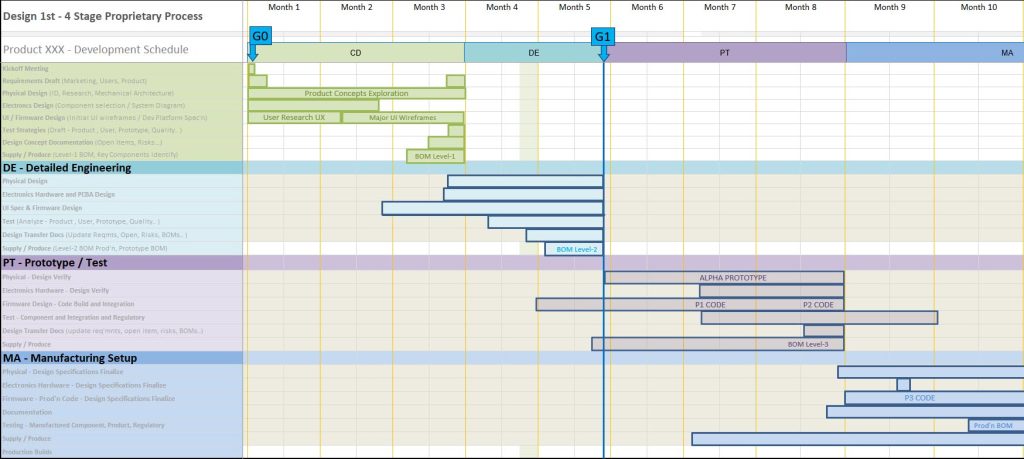
Step 1 delivered a product development schedule and rough timelines for key activities.

4-stage-product-development-process-1
Design 1st Product Development Schedule Template
Step 2: Product Concept Investigation

Before diving into product development, John opted to engage the marketing team at Design 1st for an investigation analysis of his product concept. This goal was to understand the existing market landscape including:

  • Market Size: How big was the potential consumer market for pool cooling devices? What was the monthly search query volume for these devices?
  • Patent Landscape: Which patents covered competitor devices selling in the marketplace now? What were the relevant patent classifications covering similar devices?
  • Competitive Intelligence: What key features did comparative and competitor products have? Which materials did they use? Were there any design issues with existing products?
  • Supply Chain: Who was manufacturing competitive products? What was the distribution strategy? What was the manufacturing cost of existing products?
The output was a 30-page report that revealed a promising market for the product concept. Over 2.6M residential pools in hot US climates and few direct competitors to meet demand. Google trends data revealed the exact states searching for ‘cool swimming pool’ devices:

The report also included a ‘Competitor Product Feature Matrix’. Valuable inputs that would help accelerate the product development process by identifying the materials, pricing, features, size, and distribution model of existing products.

Competitor Product Feature Matrix

The key takeaway was John’s new product concept had a solid opportunity to penetrate the existing market that had a mix of disappointing quality and high pricing. The plan was to deliver a return-on-investment to cover the product development costs in under a year, based on projected sales volume.

Step 3: Product Requirement Research

The Design 1st team took the inputs from the kick-off meeting and product concept investigation to begin exploring manufacturable concepts. This step involved diving into the target use cases, customer needs, and product configuration options. This included researching why the comparative product for heating pools (inflatable solar rings) had so many negative reviews and manufacturing issues.

Defined Key Product Requirements and Risks including:

  • Keep pool 10 degrees cooler vs. No Product
  • Does not blow away
  • Fit into standard shipping boxes
  • Pool-Chemical Safe Materials. Corrosive effect of chlorine, bromine, salt, and UV light
  • Product Configurations: thermal sheets, custom materials, heat sealing inflatable, moulded parts
  • Sizes and material configurations of the product- how many units will cover a standard pool?
  • Cooling Methods: Radiant, air gap, or combination

Output:
Step 3 solidified the critical targets and product requirements in a document for future reference to use as a trade-off tool during the product concept evaluations.

Step 4: Manufacturable Design Concepts

The fun part in every product design exercise is dreaming up new manufacturable design concepts and turning them into functional designs. For the pool cooler, this meant synthesizing all the product requirements, the unpredictability of outdoor environments and corrosive pool chemical attack on materials.

Chris led this exercise leaning on his decade of soft good and insulated product design experience to develop product concepts that would work. The first step was defining potential product concept directions.

Exploring Multiple Design Concepts

The Design 1st team went to work exploring materials, manufacturing processes and cost-effective, shippable product concepts that would keep pools cool. The result was 8 manufacturable design concepts ready for review.

These included:

  • Inflatable Devices
  • Foam with Reflective Inserts
  • Hot Tub Covers
  • Die Cut Puzzle Piece Foam
  • Floating Sunshades
  • Upside Down Umbrellas
  • Flexible Reflective Light Shades
  • Single Shot Molded Parts

Each of the 8 manufacturable concepts was reviewed with the client using a simple rating process based on the targets and requirements that were given different priority weighting based on the business strategy.

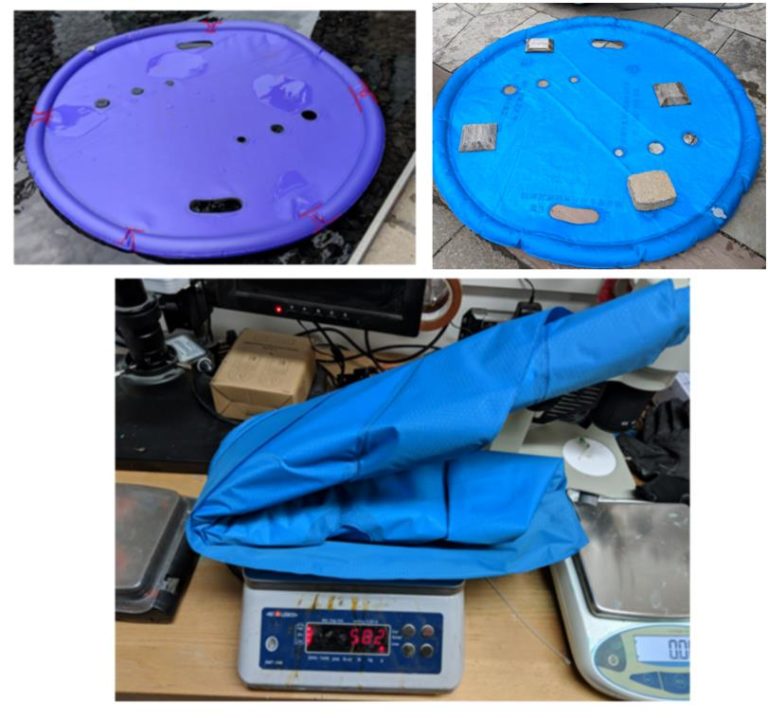
A variant of the winning concept is shown in the images below with various visual looks. The concept was based on a collapsible car shade concept with design features to ensure it would not sink or blow away.

Output:
A selected concept reviewed from a user and business perspective, ready for detailed engineering and manufacturer DFM review.

Step 5: Prototype & Testing

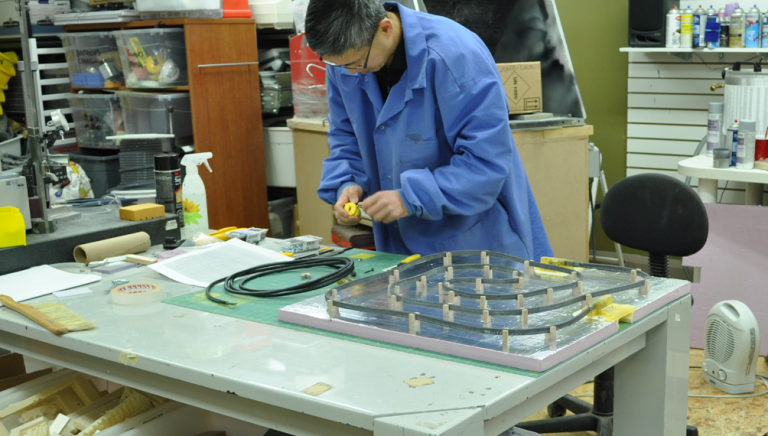
Once a design concept was chosen, full size 3D CAD geometry design files were created.  Dave, the Design 1st Manufacturing lead went to work sourcing the best material suppliers and heat-sealing manufacturing facilities for volume production. Constant communication via text chat and overnight file delivery made the process from a well-documented idea to a prototype go lighting fast even with brand new suppliers.

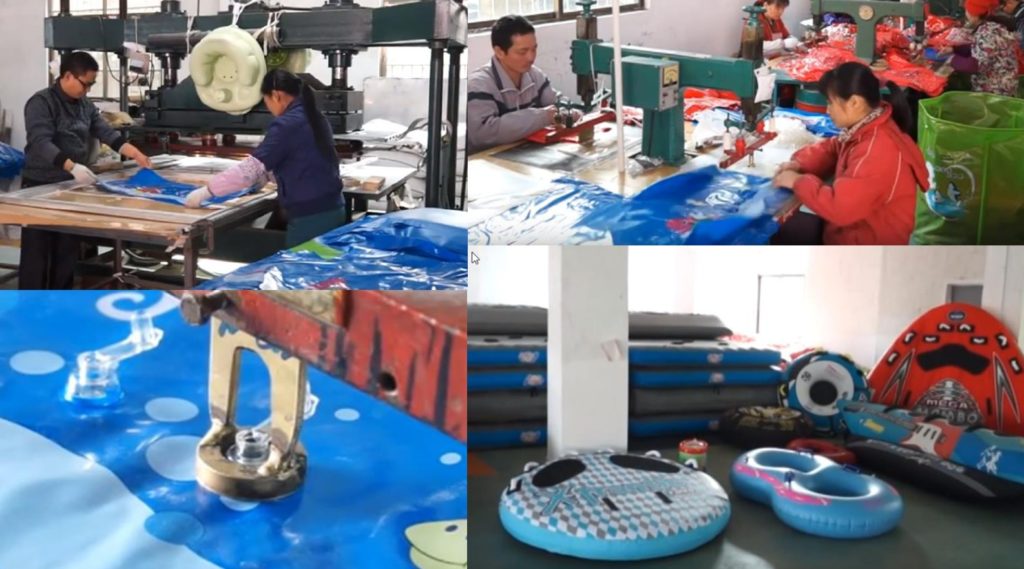
After vetted factories reviewed files, each agreed to make a custom heat-sealing tool to build prototype samples of the product. The goal was to test and validate the suppliers and a range of materials to choose the best solution that met quality and cost requirements.

“We brought in Dave, and in two weeks we had a prototype from China”

– John, Founder of Lily Chillers

Alpha Prototype Testing

Five sample prototype products arrived at Design 1st. They were inspected and catalogued by the design team before being sent to John in Texas for design validation and pool testing.

Over the course of a month, John and the design team worked on iterating the design to fine tune the performance. This included adding more small drain holes to keep the product buoyant, as well as selecting a 3-stage valve allowing for easy inflation and deflation.  First prototype images are shown here.

Design 1st discovered two of the top-performing prototypes used materials at significantly different cost points. Working with the design team, a final decision on the material was made and John was ready to move forward to mass-producing the product.

Output:
Material Samples and 5 Prototypes of different materials were sent to client for validation and testing in real use conditions.

Step 6: Manufacturing Set Up and Factory Visit

John now had a manufacturable-design ready for volume production and was excited to be in the final stage of product development – manufacturer set up.

Factory Visit to China
Before ramping up production, Lily Chillers founder John took the opportunity to travel to China with Design 1st and meet his key suppliers and factories in person.

The 4-day visit included touring multiple factories, inspecting the production process, and building relationships with the overseas supply chain team under the guidance of Dave. The outcome was a massive learning experience for John and the ability to order, inspect, and schedule delivery of products independently. Dave would only be called in if issues arose.

“Visiting China with Design 1st was one of the best learning experiences of my life. I now understand how to quickly go from a product idea to a WOW solution with reliable high-quality volume production!”

– John, Founder of Lily Chillers

Manufacturing Set Up

After inspecting the manufacturing process and seeing the custom heat-sealing tool in person, John signed off on the first volume production run of his product. While waiting for the first shipment John began building out his website www.lilychillers.com and marketing engine targeting the 2.6M+ pool owners who live in hot USA climates.

pool-cooling-device (1)

Output:
A reliable predictable product design with a qualified manufacturer, an order and shipment process, schedule lead time understanding and product specifications for the manufacturer that are 100% owned by John enabling the manufacturer to produce the product under license.

Results: Volume Production

The first volume production run of John’s idea arrived in Texas – 5000 Lily Chillers, quality inspected, packaged and ready for sale. To start out, John repurposed his garage into a distribution warehouse and got the product ready to ship. The next step was ramping up business operations, turning on the sales and marketing engine and preparing to engage the target market.

E-Commerce Sales and Marketing

John’s experience in business operations, e-commerce and marketing came in handy. A simple e-commerce website was set up and John began targeting pool owners via Facebook. Using an authentic video pitch showcasing the product and the value proposition, John began driving sales and generating positive reviews from consumers.

The result? The first 5000 Lily Chillers were sold, and it was time to restock and scale operations. View John’s original sales video below:

Visit www.lilychillers.com
Ongoing Manufacturing Support

As Lily Chiller’s sales volume continues to increase, Design 1st in-house manufacturing support team will provide part-time virtual support to John for ongoing manufacturing coordination until John is ready to take on the full supply operations role.

Effective interaction with remote suppliers is critical to schedule product supply to meet consumer demand. Ongoing activities involve design refinements, tracking manufacturing quality, shipping logistics coordination, contracts, and writing exact information on purchase orders.

Support in coordinating these activities without mistakes ensures Lily Chillers can successfully move products from the factory floor to customers without a hiccup.

Year 1 of Sales:

First-year of sales and everything is moving predictably, the first 5000 units are sold and the next order is in process.  The investment in a product design team has proven to be exactly the right way to get predictable high-quality products delivered to a national 3PL warehouse. The result is a low touch online ordering and the lowest cost delivery to consumers.

The enthusiastic customer reactions are giving John a shot at a successful business operation and massive growth in Year 2 with new product ideas to add to the sales.

The Learning:

R&D and product design is a one-time event involving hundreds of critical decisions. Using specialists you can trust is a fast and low-risk way to take the product development risk out of creating a new start-up business.

Share

Have a new product idea?

We can help take you from idea to design, prototyping, and volume manufacturing.

Published on: February 27, 2023

Top 5 Manufacturing Reasons Hardware Companies Fail

Top 5 Manufacturing Reasons Hardware Companies Fail

27 Years Experience

75+ Design Awards

1,000+ Manufactured Products

From Idea to Prototype in as Little as Six Weeks!
Ready to Start?

Having worked with thousands of inventors, hardware startups, and large corporations over the course of 30 years, you can say at Design 1st that we’ve seen it all. We love to see our customers succeed but we have also witnessed many disappointments due to manufacturing missteps.

The reasons differ from company to company, but certain themes always come up. Below is a list of common reasons we see new hardware products fail.

By understanding each of these major reasons that hardware companies fail and do not make it to market, you can avoid the common pitfalls and drive your product towards success.

Top 5 Reasons for Hardware Company Failure:

1) Creating a design that cannot be manufactured

It seems pretty basic, but you would be surprised at the number of designs that we review which simply are not manufacturable. We always try to emphasize the importance of inserting manufacturing strategy and thinking into the overall plan as early on as possible, whether from a capital standpoint or design standpoint. If you are doing your own design, make sure you’ve educated yourself on Design for Manufacturing (DFM) ahead of time.

If you’re working with internal designers or a product design firm, make sure that they have DFM experience appropriate for the manufacturing processes your product will need. For example, firms that primarily design low-volume expensive medical equipment may not be best at optimizing the design of a low-cost consumer product for mass production in Asia. Do your homework prior to committing money and time to a firm that ultimately may provide beautiful designs but do not have the first clue about manufacturability.

Kickstarter Manufacturing Fail: $13M Raised, 62K Backers

Designs that cannot be manufactured are a common reason many crowdfunding projects fail to launch. Photorealistic renderings that bring a concept to reality and working prototypes may help you run a successful Kickstarter campaign, but if it costs 3x to manufacture your product or a complete redesign of the product is required, you probably will fail.

DTU: Top Reasons Hardware Crowdfunding Campaigns Fail

Our friends at DTU Science Park in Denmark put together a research study on why hardware products continue to fail after successful crowdfunding campaigns. Their top reason? Design issues, often due to lack of manufacturing foresight and DFM best practices.

2) Making the wrong type of prototype

Coming up with an idea is one thing but having a functional looks-like, works-like prototype is everything. Simply put, if you can’t get to this stage, you really shouldn’t be building products. Prototypes are required to build, test – and most important identify risks! Removing risks from your design before investing in manufacturing can mean the difference between success and failure.
lidar-functional-prototype

At Design 1st, we never build only one prototype. We build multiple prototypes at each stage of our product development process to identify risks.

  1. Concept Design Stage:  Prototypes can be simple foam mock-ups to test form-factor and usability.
  2. Detailed Engineering Stage: We build bench models to test materials and develop cost estimates.
  3. Prototype & test Stage: We build fully functional prototypes and do our best to break them and find out why.
  4.  Manufacturing Support Stage: We build a “Pre-Production Prototype” that replicates the manufacturing process. This is a high-fidelity prototype that looks, works, and feels like the final product to fine-tune any manufacturing and assemble issues.

3) Failing to control the Product Cost and Gross Margin

Let’s be honest: the ultimate failure of any business is going to come down to money…or as it were, lack there of. Take into heavy consideration the following three subjects:

  • Controlling Your product manufacturing Cost
  • Budgeting for your product development costs
  • Understanding your gross margin and revenue forecasts
gross-margin-product-costs

We have multiple customers who came to Design 1st with a finished design that cost too much to manufacture. They required help to modify the existing design to lower costs. We did these through rethinking material selection, feature sets, and manufacturing processes. Doing your homework early, and understanding the full scope of product design and manufacturing costs will prevent costing issues.

4) Not understanding your obligations regarding regulatory certifications

Even the largest companies in the world will roll a new product out conservatively, expanding into new countries little by little. Having an understanding of the differences in regulatory certifications (or at a minimum, the knowledge that the rules are different in every country) will save you time, money, and a lot of headaches.

hardware-product-certificat

Understanding what certifications your product requires early on helps product design and manufacturing move faster. Trying to backtrack after you complete your design is expensive and often delays product launch.

5) Selecting the wrong partner to assist you in offshore manufacturing

As with any partner you select as a critical part of your business, transparency should be number one. If you don’t know who your factory is and are simply going off of the reassurances of a middle man, then you truly don’t have a partnership. At Design 1st, we help you select the best factory, component suppliers, and logistics support for your product. You deal directly with them and lean on Design 1st’s manufacturing team for support when required.

design-1st-visits-to-china
Design 1st Visiting Chinese Manufacture With Client Cloud9

When possible, we suggest clients travel to the manufacturer with Design 1st manufacturing team to inspect your product line. These visits are always rewarding for our clients as they get to meet face-to-face with the team manufacturing and assembling the final product.

Share

Need Manufacturing Support Help for your product?

We can help take you from idea to design, prototyping, and volume manufacturing.

Published on: February 27, 2023

6 Pitfalls to Avoid When Manufacturing in China

6 Pitfalls to Avoid When Manufacturing in China

Estimated Reading Time:

There are huge cost advantages to manufacturing in China

If you’re designing a new product that requires electronics (what doesn’t nowadays), finding a Chinese factory that already makes similar products is well worth your time. It can be a fast way to execute lean and bootstrapped manufacturing. All this sounds good, right?

Yes, but for it really work you will need an experienced manufacturing setup partner like Design 1st. Otherwise, you may be at risk to these common pitfalls:

1) Not Having a Firm Quotable Specification

Be sure your specifications are organized and in sufficient detail for quoting before the start of quotation cycle with contract manufacturers. This will ensure you get a competitive and comparative quote from each factory.

If the design specification evolves during the process, the additional costs are more difficult to control, but a technical partner can challenge any cost increases due to changes added on the fly.

2) Ideas and Design Files Leakage

Remember that this factory may be building a similar product or your biggest competitor’s product. Selection of the best Contract Manufacturer for your product must be done not only with price in mind but also by setting up reasonable legal contracts for expectations and quality control. Also look carefully at the Contract Manufacturers past history, their other clients and whether they have the integrity to keep your best interests in mind.

And don’t be surprised if your relationship breaks down or at the next tradeshow your competitor has implemented your pièce de résistance or killer features in their product variant. Setting up, monitoring and maintaining a good relationship are no different than any other trusted partner you choose to engage to build your business.

3) Will Your Intellectual Property Stay Protected?

Manufacturers have good process knowledge, and many times they introduce feature and component changes to the initial product design prior to manufacturing. These changes are usually done in your best interest, but they can make an unforeseen risk.

Some of these changes may alter the intellectual property of your product, which could mean the factory could have claim to contributing to the patentable elements.

4) Keep Revisions to a minimum

During the quotation period and first pilot build of your product keep revisions to a bare minimum. If you extend the schedule or continue to tweak features and aesthetics, costs go up and the attention span at the factory goes down – not a good trade-off.

Making revisions also puts strain on the relationship with manufacturers which can cause them to ignore you, delay the build or increased costs.

5) Firmware = ulcers

While the majority of manufacturing is easy for a manufacturer to proceed, build samples and get ready for volume manufacture (plastics and PCBs) – firmware is tricky.

Factories who write the firmware that makes the electronics and your product work the way you want it to do not tend to let this firmware go (custom software code written and inserted into the microprocessors on your circuit boards). This area of services usually causes big delays and drives up costs, especially if you don’t take control and write this firmware yourself. We recommend you have your design manufacturing support partner complete and update your firmware, avoid an ulcer!

6) Order size does matter

The larger the volume of your manufacturing build, the better your process management, control and costs reductions will be. Small order sizes may work when the factory is not busy but as soon as a big order arrives from another customer of the CM you could be put aside.

Training of staff to run a batch of your product takes time to get everything organized. With small batches, less process control is done and if your order interval is 6 months a whole new group may be building the second order – so knowledge is gained and lost and the risk of errors, defects and variation in your product goes up. Order size does matter to keep the attention of the factory and quality of your product predictable.

Have a new product idea?

We can help take you from idea to design, prototyping, and volume manufacturing.

Published on: February 25, 2022