
We built our own AI tools, and expertise runs every one.
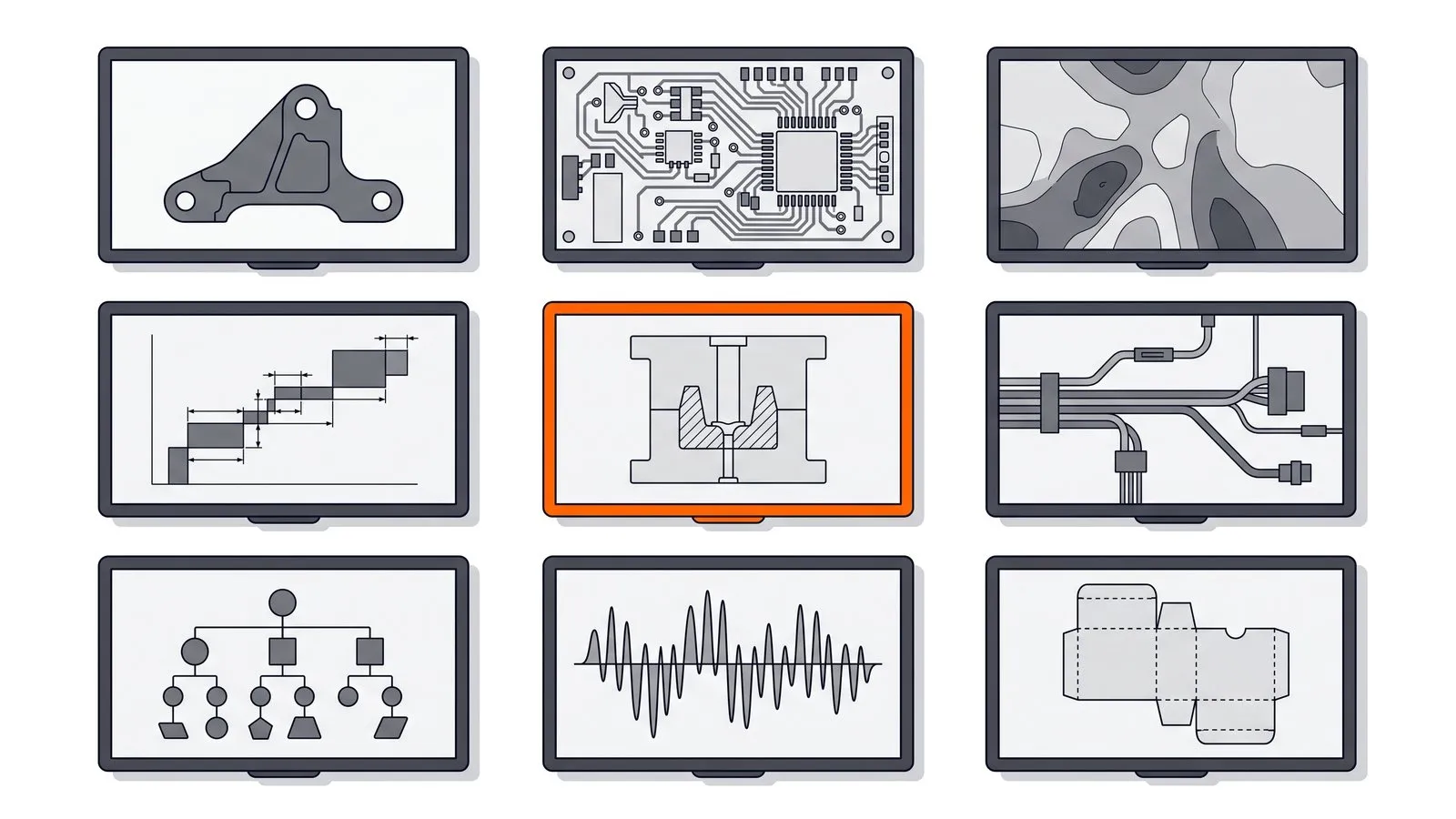
Nine disciplines, and the AI tool we run in each: some public and ready to try, others early and in-house.
AI is here and moving fast. If you are paying for product development, you want to know what AI does to your quote, your schedule, and the product you end up with. Does use of AI tools make this cheaper? Faster? Better? And the quiet one: could you just do the product design yourself with ChatGPT?
Fair questions, all four. What follows answers them the only way that is useful: by naming the tools we built, showing where each one sits in a real product development project, and being specific about the decisions we will not hand to an AI model.
- Product designs in the database guiding our new budget estimator
- 1,000+
- Of our product concept sketches trained into the new visual exploration tool
- 6,500+
- How close our AI budget estimator lands when the prompt carries enough detail
- ±20%
AI is a set of useful tools
And each tool takes on the skill of the hands driving it. Used without expertise, tools produce what feels like a plausible solution, fast. Used with expertise, and interpreted carefully enough to weed the nonsense out from the value, the gains are exponential.
| Without expertise | With expertise | |
|---|---|---|
| Time required | Output in seconds, and timeframe reads as feasible | Output in seconds, modify to feasible schedule for situation |
| Failure mode | Plausible AI part design that cracks in the field | The right material grade gets caught at the desk, not in the field |
| Wrong part | Microprocessor choice reads as feasible | Micro choice changed, edge conditions require non spec experience with part failure modes |
| Novel solution | Little reference info available, product solution poor | Experienced team must experiment on the bench and find options that may work |
| Where it ends up | Independent AI design of devices not ready yet | Expert teams process and integrate learned knowledge not yet in LLMs |
At Design 1st we create and document physical devices for clients who are innovating. Using AI as an information and options resource is critical: to create visuals, to define requirements that are feasible for the situation, to find unusual part suppliers, to avoid prototyping and testing where the information already exists, to write and check software code, and a dozen other ways to work smarter and faster.
The scale of effort in product development of devices is what people underestimate. From a walking cane to a medical instrument, hundreds to thousands of hours go into creating a physical product concept, defining every part that makes it up, and integrating parts from specific suppliers so they work reliably, are easy to use, and survive for years in the environment they have to endure. From tens to hundreds of documents and CAD files have to be created and controlled so a third-party manufacturer can quote and build repeatably, at the quality level you require, and also track the design changes you will make as you sell and improve the product over its lifetime.
All device design and engineering is complex, and it needs experts in many areas. It takes one wrong decision for the product to break in the customer's hands, and now it is landfill. AI tools are fast. They are a starting point, and they speed up a lot of detailed decisions. They are not an end point. An expert, diverse team still has to navigate what to do first, second and third across thousands of tiny decisions specific to how the product will be used and how it has to survive. That is what gives the opportunity a chance of business success.
We were building AI tools before ChatGPT
In 2016 we built Smart Hearing Glasses that listen spatially and orient a person in 3D space. We spent months collecting ambient noise from construction sites, traffic and the outdoors to train a model. Edge computing was in its infancy and training sets were small; it was a niche application, so we had to get our hands dirty with machine learning. Today connected products are moving away from processing in the cloud toward processing locally, so the intelligence runs on the device itself. We now use AI to help create code for products like Calibre, a biometric breathing wearable.
We are not AI researchers and do not claim to be. We are product development designers and engineers who have created and used AI tools long enough to learn where they help and where they are useless.
Five things we learned the expensive way
| What we learned | What it means for your project |
|---|---|
| AI usage is not AI fluency | Using AI every day does not make you fluent in it. Fluency in product development takes deep domain knowledge: you have to know feasible from useless for a specific situation and application before a tool can get you there faster. As the tool builds on this new knowledge it gets more useful. |
| AI is not automatically faster | Independent research backs what we saw ourselves. AI can make experienced engineers slower, because they investigate more options and go further down more paths before discounting what looked like a better solution, instead of going with what they know works and is low risk. So we are selective about where AI is injected into our processes. |
| AI informs, it does not decide | No AI output is handed to a client as a deliverable. We use it to explore concepts, weigh the risk in each option, analyse results and pick direction. Our designers, engineers and supply teams make the call, and every call gets assimilated into the team's knowledge bank and tools so the next project may benefit. |
| Off-the-shelf tools hit walls | Generic AI tools demo well and stall on real engineering problems in all but the simplest designs. Where a new automation tool looks useful, we test it out or we build our own. |
| The tools change, judgment does not | We have seen this movie. When 3D CAD arrived in the late 1980s it did not replace industrial designers and mechanical engineers, it demanded they learn it, and the ones who did moved faster, evaluated many more options and prototyped virtually. Deciding whether an AI tool output is appropriate, feasible and fits the specific situation is the same design creativity and engineering judgment and expertise we have provided to our clients since 1996. |
A product and all the parts that make it up go through hundreds of decisions on the way to being ready. AI helps us expand the search field and weigh the risk around each one. We have created over 1,000 products across a wide variety of industries, and each new one still requires many nuanced decisions that lead to its success.
Using AI tools to augment our knowledge and our network means fewer hours, lower cost, and better solutions.
Could you just design the product yourself?
Partly, and it helps when you do. If you are a designer, an engineer or a marketing expert, using AI to sift through specific product details yourself is genuinely useful to the team.
The limit is integration. A new product design crosses nine or more disciplines: market and user requirements, form, user interface, mechanics, electronics, firmware, certification, packaging, manufacturing. The expensive mistakes live at the boundaries, where those priorities compete. Getting a draft solution out of an AI tool is easy, because the tools can always be persuaded to produce something that looks feasible to a non-expert.
What is not easy: knowing which part shapes and interlocks will be moldable in an injection tool; what board layer count and size will be producible for the functions it has to perform; what to expect from the expensive test labs; which assembly process leads to a low manufactured cost. It is certain that the parts making up the whole will require many compromises during integration, so that the finished physical product meets the full array of business, user, market, product and supply requirements at once.
Where AI sits in our work, discipline by discipline
Nine disciplines. Each panel opens onto the tools we actually run in it, what they do, and what a human still decides. No hype. Where something is early, we say early. The label tells you whether you can run the tool yourself.
Order-of-magnitude AI generated budget
Public tools
Fast estimator budget, priced off 1,000+ programs we actually delivered.
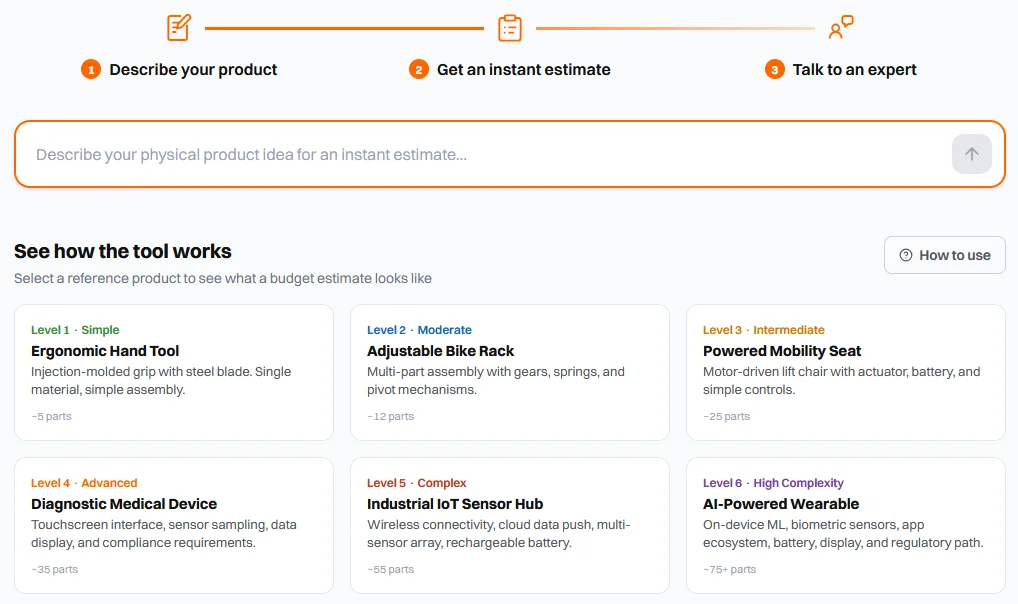
We keep a deterministic database of over 1,000 Design 1st projects spanning dozens of industries: budgets, timelines, complexity, requirements, results. Our AI budget estimator pairs that record with machine learning and AI inference to produce instant estimates, so you see realistic ranges and the assumptions behind them. It is not a chatbot wrapper. The value is the knowledge underneath it, and how our AI tool presents the information. Be aware the budget is as good as the prompt you give it. Use the tool, then call us and we can make sure a budget includes the key features and functions of your new product idea.
Every product development is unique, so the database points an ROM arrow in a direction. A thorough budget still comes from a conversation with our technical team to ensure all your requirements are included. For example: did the type of radios the electronics have to run get specified correctly? If not, hundreds of additional hours may be required.
Ian Kayser, our VP of Sales, has budgeted more than 7,500 projects in 25 years at Design 1st. His intuitions, plus our technical team reviewing your product requirements, get amalgamated into a more accurate budget for the work required to go from your idea to a product in the market.
Treat our AI budget tool as a financial planning instrument for ballpark dollars and timelines. It is not a Gantt chart activity roadmap. The many activities specific to a new product idea have to be assessed case by case by our development experts, and their analysis with you may move the estimate up or down.
Our public AI budget tool includes six example real projects we worked on, with their budgets, as part of the training data, from a simple hand tool to a complex wearable. Our private AI budget draft tool is what produces the actual budget released for sign-off paperwork, after we have discussed the details of your project with you and our technical team.
Product concept planning
Public tools
Product requirements, target market research and user persona drafts in hours, not months.
Dreaming up the next out-of-the-park product concept that addresses a real market need and improves a user's workflow: this is step one. Drafting the targets and requirements to guide the development team is step two. Cost, price, feasibility and supply planning follow from there.
Drafting the requirements (PRD) is labour intensive, boring, has to be meticulous, and is the last thing anyone wants to spend time on or document. There are hundreds of details to work through, and many need research before they can be pinned down, which makes it an excellent place for AI to help. Our AI PRD tool drafts requirements across the five critical areas (business, market, user, product and supply) and outputs them as a tabbed Excel document for humans to filter, adjust and refine the last 10%.
The draft PRD is never correct. You will research further, tune, remove, add and re-specify. What it does is take roughly 90% of the research and documenting work, typically months of effort, out of the process, and hand the development team a running start. Many items cannot be fully defined early on and will be updated as decisions get made while the development proceeds, and the PRD is an excellent place to track all the decisions that get made on the road to finishing the product development.
A second early stage AI Target Market Research tool we created looks through internet information on markets, distribution channels and likely competitive products, and identifies the opportunities, constraints and risks you may face selling into your chosen market, along with geographic and ethnographic detail estimating the size of the opportunity.
Try the target market research tool →
A third early stage AI Personas tool we created is complementary to the Target Market Research tool: it drafts both primary and secondary user personas for the likely consumers, buyers and users of your new product. This feeds into the market research.
The PRD requirements tool available on our website includes four real projects with their requirements drafted, from a water bottle to pet tech. You can also find a funding help search tool there. There are example projects with all of the tools to try out if you do not want to share any information about your specific product. Get a feel for the tools, then sign an NDA with us and we can run the tools with you after that.
Industrial design
In-house only
A form-exploration tool, pulling from public LLMs and 6,500+ of our own concept sketches.
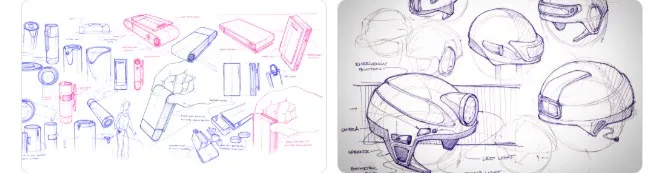
Our AI Visual Concept Exploration tool is used by senior product leads to explore form, fit and function, and to move quickly through a dozen concept directions early, while the core of the product is still being decided. We pull from the many products and images in the world via public LLMs as well as 6,500+ of our own concept sketches. The tool outputs are used for conversations, debates, option exploration, client feedback and synthesis of various visual elements as the team begins the creation of the geometries that will define the direction of the product to be developed in CAD tools on the path to prototyping, tooling and manufacture.
Hand sketching still does a higher fidelity of nuance that the AI tools do not yet provide. We draw dozens of rough sketches per client, not photorealistic renders, because rough is where the emotional wow, usability and the human factors get explored, along with quick build prototypes to hold, assess and refine.
The math: concept exploration used to require a table of industrial designers at $1,000+ an hour. Now one senior lead with the tool brings the same creativity and output to the larger product level planning and decision making team. Development cost drops because this exploration stage moves faster. Our hours required stays similar and the team explores many more options in detail before committing to a direction.
Mechanical engineering
In-house only
Three places so far: finding real parts, thermal analysis, and the bill of materials.
Finding physical parts. Our AI Finder internal tool scans open-source multi-country customs records to find the factories that could actually make a part at the yearly volume you anticipate, instead of trusting a web search and a catalogue listing. From those early supplier options it collects specification sheets, contact information and comparative reliability for the intended application, for our design team to review as we select parts against the targets the business and marketing teams set.
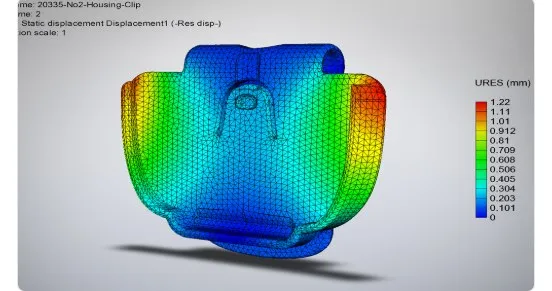
FEA thermal analysis. We use simulation for feasibility from deterministic physics: SolidWorks FEA for heat, stress and deflection, and CFD for fluid flow. We design and check heat dissipation with traditional CAD and FEA to get system-level feasibility for our housing concept when the chance of thermal overload is identified as risky. Traditionally we then collect real data with bench tests, thermocouples and a thermal chamber. AI comes in at the beginning and the end of the process: to assess system level feasibility of heat generated inside a volume prior to FEA, so no time is wasted on obvious no-go designs, and afterwards to help with data analysis. This speeds up the analysis and guides the decision on which option for product direction to carry forward.
Bill of materials. A BOM starts with critical parts selection at the concept stage, and then gets further filled in right through detailed engineering, prototype and testing, where every component is selected and prototype and production suppliers are finalised. The evolving BOM becomes the order list for the first pilot manufacturing builds. Our AI BOM creation tool makes the creation and evolution of the BOM throughout development stages faster, and eliminates the manual errors traditional to assemblies with hundreds of parts that all have to come together with no confusion.
None of these three AI tools replaces an experienced mechanical engineer's judgment, as they must review all outputs for accuracy. The AI tools let an expert move faster, cover more options, and collate a large amount of information into organised documentation.
Electronics engineering
In-house only
Our own 3D board layout tool before a schematic exists, and a year of wireless power theory.
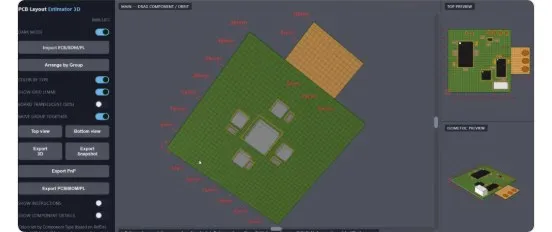
PCB Layout AI Estimator 3D. A spreadsheet of components and a board shape goes in; an optimised board component layout comes out, in three dimensions. Arrange parts by group, flip and rotate them, check top and bottom views, all before a schematic exists. Working closely with the industrial designers and mechanical engineers, board size, shape and depths can be optimised early, which is essential for small products where there is almost no room to give. Same rule as the AI budget estimator: it gives the team a direction to chase, not a finished circuit board. The tool is evolving toward trace route planning, layer count, and risk assessment on critical components.
Wireless power design AI tool. Our electronics team has spent a year deep in wireless power transfer theory, and AI has been implicit in the review of more than 100 research papers on this new technology. The current status is an optimisation and modelling engine that captures candidate solutions against product requirements in days. In the senior engineer's own words: “It's more complicated than it looks on the surface.” A year of accumulated expertise gives our clients access to leading-edge wireless power application effectively instantly, without the parameter, application, materials and testing research that takes months.
Software and firmware
In-house only
Our own on-premise AI server, open models, and scaffolding code a human still reviews line by line.
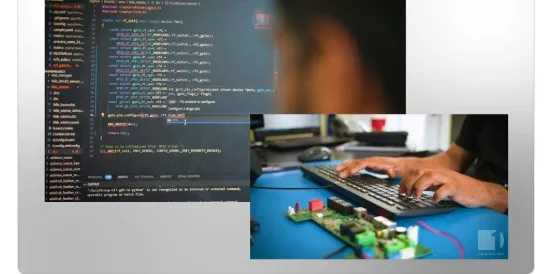
Our firmware team built and runs our in-house AI server, with open models. This internal AI server is also the same one that the rest of the company's other AI tools work on. We scale the selected open-source models as our needs grow. New models are tested against real work from our wide array of past projects, and our VP of Software, Yih-Shyang, signs off before any new implementation is used on client work.
AI firmware creation toolset. Our AI coding tools are built for designing and testing physical device code: peripherals, microprocessors, PLCs and display drivers all need specialised integration code. AI drafts libraries and the layers around the core: test harnesses, build scripts, protocol glue, documentation. Register-level and timing-critical code stays human-written, and every AI-drafted line gets the same review as a human-written one.
A recent example: a major telecom client's outdoor control device had a 1,000-hour software budget, far smaller than a traditional non-AI-supported build. AI assistants carried the scaffolding; our engineers created and tested the code that matters. Modules reused from previous designs already carry their testing and validation hours and needed only integration testing. Your budget goes to human architecture and judgment, not typing.
Prototyping and testing
In-house · early
Virtual prototyping before bench testing, a P-BOM that flags interim parts, a test plan builder.
Virtual prototyping before bench testing. To devise high-level fluid flow models that represent the product configuration and its constraints takes deep experience if the results are going to be trusted, because the simplifications and assumptions are what make the output usable or worthless. From there we move to physical bench-model testing, and that is not changing. In all but the simplest designs, the cost and time of simulation, and the trust you can place in it, require time, iteration and a large budget. Blending AI-driven information collection with finite element tools and real-world testing gets to a feasible solution for much less than a simulation-centric approach alone.
We are early to AI-driven simulation of real-world operating environments. Our large database of real testing results is what lets us confirm whether any of the emerging third-party AI tools are actually useful for physical product development.
Prototype BOM tool. A P-BOM is a variation of the production BOM, and it carries parts the final manufacturer has not made yet, which introduces uncertainty into what the testing of a prototype with non-production parts can honestly tell you. Housing parts are not molded from tools yet and come from prototype materials without the strength, ductility, surface finish or chemical compatibility of the final product. The same applies to electronics and firmware at prototype level. Our tool flags every interim part and feeds that into the test plan, so we do not test a requirement on a prototype that cannot properly be assessed during the prototype stage. Some features, functions and product materials cannot be properly evaluated until the manufacturer builds the production product later on. Knowing this reduces test iteration, development time and cost.
Test plan builder and optimiser. The Product Requirements Document (PRD) holds the specifications a product is tested against: business, user, market and product performance, objective and subjective, some solvable and some requiring modification, as decisions are made and changed during the development process. Our test plan tool uses the PRD to separate out the critical and risky elements that deserve careful testing and qualification, and sifts available results from public sources and our own private library so humans spend less time reviewing, debating and planning. Testing is one of the most expensive and time-consuming parts of development, so testing for the risky items that matter is where the money and time is saved.
Regulatory and certification prep
In-house only
Research requirements early, and pre-compliance in our own lab before costly third-party approvals.
Our design team supports clients through third-party regulatory testing of the product. Early in concept planning we also help organise the critical testing a client's market and country will require, using our AI research summary tool. As development progresses we run physical tests in our own lab first (EMI, ESD, RFI) to raise the odds the product passes the costly approval testing, hopefully the first time.
AI digs up the relevant information and flags where the risks are, so time and resources go to the right places. Our regulatory expert reviews the output and the client's business team adds their own expertise and learning to the plan. It maps the playing field and the industry contacts far faster than a person with a browser and a phone. It is a starting point, not an output.
Our AI regulatory tool also finds and fills regulatory form drafts, saving the days and weeks of back and forth that are required when humans create these documents. Humans always review and complete the documents ready for submission.
The AI Regulatory Assessment tool serves the development team and the client, to identify the industry experts who guide approvals. On recent medical device projects the time savings, test cost savings and breadth of exploration have paid off clearly.
Manufacturing and sourcing
In-house only
Where public AI searches are strong: is it ready, who can build it, what will they charge?
This last stage of development is where public AI tools are strongest today, tapping into the online information highway full of true and false. With carefully crafted prompts, current public AI tools will produce a stunning array of information for anyone setting out to have a physical device made by a manufacturer somewhere in the world.
You should get AI to answer certain questions:
- Do I start with a manufacturer, or is what I am building going to take several expertise groups to pull it all together?
- Is a similar design already being made by an existing manufacturer, and if so will they build my design as well and protect it from competitors?
- Are my design files and documentation manufacturing-ready?
- What will engaging with the manufacturer cost, to design and to build a quantity of units?
First, getting your product design ready to manufacture, what are your choices?
There is more than one way to design, develop and manufacture a new product idea.
- Go straight to a manufacturer and have them design and build your product.
- Build your own development team, design it, then find a manufacturer.
- Hire a professional design development company, then find a manufacturer.
For an innovative new product idea, setup 3 is often the only way forward. It uses professional teams trained specifically for their role in development, and is by far the most predictable route to arriving at a solution that sells well in your market, with the lowest execution risk, the least time and the lowest development cost.
As companies grow in revenue and in the number of custom SKUs, they often migrate from setup 3 to setup 2 with an internal development team. Setup 1 is most often used when copying an existing design with minor variations, where a manufacturer is already set up to make something similar and your changes are incremental to what they already produce.
Next, which tier of manufacturer can you attract?
You need to know what type of manufacturer your new product can attract. Global Tier 1 manufacturers build high-volume continuous production and deliver quality product at a premium per-unit cost. In your first year or two of sales you are far more likely to need a manufacturer willing to do smaller batch builds while you test the market, tune user expectations and grow sales.
It is simply about yearly volume economics: Tier 1 is 100,000, batch is 1,000, 5,000 or 10,000 per year.
| Tier 1 (Foxconn, Jabil, Flex) | Tier 2–3 batch builders | |
|---|---|---|
| Built for | High-volume continuous production. Think 100,000+ devices a year | Batch builds every few months, or once a year |
| Per-unit cost | Premium, folding in their management overhead | Lower, especially offshore |
| First-year fit | Poor. They are the worst at doing 10 units, then 100, then 500 | Good. This is the volume they are set up for |
| Lead time | Typically 4–9 months; small runs get fitted around continuous customers | Faster, smaller organisations |
| Will they take you on | Rarely, unless you already have a relationship or you are strategic to their plans | Yes |
| Where it wins | Stable product, serial production, reasonably headache-free delivery | Years 1–2, while you test market and tune the product |
You can save significantly in the first two years with batch builders onshore, and more saved if you go offshore, enough to get you through to a stable continuously producing product. At that point a Tier 1 becomes very interested as your volume climbs from lower-volume batches toward 100,000+ units a year.
Whichever option is open to you, make sure your file package stays with you
No matter which manufacturer you choose in year one, the product file carrying every specification they need to build your product must be professional, detailed and release-controlled. That is the development team's responsibility, in creation and in delivery.
Our output files are Tier 1 level, and manufacturers love Design 1st product files for what is in them, so they can focus on their specialties of review, minor modifications to suit their processes, build instructions, test instructions, quality control, assembly efficiency and the inline test equipment for each batch you order of continuous production.
In year one most products start with batch builds, and the design will keep changing as you tune features and adjust to the feedback from first customer use. The design company can handle these file changes, because manufacturers do not like doing that part; ideally they want build instructions that are flawlessly clear. We use release control documentation to keep your design files straight until you want to take it over yourself. Most of our clients would rather not own the update-and-release-control headache, so they let us keep the factory current with the latest information for each build.
And what will the manufacturer cost you?
There are four major cost areas to expect from a contract manufacturer.
| Cost area | What it covers | What moves the cost up or down |
|---|---|---|
| Non-recurring engineering (NRE) | Getting your design into their manufacturing system: examining and adjusting it to suit their needs, writing assembly instructions, defining in-process test and quality steps, and readying everything for production. | NREs are significant, but can be reduced. A development company with strong supply network relationships can influence the manufacturer to take some NRE off the table. |
| Tooling for custom molded parts | Capital costs. The CM's suppliers build the injection mold tools to their specs; the design team verifies the parts coming off those tools meet requirements. | Part count, complexity, cavity count, yearly part volume (tools wear out) and the tool life you specify. |
| In-process test | Custom jigs and fixtures for testing product and circuitry during the build. It may be as simple as a bed-of-nails fixture that connects to the electronics and confirms they function to spec. Some products require acoustic, mechanical and other tests. | What equipment the CM already has in house, how flexible their test stations are, your volume, and where the bottlenecks fall in the assembly flow that affect flow and time cost. |
| Parts inventory | You buy and pay for all the parts up front, for every purchase order you place, so significant money is required a while before goods get shipped and sold. | Minimum order quantities on some parts, order size, and per-unit part cost, requiring from tens to hundreds of thousands of dollars. |
Clients either rely on the manufacturer or on the design team to create the engineering files for any test equipment, and to decide who builds the jigs and fixtures the CM specifies and requires. We have this discussion with manufacturers as early as possible.
Then there is the timeline, which is a cost of its own. Tier 1 manufacturers can be much slower than batch builders, typically four to nine months, because bigger organisations fit smaller work in around their larger production customers. For the first builds of a brand-new product, where you want 10 units, then 100, then 500, then thousands so you can debug with real customers in the field, Tier 1 manufacturers are impossible to attract. They rarely accept new customers who need to go through that learning and tuning process at all, unless you already have a strong relationship with them on other high-volume products, or the category you are entering is strategic to their future plans.
FAQ
Will your AI tools cut my development hours?
The lower hours are already in your budget. Every budget we write is built with our in-house AI tools and the record of 1,000+ past projects, so the savings are priced in before you see a number rather than promised as a discount later. We break projects into development stages so decisions happen in an efficient order, and the saving passes through.
Could I just do this myself with ChatGPT?
You can get a draft that looks feasible. That is exactly the problem. A new product crosses nine or more disciplines, and the expensive mistakes live at the boundaries between them. Knowing which shapes and interlocks will actually be moldable, what board size and layer count is producible for the functions it has to perform, what the expensive test labs will do to you, and which assembly process leads to a low manufactured cost is the synthesis work. If you are a designer, engineer or marketer, using AI to sift details yourself genuinely helps the team. It does not replace the integration.
Where does my data go? Do you put it into a chatbot?
Our AI tools run on our own secure server, in our building, on hardware we own, using open-source models. Where we use third-party cloud AI we use paid services with closed models and strict data-use rules. The in-house rule is blunt: we treat any AI chatbot like a person who has not signed your NDA. No proprietary data gets transferred.
Do any AI outputs end up in my deliverables?
No. AI is used to explore concepts, weigh options, analyse results and set direction. Our designers, engineers and supply teams make every call, and AI-drafted code gets the same review as human-written code. Register-level and timing-critical firmware is written by a person.
Which of your AI tools can I try myself?
Five are public: the budget estimator, the PRD drafting tool, the user personas tool, the Target Market Research tool, and the funding search tool. There are example projects with all of the tools to try out if you do not want to share any information about your specific product. Get a feel for the tools, then sign an NDA with us and we can run the tools with you after that.
How accurate is the AI budget estimate?
In practice the estimator lands within about 20% when your input prompt description carries enough detail. It is a financial planning number, not a quote. A released budget comes after our technical team has reviewed your actual requirements, and that review can move the amount of work required either way.
AI provides plausible solutions to the non-expert; it does not carry the risk. Thirty years, 1,000+ products, and a team that still signs its name to every decision. That is the part the AI tools do not replace. The AI tools draft information to speed up development time and present more possible options for any challenge. People integrate, synthesise and make physical products actually function as expected and survive a lifetime of use and abuse.
The Design 1st team are experts at device development, and we are here ready to help.