
Growth in AI tools for hardware
Every stage of a hardware program now has an AI tool pointed at it. None of them talk to each other.
In June, PhysicsX raised $300M at a $2.4 billion valuation. Their models approximate the physics instead of solving it, so a stress study that ran overnight comes back in seconds. Siemens and NVIDIA are both on the cap table. A month later CoLab put AI agents inside design review, on programs that build nuclear reactors and jet engines.
Neither is an outlier. In April Y Combinator asked founders to build hardware. Eight of its fifteen categories need it.
- Venture capital behind roughly 600 engineering software startups, across 45 countries
- $15.7B
- Stages of a hardware program with a funded AI tool aimed at them
- 13 of 13
- YC summer categories that need hardware or capital
- 8 of 15
We went looking for the gaps. There aren't any. The table below runs from requirements capture to first-article inspection, and every stage on it has a funded tool aimed at that one step.
One step. That's the catch. Each tool is sold to an engineer to shorten a single task, and none of them hand off to the next. Buy across the board and you own a dozen subscriptions, a dozen file formats, and a dozen vendors who each think their piece is the hard part.
Someone still has to decide which ones survive a real program. A render tool that saves four hours is worth nothing if it hands you geometry no shop will quote, and an extraction tool at 94% accuracy on drawings means one dimension in sixteen is wrong on a print nobody re-checks. Those calls are the job. They're the job a product development firm already does, every week, with or without AI in the picture.
The opening isn't another tool. It's running them. Test them on live work, keep what holds, drop the rest, and carry the stack so the client never has to assemble it.
Here's the map.
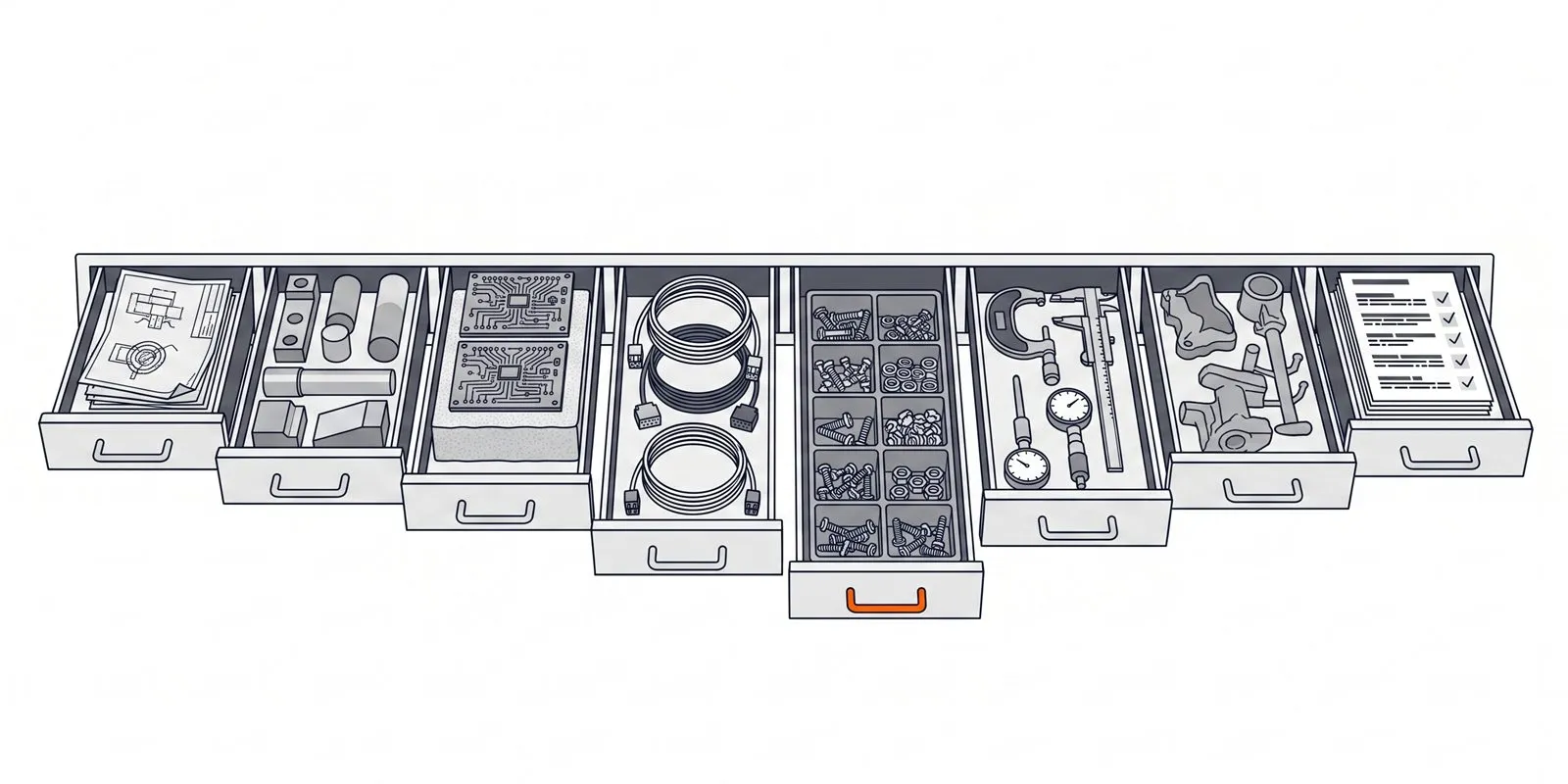
Every tool, by stage
Read the left column as the workflow. Orange marks something that happened inside the last three months.
| Stage | Tool | What it does | Signal |
|---|---|---|---|
| Requirements | Trace.Space | AI-native requirements and traceability. Two clicks from a requirement to the design element to field data. | Space Agent, Apr |
| Violet Labs | Agent access across requirements, CAD, PLM, MES, ERP and simulation, with permissions. | 2 years old | |
| Industrial design | Vizcom | Sketch to photoreal render to 3D. Used by Ford, Dell, Target, New Balance, Omega. | $27M Series B |
| Mechanical CAD | Leo AI | Text, sketch or spec into a full assembly optimised for manufacture. 60,000 users. | $9.7M raised |
| Simulation | PhysicsX | Predicts stress, heat, flow and vibration in seconds rather than hours. NVIDIA and Siemens are investors. | $300M, 8 Jun |
| Neural Concept | 3D deep learning for design optimisation. | — | |
| Electronics | Quilter | Autonomous board layout. Returns finished projects in Altium, Cadence, Siemens or KiCad. | Startup program |
| Flux.ai | Browser-based ECAD with a copilot that builds symbols and footprints from datasheets. DeepPCB and siliXon sit behind it. | — | |
| Firmware | Embedder | Agents grounded in silicon documentation. Code generation and hardware verification for ST, Espressif, Nordic, NXP, Infineon. | Award nominee |
| H2LooP | AI coding for the software hidden inside hardware. | $2M seed | |
| Design review | CoLab | AI agents in design review, with whiteboards and notebooks that capture rationale as context. Customers build nuclear reactors and jet engines. | 4.0, 9 Jul |
| Data and BOM | Duro · OpenBOM | Lightweight product lifecycle management and BOM automation built for hardware startups rather than enterprises. | — |
| Drawings | Energent.ai | Turns 2D drawings, scans and PDFs into structured tolerance and GD&T data. | — |
| QualityEngineer.ai | Pulls dimensions, GD&T callouts, material specs, notes and referenced standards off a drawing, then checks its own work. | — | |
| Manufacturability | KnowYi | Takes incomplete engineering inputs and produces drawings, supplier routing, inspection evidence and delivered parts. Waterloo, Ontario. | Founded 2025 |
| Galorath SEER | Links design decisions to cost and manufacturability. | — | |
| Rapid parts | Prototyping.io | Reads a 3D model, pulls out the manufacturing features, flags problems and suggests changes before anyone quotes it. | YC Spring 2026 |
| Protolabs | The incumbent, making parts in its own factories. Hlabs and Productive Machines are the newer entrants. | — | |
| Sourcing | Xometry | Instant quoting marketplace. Rolled out lead time prediction and per-quote dynamic pricing this year. | Q1 2026 |
| Lumari · Fictiv | Agents running RFQs, purchase orders and supplier chasing. Lumari was built by ex-Google, Tesla and Stripe supply chain engineers. | YC backed | |
| Quality | Instrumental | Combines images of units on the line with production data to find the root cause of defects in complex electronics. Founded by two ex-Apple product design engineers. | $80M+ raised |
Signals are verified against a primary or dated source where shown. Vizcom's round is from October 2025 and Leo AI's is older; both are here because they are the reference tools in their category. Vendor accuracy claims have not been independently tested.
What Design 1st is doing about it
Vendor benchmarks are run by vendors. Energent claims 94.4% on drawing extraction. Leo AI claims 96% on CAD. Neither number tells you what happens to a 2003 scan with a handwritten revision note in the corner, and that's most of the drawings that come through the door.
Four tools, four live programs, the measurement agreed before we start.
Some of these won't survive the first program. That's the finding worth having, and no vendor is going to write it down. Search AI and hardware today and you get two things: a tool company ranking itself against its competitors, or a listicle by someone who has never released a drawing package.
We'll publish what we find with the engineer's name on it. Including the weeks we waste.
Sources
PhysicsX · CoLab · Y Combinator Summer 2026 requests for startups · Threaded 2026 engineering software survey · Semiconductor Engineering, Q2 2026 funding · vendor sites as linked.