
An Ontario fund may pay up to a third to engineer and prototype a defence version of your vehicle or drone product, if a customer signs on as partner
The Ontario Vehicle Innovation Network (OVIN) now funds defence and dual-use technology for vehicles, drones and space, nothing weapon-specific, at Ontario companies under 500 staff.
To qualify, you need to clear eight rules in OCI's guidelines
What OCI's guidelines ask
- Your company has fewer than 500 full-time employees worldwide.
- It has registered operations in Ontario and carries out the project there.
- It isn't already the applicant on another R&D Partnership Fund project.
- An arm's-length customer partner (OCI's "primary partner") has signed on to show there's a market.
- The technology is at technology readiness level (TRL) 3 or higher on the federal scale, a proof of concept or beyond, so not a feasibility study or basic research.
- It's mobility technology for defence, dual-use, space or public safety, and it isn't weapon-specific.
- You, your private-sector partners or both can fund at least two-thirds of the eligible cost.
- The project ends with a working product you can demonstrate in Ontario.
All eight are in version 5 of the fund's guidelines, posted in October 2026. OCI calls the fund discretionary and says it can't fund every eligible application.
Once your company has received more than $500,000 from OCI's programs over its lifetime, not counting OCI's Talent Development program, it needs OCI's approval before it starts a new application.
Your two-thirds has to be "unencumbered from other government grant sources".
We read unencumbered to mean the same money can't also be your share in another public program that pays for the same work. OCI can confirm how it applies to yours.
Money from public bodies, government departments and grant programs doesn't count toward your two-thirds at all.
OCI's examples include drones, vehicles, navigation and communications
Nothing weapon-specific fits the fund's defence focus area.
The guidelines' eleven examples name parts as well as whole vehicles, among them drivetrains, batteries and space-qualified components.
- Platforms. Uncrewed ground vehicles, modular chassis and drivetrains, and drones whose design adapts to civilian, emergency or defence work.
- Systems for hard conditions. Navigation where satellite positioning is denied or degraded, cyber-hardened communications, and rugged electric drives, batteries and off-grid charging.
- Space. Radiation-tolerant electronics and other components that move between automotive, ground and space use, planetary and lunar rovers, and satellite positioning and data services.
- Public safety. Electrified ambulances, fire apparatus and police fleets, and the vehicles, routing and charging used in disasters and evacuations.
OCI says the list isn't exhaustive, and as we read it, every example ties to a vehicle, a platform or the transport systems around them. An OCI business development manager can say whether yours fits.
OVIN's 6 October 2026 release lists more areas, including sensor systems and earth observation. The guidelines set the focus area's scope.
Every project needs a customer partner that co-signs the agreement
A prime contractor (the firm holding the main contract with a military buyer) appears to fit the guidelines' partner list, as a national or multinational company.
Other partners on the list include small and medium-sized companies, municipalities, Crown corporations, not-for-profits that represent industry and, new in version 5, government entities.
A public body appears to qualify as the customer partner too, but its money doesn't count toward your two-thirds.
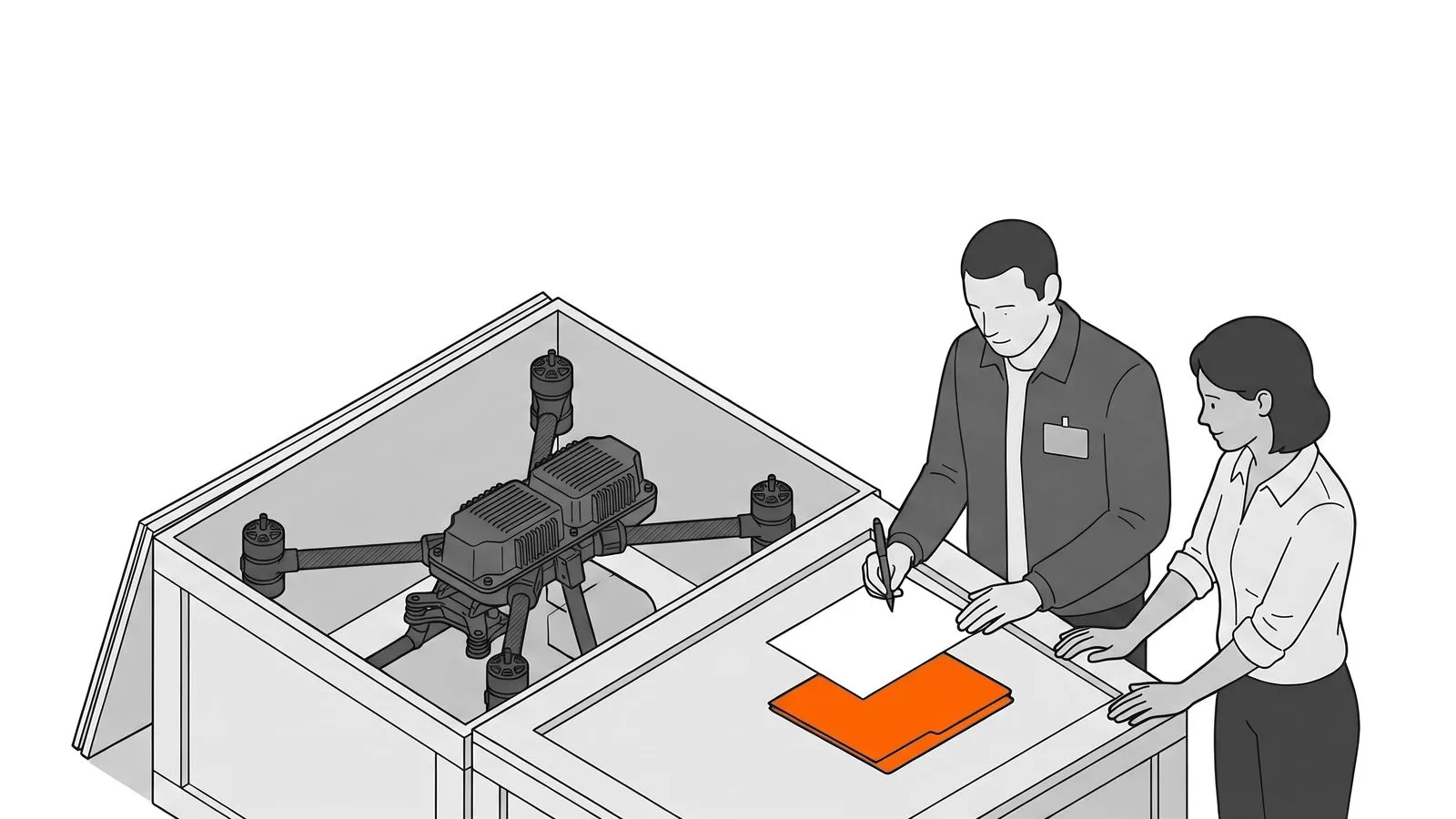
OVIN's guidelines ask four things of the customer partner.
- It's at arm's length from your company.
- Its part in the project shows there's a market for what you're developing.
- It co-signs the funding agreement.
- It signs a letter of support for the application, as does every partner that puts in money or work.
As between OCI and the companies on the project, OCI's standard agreement makes those companies "the sole and exclusive owner" of the intellectual property the project develops.
OVIN's guidelines advise settling the split between partners before applying.
Under the federal Controlled Goods Program, a company must register before it examines, possesses or transfers controlled goods in Canada, and other export controls can apply as well, which this guide doesn't cover.
A grant at the cap needs a project three times its size
Stream 1's $100,000 cap takes a $300,000 project, $200,000 of it from you and your private-sector partners. Stream 2's $1,000,000 cap takes at least $3 million.
Both streams have the same eligibility rules, customer partner included.
| Stream 1 | Stream 2 | |
|---|---|---|
| OVIN pays | Up to a third, to $100,000 | Up to a third, to $1,000,000 |
| Longest project | 12 months on the fund page | 24 months |
| How you apply | One application, listed as rolling (14 November 2026) | EOI, full application, pitch |
Terms as posted on OVIN's fund page on 14 November 2026. The Stream 1 guidelines (version 5) say up to 24 months and open funding rounds, so confirm the current terms with OCI.
Your engineers' time and prototype parts can be an eligible cost
OCI's expenses guide (PDF), version 3 from August 2023, sets what any OVIN budget can claim. Each cost counts on conditions, and outside engineering needs OCI's approval before the project starts.
| Cost | When it counts |
|---|---|
| Your own people | Incremental salary and benefits, project-only people, in proportion to time, with timesheets |
| Prototype parts | Materials, plus project hardware and software |
| Equipment time | The cost of using equipment on the project |
| Outside engineering | Approved by OCI before the project starts, bought under Ontario's Broader Public Sector Procurement Directive |
| Regulatory compliance | Up to a limit OCI sets |
You spend first, and OVIN pays back its third quarter by quarter
The only money up front is an optional advance of up to 10 per cent, at OCI's sole discretion. OCI also holds back 10 per cent until it approves the final report.
The rest is paid against approved quarterly claims, after you've spent the money, so the project's cash comes from you and your partners first.
Each quarterly report has to show progress and project metrics, and prove what you spent, before any money comes back.
OVIN pays only the applicant, which pays its partners.
On OVIN's own Stream 2 example, a $400,000 project gets up to $133,000 from OVIN and needs at least $267,000 from you and your private partners.
By our arithmetic on that example, at 10 per cent of OVIN's share, up to $13,300 can come as the advance, and $13,300 is held back. Approved quarterly claims pay $119,700, or $106,400 after a full advance.

OCI's fiscal year starts on 1 April, so money you spend in January falls in the quarter that ends in March. You claim it with that quarter's report, due by 30 April, and OVIN pays once OCI approves the claim.
Round 3 of Stream 2 runs about 15 weeks from opening to decision
Round 3 opened on 7 October 2026, and OCI sends its decisions on 22 January 2027, about 15 weeks later. Stream 2's steps follow.
- The applicant fills in OCI's intake form, linked from OVIN's fund page, and a business development manager calls.
- The expression of interest goes in by the round's deadline (4 November 2026 in Round 3).
- Invited applicants submit a full proposal with the business development manager's endorsement (by 30 November 2026 in Round 3).
- Applicants whose score clears OCI's minimum pitch to the external review panel.
- OCI's internal review panel decides, and applicants hear the result (on 22 January 2027 in Round 3).
OCI's reviewers score applications on criteria that include the market, technical merit, the team, the plan and budget, and impact on the automotive and smart mobility sector. None of them mentions defence.
Questions people ask
Can I apply before the next round?
OVIN's fund page lists Stream 1, for up to $100,000, as reviewed on a rolling basis throughout the year (as of 14 November 2026).
Its version 5 guidelines say open funding rounds, so ask an OCI business development manager whether it accepts applications now.
Is there federal defence funding too?
Defence Industry Assist, from the National Research Council, gives small and medium-sized companies advice, connections and funding for defence and dual-use technology.
As of 14 November 2026, NRC requires a Canadian Armed Forces capability need, a fit with the Defence Industrial Strategy's priorities and a clear path to commercialization.
It runs through the Industrial Research Assistance Program (IRAP), so IRAP clients can ask their industrial technology advisor.
Does it fund weapons?
Only technology that isn't weapon-specific fits the defence focus area.
Version 5 of the guidelines doesn't say how OCI treats a dual-use part, such as a drive, that could end up on an armed vehicle.
What does dual-use mean?
The National Research Council describes dual-use technologies as "those with both military and civilian applications".
OVIN's guidelines don't define the term, but their examples are platforms that adapt to civilian logistics, emergency response or defence work.
Can a startup apply?
Yes, if it clears the same rules, including a signed customer partner and two-thirds of the cost in private money.
The guidelines ask for technology at TRL 3 or higher, a proof of concept or beyond, and exclude feasibility studies and basic research.
Is it a grant or a loan?
OCI's standard funding agreement, posted on OVIN's resource page, calls it grant funding. Your signed agreement governs, so read it with your own counsel.
That form lets OCI recover its payments if it ends the agreement for a default, such as keeping under half your operations in Ontario.
Will the project be made public?
Under OCI's standard agreement, major announcements about the project need 21 working days' notice and OCI's approval, and OCI and the Government of Ontario can take part.
You're also expected to join OCI's publicity about the results, unless taking part would seriously hurt your competitive position.
When a product you already ship needs a rugged version, we design, build and prove it. Our guide to funding a hardware startup covers the other ways to pay for hardware R&D.