

Category: Product Design

Navigating Edge AI for Physical Products

Navigating Edge AI for Physical Products

Artificial Intelligence (AI) is ushering in a new era of innovation, particularly with Edge AI, which allows companies to embed smart, responsive AI capabilities directly into their physical devices.

By processing data on the device itself, Edge AI enhances efficiency, privacy, and performance, making it a game-changer for product innovation. Let’s dive into how Edge AI is redefining the capabilities of physical products.

Embedding Intelligence in Physical Products

Edge AI refers to the technology that processes data on the device it’s generated, like in smartphones, IoT devices, and industrial machinery, rather than sending it to a centralized location. This approach streamlines the way we interact with data, presenting unique challenges and unlocking new advantages. Learn how Design 1st navigates the evolving Edge AI Landscape:

Table of Contents

Challenges in Edge AI Integration


When integrating Edge AI into new products, it’s crucial to be aware of several challenges that can impact performance and user experience:

  • Resource Constraints — Optimizing AI models for compact devices with limited power is a critical step towards harnessing Edge AI’s full potential.
  • Data Privacy and Security — Implementing robust security measures is essential for leveraging local processing without compromising user privacy.
  • Latency Issues — Minimizing latency through efficient algorithms ensures real-time applications run smoothly and reliably.
Advantages of EDGE AI for Physical Products


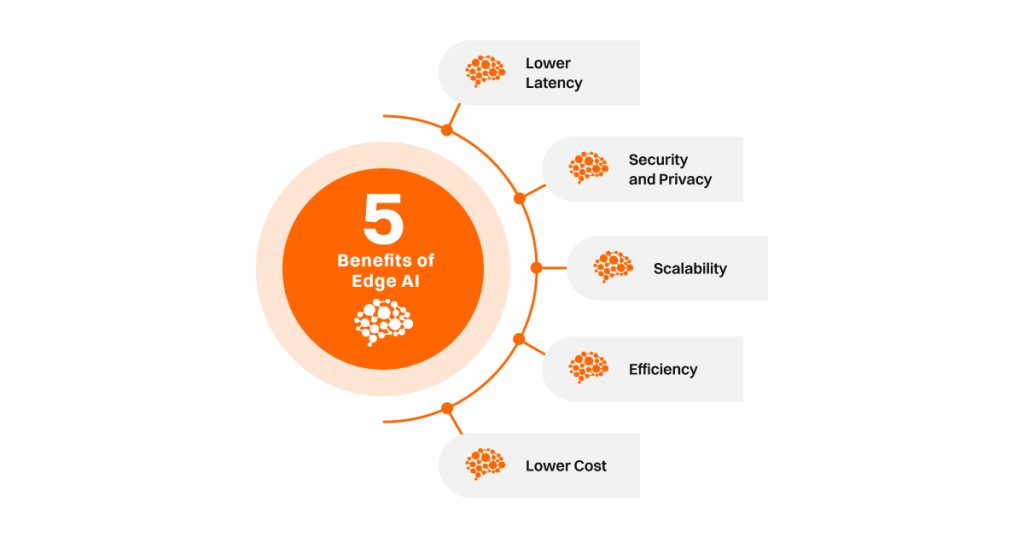
Embedding Edge AI into physical devices brings several key advantages that significantly enhance performance and user experience:

  • Reduced Latency: Local data processing cuts down latency, a game-changer for critical-response applications like autonomous vehicles and wearable IoT devices.
  • Bandwidth Efficiency: By minimizing data sent to the cloud, Edge AI conserves bandwidth and reduces the costs tied to cloud storage and communication.
  • Cost Savings: Edge computing slashes the overhead linked to cloud services by reducing the need for ongoing data transfers and storage in distant data centers.
  • Improved Reliability: With the ability to function independently of cloud connectivity, Edge AI ensures devices remain operational and reliable across various conditions.
  • Scalability 

Image: Five benefits of Edge AI

Real-World Applications of Edge AI in Physical Products


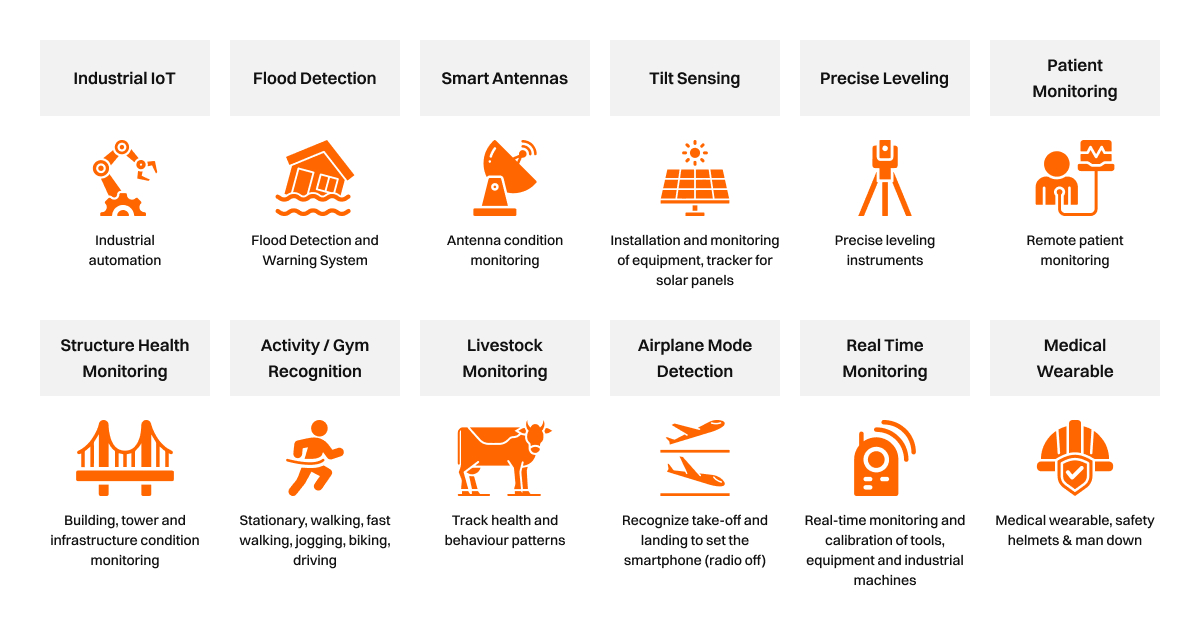
Edge AI is transforming the landscape of physical products, making them smarter and more responsive to our needs:

  • Wearable Health and Well-being: Revolutionizing the way we monitor health, Edge AI in wearables provides instant analysis of vital signs and biometric data. It extends its capabilities to monitoring the health of humans, pets, animals, and even plants, efficiently transmitting only essential information to conserve bandwidth and battery life.
  • Remote Sensors: In applications ranging from agriculture to security, Edge AI enhances the functionality of remote sensors. It enables automatic actions, like shutting off utilities during emergencies or detecting security breaches, offering rapid responses and valuable insights in real time.
  • Anomaly Detection/Preventive Maintenance: Edge AI is crucial in industrial settings for early detection of wear and potential failures. This prevents costly downtime and maintains operational efficiency. This predictive maintenance capability ensures smoother, uninterrupted industrial processes.
  • Fast Activation and Battery Saving:: Through technologies like wake word detection and gesture recognition, Edge AI improves device usability and energy efficiency. It supports a wide array of applications, from inventory management to quality control in manufacturing, by enabling quick activation and smart monitoring without excessive power use.
  • Signal Enhancement and Smart Processing: By refining and augmenting data directly on devices, Edge AI significantly enhances the quality of information derived from audio and visual inputs. This includes noise reduction, signal enhancement, and real-time content generation, like blurring backgrounds for privacy or translating spoken language instantly, making devices more versatile and user-friendly.

Image: Industries and applications of Edge AI

Examples of Industries Embracing Edge AI


Discover how Edge AI is transforming industries by integrating intelligence directly into physical products:

  • Logistics and Transport: Revolutionizing logistics with Edge AI for seamless real-time tracking and autonomous vehicle navigation, streamlining data processing for efficiency.
  • Intelligent Sports Wearables: Edge AI in sports wearables offers instant performance feedback, risk assessments, and training enhancements, leveraging sensor analytics.
  • Retail Stores: Transforming the retail experience with Edge AI for tailored recommendations, streamlined inventory management, and faster checkout processes.
  • Urban Mobility and Traffic Control: Improving traffic management and autonomous vehicle safety in urban settings with Edge AI, utilizing advanced data analytics.
  • Healthcare Devices: Edge AI plays a crucial role in wearable healthcare devices, focusing on sensor integration and efficient AI algorithms for privacy-respected real-time monitoring.
  • Consumer Electronics: Elevating user experiences in consumer electronics like smartwatches and home assistants with Edge AI, emphasizing low power use and swift processing.
  • Industrial Equipment & Manufacturing: Edge AI is reshaping manufacturing with predictive maintenance and quality control, enhancing operational efficiency and addressing integration challenges.
Cloud Computing vs. Edge AI
edge ai vs. cloud

Edge AI enables processing and decision-making at the source of data generation, offering a tailored solution for physical devices that operate with immediacy and autonomy, in contrast to Cloud Computing which relies on centralized data processing. The main benefits of using Edge AI over Cloud Computing include:

  • Latency: Edge AI minimizes the delay between data creation and action by processing information directly on the device, crucial for time-sensitive operations where even milliseconds matter.

  • Security: By processing data locally, Edge AI reduces the exposure to potential vulnerabilities that can occur during data transit to and from the cloud, thereby safeguarding sensitive information inherent in physical devices.

  • Power Efficiency: Physical devices leveraging Edge AI can operate with greater power efficiency since they don’t rely heavily on long-distance data transmission, which can be energy-intensive, thus extending the operational time of devices on a single charge.

  • Real-time Operations: For devices that need immediate response, such as autonomous vehicles or industrial automation, Edge AI ensures that real-time data is acted upon instantly without the inherent lag of cloud-based decision-making processes.

The table below compares the main features of Edge AI vs. Cloud Computing for usage with physical devices.

Features

Edge Computing

Cloud Computing

Latency

Low

High

Bandwidth Required

Low

High

Processing Power

Low

High

Storage Capacity

Low

High

Security

High: no transmission

Medium: cloud backup

Cost

Medium

High

Scalability

High: number of devices

High: Processing/storage

Context Awareness

High

Low

Power Efficiency

High

Low

Maintenance & Upgradeability

Medium

High

Where Design 1st Can Help


Navigating the complexities of Edge AI development can be daunting, but Design1st is here to streamline the process, reduce risks, and accelerate your journey to market. With over a decade of experience and a full-service team of experts, we provide a safe and efficient path to bring your Edge AI product from concept to volume production. Here’s how we can help:

  • Optimizing AI Models: Our team specializes in refining AI solutions for physical products with limited resources, ensuring optimal performance while mitigating risks associated with power consumption and processing capabilities.
  • Accelerate Your Path to Market: Leveraging our expertise and efficient processes, we expedite your product development timeline, enabling you to launch your Edge AI solution faster and stay ahead of the competition.
  • Commercialize Your R&D: We assist in commercializing your research and development efforts, helping you turn your Edge AI innovations into market-ready products quickly and efficiently.
  • Prototype Fast: Using rapid prototyping techniques, we iterate and refine prototypes swiftly, allowing you to validate your Edge AI concept and make informed decisions early in the development process.
  • End-to-End Product Development: From concept to volume production, Design1st offers comprehensive support, ensuring a smooth and successful transition from idea to market-ready solution while minimizing risks and maximizing speed to market.

What’s Next?

Edge computing is reshaping the landscape of AI, offering unique challenges and unmatched advantages. Partnerships with seasoned experts like Design1st are essential for navigating this transformative journey. Together, we unlock the full potential of edge AI, ushering in a new era of smarter, more efficient technologies. Ready to explore the possibilities? Let’s embark on this journey together.

Share

Have a new product idea?

We can help take you from idea to design, prototyping, and volume manufacturing.

27 Years Experience

75+ Design Awards

1,000+ Manufactured Products

From Idea to Prototype in as Little as Six Weeks!

Ready to Start?

Published on: April 1, 2024

Design 1st 2023 Year in Review

Design 1st 2023 Year in Review

Design 1st Completes a Successful 2023 Amidst Economic Uncertainty

The product design and development experts identified AI integration, battery innovation, edge AI hardware, and product redesign as key trends heading into 2024

January, 2023 –  Design 1st, one of the most prolific full-service product design-engineering firms across North America, completed another successful year in 2023, closing the year with 84 unique physical products designed, 26 new customers ranging from entrepreneurs, startups, to corporate, 7 products brought to market, 3 industry awards, and 2 New Product Introduction (NPI) trips to China.

The trend of strong client rentention continued in 2023 with 70% of project revenue from existing clients. 

Explore the Design 1st accomplishments of 2023 in the infographic below. (click image to enlarge):

What-Did-We-Accomplish_2023
Growth Highlights from 2023
Projects-We-Designed_2023 copy
2023 Project Breakdown by Industry and Product Type
How-Did-We-Work_2023
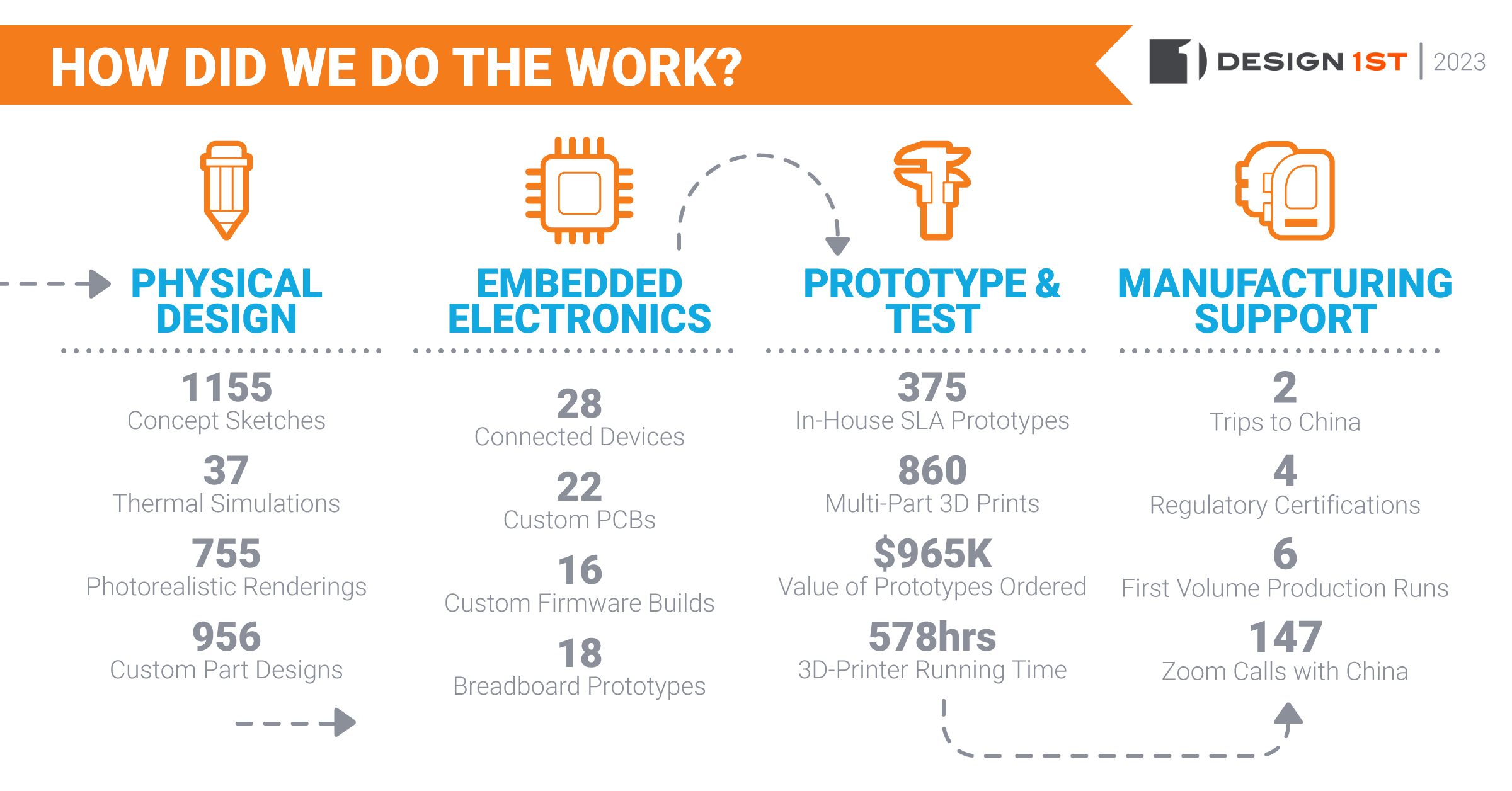
Design 1st highlights by discipline
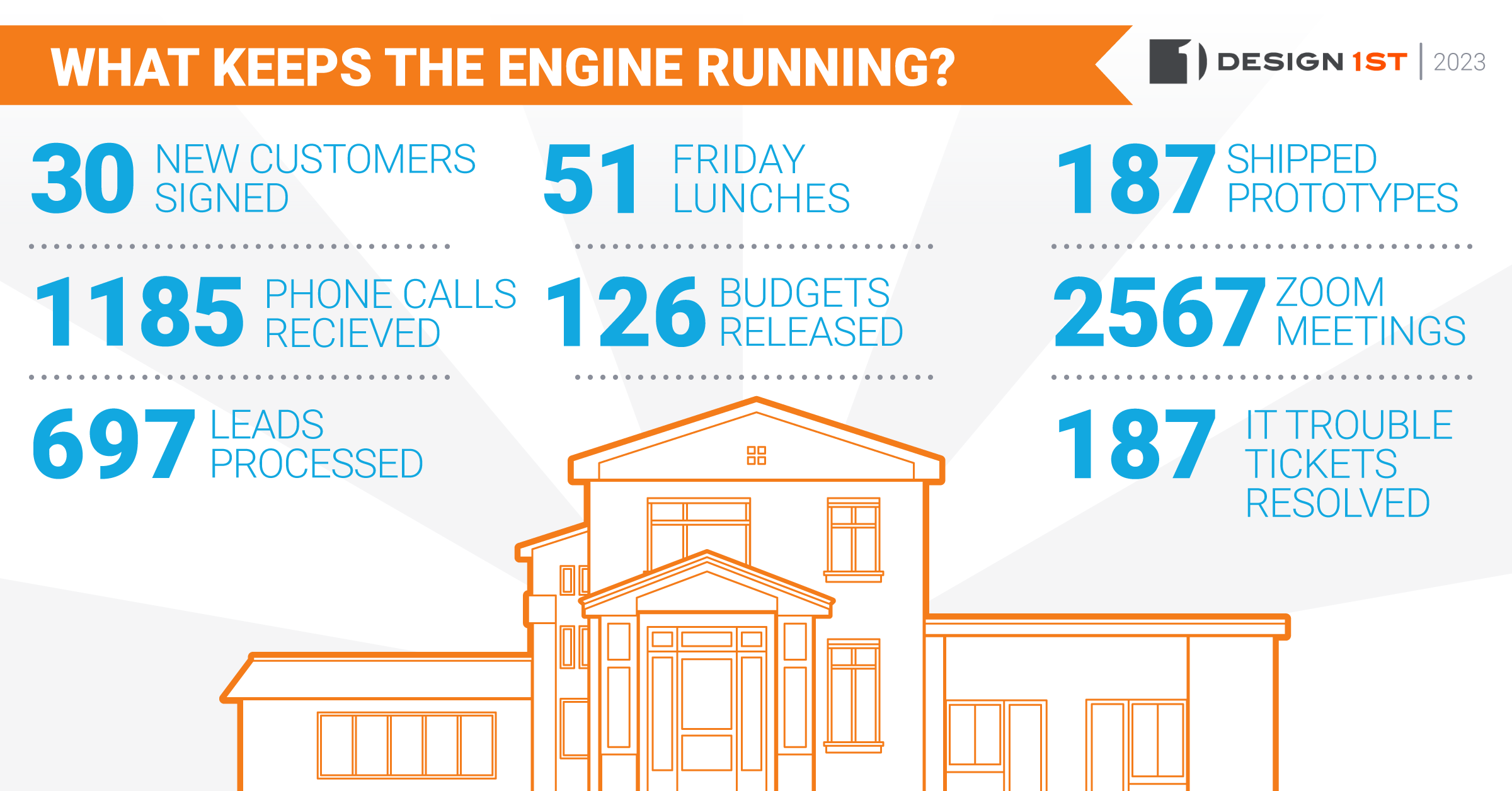
Design 1st Admin, IT, and Sales team highlights.

“These past few years have proved to be both dynamic and disruptive for the manufacturing industry,” said Kevin Bailey, CEO, Design 1st.

“Despite an unpredictable market our team at Design 1st has persevered through and positioned our clients for success during these times. We are excited for 2024, and look forward to reaching new heights.”

Project highlights for Design 1st in 2023 include:

  • 6 innovative AI Devices across consumer, medical, sports and commercial applications containing sensors and edge AI processors for on-device processing.
  • 4 projects involving electric bikes, fintech workstations, and solar charging. 
  • 4 innovative connected devices for the ‘Transport and Logistics’ industry to improve security, and safety when shipping goods.
  • 3 innovative hydroponic growing systems from unique clients across North America, hinting that the future of farming is upon us.
  • 3 Collaborative Robotics (CoBot) projects for commercial use helping human-led processes move faster, safer, and more predictable.


To learn more about Design 1st and past projects, please visit: https://portfolio.design1st.com/.

Explore Design 1st Highlights From Previous Years:

Have a new product idea?

We can help take you from idea to design, prototyping, and volume manufacturing.

Published on: January 3, 2024

Glossary of Product Design Terms

Glossary of Product Design Terms

27 Years Experience

75+ Design Awards

1,000+ Manufactured Products

From Idea to Prototype in as Little as Six Weeks!

Ready to Start?

88 Product Design Terms You Need to Know

product-design-terms

If you are designing a new product, working with a product design firm or have an interest in hardware startups – knowing your way around product design terminology is critical.

For example, exploding a  BOM – may come as shock to those who don’t know BOM stands for bill of materials, and flashing it simply means showing a list of all the components in one view!

But a quick read of the most frequently used product design-related terms below will bring you up to speed, and ensure the next design engineering meeting goes smooth.

  1. Alias
    Brand of CAD software, most often used for free-form modeling and visualization. Becoming less prevalent.
  2. Animation
    A visualization comprised of moving images, usually created from 3D CAD, which allows a ‘movie’ of the design without needing physical samples. The quality of an animation can vary dramatically depending upon the application.
  3. Anthropometrics
    Study of measurements of humans. Used to inform ergonomics.
  4. Assembly
    A collection of components that are related and have interconnections. Parts joined together form an assembly. Maybe physical, also within CAD.
  5. Backend
    The later phases of a design program, closer to manufacturing. Within some organizations some of these activities are identified as engineering.
  6. Bill of materials (BOM)
    A table containing a list of the components and the quantity of each required to produce an assembly. A costed BOM includes pricing information. An indented BOM indicates how different components and sub assemblies relate to one another and the order in which they are assembled.
  7. Brief
    Instructions and requests provided to design team prior to the commencement of a project. The format can vary and may range from informal & verbal, to comprehensive document.
  8. CAD
    Computer-aided design is software used to assist with design and documentation.
  9. CMF
    Colour, material, finish.
  10. CNC
    Computer-numerically-controlled. Refers to various machinery used to produce prototypes, tools and components.
  11. Commercialization
    Commercialization is the process or cycle of introducing a new product or production method into the market. Many technologies begin in the laboratory and are not practical for commercial use in their infancy.
  12. Component
    Part. Single, discrete element within an assembly.
  13. Concept design
    Early-stage design, not all aspects are resolved, however overall intent or direction should be apparent.
  14. Contract Manufacturer (CM)
    The external company that produces parts or products to order.
  15. Control Drawing
    2D representation of a design, used to assist production. Often used in conjunction with 3D CAD data, a control drawing can provide information such as dimensions, tolerances and notes that may not be readily obtained from 3D data alone. Also called 2D drawing, engineering drawing or technical drawings. Similar to architectural ‘plan’
  16. Design Thinking
    An approach to problem-solving based upon the methodology used by designers, but (usually) applied to other disciplines, such as business and education.
  17. Detail design
    Determining and accurately documenting all the aspects of the design, largely related to the performance and manufacture of the part. Depending upon organizational structure this work may be carried out by engineers.
  18. DIA
    Design Institute of Australia.
  19. Dimension
    Distance or measurement.
  20. Drawing
    Usually refers to a precise black and white ‘line’ image often generated in CAD within a recognized format, used for communicating technical aspects of a design. See also control drawing.
  21. Eco-design
    Design with significant consideration to the environment also called green design.
  22. E.E.
    Electrical (or electronic) engineering.
  23. Ergonomics
    Application of principles that consider the effective, safe and comfortable use of a design by humans. An example would be the design of a handle based on anthropometric data and with subsequent usability testing.
  24. Exploded view
    Visual representation of an assembly, showing some or all of the components separated to illustrate the parts and their relationships to one another.
  25. FEA
    Finite-element analysis: a computer-based engineering tool for assessing structural aspects of a mechanical design.
  26. Feasibility Study
    A feasibility study is an evaluation and analysis of the potential of a proposed project, based on extensive investigation and research to support the process of decision making.
  27. Finish
    Surface treatment of component. Maybe functional and/or cosmetic, examples include polishing, painting and anodizing.
  28. Form
    The three-dimensional equivalent of Shape.
  29. Form study
    Type of prototype used to assess the external form of the design, usually full size, often in a single colour or with minimal cosmetic finishes. The ‘clays’ used in automotive design are an example.
  30. Front end
    Preliminary stages of the design process, typically where overall configuration and desired appearance are established.
  31. General Assembly (GA)
    A drawing or CAD model illustrating all the components of a finished product and their relationship to one another. May incorporate a bill of materials (BOM).
  32. Human Factors
    A phrase largely interchangeable with ‘ergonomics’, human factors relates to consideration of human users in the design of a product and environment. Some people make a distinction that ergonomics more specifically relates to the physical association between people and products.
  33. ID
    See industrial design; also internal diameter (e.g. the distance across the hole in a donut).
  34. IDEA
    International Design Excellence Award. Presented by IDSA.
  35. Ideation
    Idea generation, typically early in a project and in a relatively loose/abstract form. Brainstorming is an ideation technique.
  36. IDSA
    Industrial Designers Society of America
  37. Illustrator
    Computer software often used for 2D design work. Also used extensively by graphic designers.
  38. Industrial Design (ID)
    A term for the profession, as in the design of industrially-produced goods. Some attribute the origin of the phrase to a Kiwi c.1920, and it has been largely misunderstood by the public ever since…
    ID is generally interchangeable with product design, though industrial design (or ID) is more often used by people ‘in the know’. When a distinction is made, it is generally that whilst there is a lot of overlap, industrial design is more focused toward the earlier stages of the design process
  39. Intellectual property (IP)
    Characteristics of a design the owner may wish to protect from unauthorized use. Strategies include trade secrets and formal, legal IP protection such as utility patents & design registration.
  40. Interface
    Elements of a product via which a user receives and inputs information. On a smartphone this may be as simple as a touchscreen and a few buttons. On a motorcycle it is far more involving, with both hands and both feet operating controls, along with visual display of information.
  41. IP
    See intellectual property.
  42. ME
    Mechanical engineering.
  43. Model (including CAD)
    Representation of a design. May refer to a physical item or a representation within computer software e.g. CAD model
  44. Mould (or mold in American-English)
    Tool used to create plastic parts. Typically made of metal.
  45. Mood board
    Collection of images gathered at the outset of a project to help clarify and communicate aspects of the aesthetic of the yet-undesigned product. Interchangeable with theme board.
  46. Native
    The file type used by a given software program during normal use (creating & saving files) Example ‘.docx’ for MS Word. Native files are often not used to transfer design data, as translation formats such as STEP offer tamper resistance, revision control and do not have the interdependence that is common with CAD data.
  47. New Product Introduction (NPI)
    New product introduction is the complete process of bringing a new product to market.
  48. Original Design Manufacturer (ODM)
    Company that designs and produces goods to be sold by other brands. The design may be initiated by the ODM or may be to meet a specification provided by a brand.
  49. Original Equipment Manufacturer (OEM)
    Contract manufacturer that produces complete, finished products. Manufactures products for other brands, (to the design and specification of those brands) which the brand then distributes. Common business model, with many brands outsourcing some or all of their production (to OEMs).
  50. Off-Tool Sample (OTS)
    Initial sample created using production tooling. Used to check design and ‘tune’ tooling prior to making production quantities. Common to have at least 2 generations of OTS (OTS1, OTS2, etc.) as first OTS will often not have cosmetic finishes applied to tool.
  51. Organic
    Describes form. Soft, irregular shapes, as occur in nature.
  52. OTS
    See off-tool sample.
  53. Part
    A single element. Some products, such as a paperclip, consist of a single part. Often a product is an assembly of multiple parts.
    PCB
    A printed circuit board (PCB) mechanically supports and electrically connects electronic components using conductive tracks, pads and other features etched from copper sheets laminated onto a non-conductive substrate. PCBs can be single sided (one copper layer), double sided (two copper layers) or multi-layer.
  54. Percentile (as in ’5th percentile’)
    Term used within ergonomics to indicate a portion of the population with regard to a particular trait. Using height for example, of a sample population 50th percentile is the mid point, 5th percentile would be the shortest 5% of people within the sample group, 95th percentile the tallest 5%.
  55. Phase
    A period within a design program that is identified as having a particular focus of activity and/or outcome.
    A project may have a user-research phase, a concept phase, etc. This term is commonly used in the US, the word ‘stage’ is largely interchangeable.
  56. Pilot Run
    An initial small production run produced as a check prior to commencing full-scale production. The pilot run provides an opportunity to further refine assembly process or identify any remaining issues with the design or manufactured parts, thereby saving time & $ in the transition to full production.
  57. Pro/E
    Brand of CAD software, subsequently named ‘Wildfire’, and now ‘Creo’ (the family of products still widely referred to as Pro/E). Well-established platform for mechanical CAD with large user base.
  58. Program
    A body of design work for a single organisation, typically involving multiple projects. Alternatively a piece of computer software, increasingly called apps or applications.
  59. Project
    A specific, defined design task. In this context often a product. May also be more narrowly defined, such as a piece of stand-alone research or a conceptual exploration used to gather knowledge without necessarily being intended for production.
  60. Proposal
    Stated approach to a design project. This is a response to a brief.
  61. Prototype
    A model made during the design process to assess aspects of the design prior to manufacture. Usually physical, but may take other forms, including on-screen or even Post-it notes. For glossary of terms relating to prototyping see separate article, (coming soon!)
  62. Quality Assurance
    Quality assurance (QA) attempts to improve and stabilize production (and associated processes) to avoid, or at least minimize, issues which lead to a product’s defects.
  63. Quality Control
    Quality control (QC) is a process in which the quality of all factors involved in production is reviewed. It emphasizes testing of products to uncover defects and reporting to those who make the decision to allow or deny product release.
  64. Quality Management Systems
    A quality management system (QMS) is a collection of business processes focused on achieving quality objectives to meet customer requirements. It is expressed as the organizational structure, policies, procedures, processes and resources needed to achieve the desired standard of quality.
  65. Rapid Prototyping (RP)
    Various technologies for producing a prototype directly from 3D CAD data which produce a result far more quickly (typically within a couple of days) than traditional model-making.
  66. Rendering
    An image of a proposed design which may be generated by various means including marker pens on paper, 2D software, or 3D CAD visualisation software. The detail provided in a rendering can range from quite abstract and suggestive to photorealistic. In layman’s terms, an ‘artist’s impression’. I have no idea why the term rendering is used…
  67. Research
    May be undertaken at different times in a project, for different reasons. Common types are user research, competitor research, and research into materials and process.
  68. Rhinoceros (Rhino)
    Brand of CAD software, tends to be used for free-form modelling and visualisation.
  69. Sample
    Item demonstrating one or more characteristics of a design. Can differ from a prototype in that a sample may represent a material or process, without necessarily being in the form of the design in progress.
  70. Scale
    A ratio of size to allow documentation of designs that are too large or small to be documented effectively at true size. For example a chair may be drawn at 1:5 scale (one fifth of full size). A scale may also refer to a ruler with graduations to easily measure scaled drawings, but this is more common in architecture.
  71. Schematic
    A structural or procedural diagram, especially of an electrical or mechanical system.
  72. Sketch
    An image that is quick to generate and does not contain complete detail. Also used as an adjective, e.g. sketch model.
  73. SolidWorks
    Brand of CAD software. Widely used platform for mechanical CAD.
  74. Stage
    See phase.
  75. STEP file
    Computer file format for cross-platform transfer of 3D CAD data.
  76. Styling Freeze
    Point in time after which no further changes to the appearance are intended. This may be implicit and not formally identified.
  77. Sub assembly
    An assembly that forms part of a larger assembly. For example the display of a smartphone.
  78. Supplier
    A company that provides goods or services relating to the item being designed, typically prototype or production components. For design the term is largely interchangeable with ‘supplier’ (though this may be debated by a procurement specialist!). Supplier is more commonly used in Australia and the UK.
  79. System Architect
    System(s) architects define the architecture of a complex system in order to fulfill the technical requirements. Such design includes a breakdown of the system in components, how these components interact together, and generally what technologies they employ.
  80. System Architecture Plan
    It is the conceptual model that defines the structure, behavior, and more views of a system. An architecture description is a formal description and representation of a system, organized in a way that supports reasoning about the structures and behaviors of the system.
  81. Theme board
    See mood board.
  82. Thermal Management
    Heat generated by electronic devices and circuitry must be dissipated to improve reliability and prevent premature failure.[1] Techniques for heat dissipation can include heatsinks and fans for air cooling, and other forms of computer cooling such as liquid cooling.
  83. Thermal Simulation
    Thermal simulation calculates the theoretical temperature and heat transfer within and between components in your design and its environment. This is an important consideration of design, as many products and material have temperature dependent properties. Product safety is also a consideration—if a product or component gets too hot, you may have to design a guard over it.
  84. Tolerance
    Dimensional variation that can occur between nominally ‘identical’ components during manufacture. Tolerance may refer to a dimensioning approach to define this, or the variation observed in parts.
  85. Tool, tooling
    Catch-all phrase for dedicated elements of manufacturing equipment used for the mass production of components. Tooling is a general term which includes molds used for injection-molded plastic parts and dies used for cast metal parts. Investment in tooling often represents a major capital expense and time component of new product development programs.
  86. User
    The person or people who will use the design. A product may have multiple users, for example ‘users’ of a piece of medical equipment may include the patient, the doctor, and technical staff.
  87. Vendor
    A company that provides goods or services relating to the item being designed, typically prototype or production components. For design the term is largely interchangeable with ‘supplier’ (though this may be debated by a procurement specialist!). Vendor is more commonly used in the US.
Share

Need Help WIth Your Product Idea?

We can help take you from idea to design, prototyping, and volume manufacturing.

Published on: July 21, 2023

Design 1st – Color Teller Connects with Stevie Wonder

Design 1st – Color Teller Connects with Stevie Wonder

27 Years Experience

75+ Design Awards

1,000+ Manufactured Products

From Idea to Prototype in as Little as Six Weeks!

Ready to Start?

“As a messenger of peace I want to encourage countries throughout the world to find ways of subsidizing technology and ways of making the world more accessible to those with disabilities.” – Stevie Wonder

Advances in technology and innovative product development have made Stevie Wonder’s message of accessible technology for the disabled – a reality. Selective material sourcing, user-centric design methods and innovative technology have all been combined to produce useful and empowering devices for the impaired.

A recent 2010 NFL Superbowl Volkswagen commercial highlighted the latest advances in technology for the visually impaired. In the ad featuring Stevie Wonder, a variety of people in different driving situations are playing “Punch Buggy”, where the first person to see a Volkswagen playfully slugs his or her friend. The twist comes when Stevie Wonder correctly identifies the color of a nearby Jetta and slugs a surprised Tracy Morgan. To find out how Stevie did it, watch here:

“Just because a man lacks the use of his eyes doesn’t mean he lacks vision.”  
– Stevie Wonder

Brytech’s Color Teller˙ provided a substitute for Stevie Wonder’s vision in the commercial allowing him to accurately determine the color of the car through the push of a button. The “Color Teller” device announces colors, shades and whether a light is on or off to the user. Design 1st was the physical product design and development team behind the product, working closely with the electronics and business team at Brytech.

Working with the blind requires designing with your eyes closed. The Design 1st team had to think blind to come up with the shape of the object that deals with getting it out of a pocket or purse, tethering the product for security, comfort in the hands and simplicity of use. Simple can be the best thing ever for those with vision disabilities ˆ a must have. To come up with the right shape a dozen shapes from wallet rectangles to long tubes were created and reviewed with a group of blind volunteers. From this feedback the final shape was determined and the complex color measuring window was developed with keys, speaker and accessible battery door that could be used without sight. The Color Teller features a single button operation that never needs to be switched off, multiple language selections, different volume levels and a talking battery monitor. Buy one at www.brytech.com

We’re proud that our partnership with Brytech brought an innovative and highly useful product to market. A product that is being recognized for its vision.

Share

Have a new product idea?

We can help take you from idea to design, prototyping, and volume manufacturing.

Published on: July 20, 2023

Ottawa Personal Trainer with a Product Idea

Ottawa Personal Trainer with a Product Idea

27 Years Experience

75+ Design Awards

1,000+ Manufactured Products

From Idea to Prototype in as Little as Six Weeks!

Ready to Start?

After meeting Guy Murray for the first time you’re guaranteed to hear at least one product idea. ThOttawa personal trainer embodies the definition of an inventor and has used his ingenuity to create several products over the years.

In early 2010, Guy came up with one product idea he knew would take more than elbow grease to bring to life. After contacting several machine shops, engineers and prototype outfits he stumbled across Design 1st online.  Quickly a meeting was set up, budget identified and a team put in place. Over the next six months the design team moved Guy from Idea through to engineering and prototyping.

The results following the early stages of product development were a finalized concept, detailed design and a  CAD rendered video showcasing the new benchpress revolution called PowerPress:

This followed with a low volume production run of the PowerPress and various product trials. The most popular trial was at the 100% Raw Bench Press Provincials in Ottawa where the PowerPress was tried out by dozens of conditioned Powerlifters. The consensus — they loved it, PowerPress was a hit.

After product trials Guy took the feedback and put together a professional commercial video detailing the mechanics, technology and benefits of the PowerPress.

Now moving into 2014 Guy is nearing the end of the product design process and is preparing to sell and distribute the PowerPress. While currently a hit at his private gym, Studio Elite Fitness – Guy  is hoping other gyms’ will have a chance to reap the benefits of his innovation.

Share

Have a new product idea?

We can help take you from idea to design, prototyping, and volume manufacturing.

Published on: July 20, 2023

Design 1st 2022 Year in Review

Design 1st 2022 Year in Review

27 Years Experience

75+ Design Awards

1,000+ Manufactured Products

From Idea to Prototype in as Little as Six Weeks!

Ready to Start?

Design 1st Achieves Record Numbers in 2022 Despite Challenging Economy


Battery innovation, sensor technology, autonomous robotics, and increasing entrepreneurship are among the growing trends happening today.


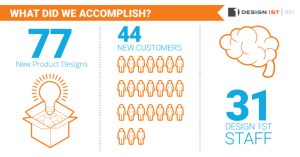
January 10, 2023 – Design 1st, one of the most prolific full-service product design-engineering firms across North America, achieved record numbers across the board in 2022, closing the year with 93 unique products developed, 44 new customers, 38 new customer projects, and 6 industry awards. Additionally, the company helped 15 unique clients complete their first volume production runs in 2022, compared to the 6 client projects launched in the previous fiscal year.

Growth Highlights from 2022
product-development-project (1)
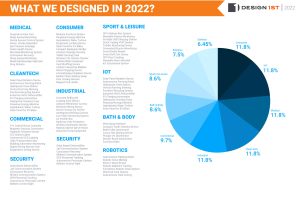
2022 Project Breakdown by Industry and Product Type

For over 25 years, Design 1st has helped guide customers, from entrepreneur to enterprise, through all stages of the product design and development process. Design 1st balances deep expertise in new tech, usability, materials, component supply and risk assessment with global manufacturing expertise and network to provide an end-to-end service. Design 1st has designed and developed over 1,000 products for a wide range of clients that influence millions of people globally.

Key highlights of the year include:
  • 200% increase in industry accolades
  • 150% growth in projects completed and launched to market
  • 45% growth in connected electronics projects
  • 78 new products in development in 2022
Client Product Awards in 2022

“These past few years have proved to be both dynamic and disruptive for the manufacturing industry,” said Kevin Bailey, CEO, Design 1st.

“Despite an unpredictable market our team at Design 1st has persevered through and positioned our clients for success during these times. We are excited for 2023, and look forward to reaching new heights.”

Product Design Trends We See in 2023:

As the world continues to acclimatize to social and economic changes caused by the pandemic, consumers and businesses look to adapt to the new trends that continue to emerge via an altered landscape. Not only did Design 1st play a pivotal role in identifying and helping companies implement these trends through an uncertain economic environment, they did so in 10 distinctive markets, expanding their reach by 43% since 2020. Some notable trends the company identified, and their solutions, are:

  • An increase in unique physical products with innovative battery configurations. As technology advances, consumer expectation increases with it. Batteries, a product typically expected to simply produce power, are now sought to be interchangeable, have a longer lifespan, and even have solar compatibilities. Design 1st helped develop products to fit these needs, such as the swappable battery designed for Levy Electric Scooter, described as the first electric scooter with a swappable battery pack, a solar power pack for electric vehicles, a USB charging station for warehouse and commercial spaces, and custom firmware of existing IoT-connected products to maximize battery life.
  • New sensor technology creating wearable innovation. Since the start of the pandemic, health has become the topic of seemingly every discussion. From respiratory, to neuro, to sleep health, Design 1st has played a role in developing a product to help make the world a healthier place. Calibre Biometrics’ wearable breathing tracker, described as the first in the world, Neurovine’s concussion recovering system, Dreamclear’s compact sleep apnea monitoring system, and Smarter Wake Up’s wearable vibrating alarm bracelet are all wearables that have received the Design 1st touch.
Benchmodel Prototype of Design Client's Headband With Sensors
  • Autonomous robotics. From self-driving cars to delivery robots, autonomous technology continues to improve at a tremendous rate. As these technologies become increasingly integrated into our everyday lives, Design 1st aims to play a large role in its development. In 2022, Design 1st helped create a robotic farming tractor and a robotic sports field turf cutter.
  • The rise of entrepreneurs. Another byproduct of the pandemic is the ascent of entrepreneurship, a trend that Design 1st has witnessed for 27 years. During times of economic turbulence, entrepreneurs shine because, rather than investing capital, they put it to use building innovative ideas and improving existing products. Design 1st experienced this firsthand in 2022, generating 780 leads, a 22% increase from the previous year, and gained 44 new customers. We’ll likely see further growth in 2023 as the economy remains unstable.
Meeting With Entrepreneurs in Design 1st Boardroom
Additional Resources

About Design 1st

Design 1st is one of the most trusted full-service product design firms across North America, with a seasoned team consisting of diverse technical expertise, over 1,000 products developed, and 130 client patents secured. From Startup to Enterprise, we enable companies to quickly scale capabilities throughout their new product development programs by leveraging our core competencies in human behavior, industrial design, mechanical engineering, electronics engineering, embedded firmware, and manufacturing setup. Design 1st’s plug-in experienced team has helped clients transform their physical ideas into commercialized hardgoods products across a variety of industries and influenced millions of people globally. For more information, please visit our website, www.design1st.com, or follow us on LinkedIn.

Media Contact:
Joan Highet
jhighet@design1st.com
+1 (613) 620-3243

Share

Have a new product idea?

We can help take you from idea to design, prototyping, and volume manufacturing.

Published on: February 27, 2023
How to Design a 250lbs Battlebot in 6 Weeks

How to Design a 250lbs Battlebot in 6 Weeks

27 Years Experience

75+ Design Awards

1,000+ Manufactured Products

From Idea to Prototype in as Little as Six Weeks!

Ready to Start?

Battlebots is an American TV series, where remote-controlled robots fight one another in a UFC arena-style elimination tournament. There are weapons, armour, hazards, and destruction. The winners drive off glorious, the losers have to be carried out.

The 2023 Battlebots season is airing now on Discover Channel!

Design 1st staff support the  product design and development of crowd favorite Battlebot, Lucky Canucky


Lucky was the brainchild of a group of robot enthusiasts which included Design 1st VP Engineering, Matthew Bailey. Matt worked alongside a team of software, electrical, and mechanical experts spread across North America to bring the robot from idea to the San Jose combat arena in under 6 weeks.

We sat down with the Lucky development team to talk about their experience prior to the show.

Here are a few topics we discussed:

  • Challenges of collaborating across 7 cities
  • How strong global supplier relationships enabled fast part delivery
  • The strategy behind Lucky’s weapons and armour
Share

Have a new product idea?

We can help take you from idea to design, prototyping, and volume manufacturing.

Published on: February 27, 2023
Product Design Predictions for 2022

Product Design Predictions for 2022

27 Years Experience

75+ Design Awards

1,000+ Manufactured Products

From Idea to Prototype in as Little as Six Weeks!

Ready to Start?


Climate change, AI and supply chain disruption among trends to heavily influence product design in the years ahead.

 
Feature Article: Design & Engineering Magazine, Winter 2022 – By Kevin Bailey

If there’s one thing we’ve learned from 2020 and 2021 it is that 2 years of unpredictability has changed how we live, work and purchase goods and services. Changes in climate, fears of inflation, global supply chain effects on availability, and a shift in the types and purchasing methods of goods and services consumers want were all contributing factors.

The question here is whether these had any effect on how new products are designed, developed and delivered to businesses and consumers.

Similar to what we saw in 2021, we’ll see technologies evolving to meet consumer demand, which will in turn result in continued shifts in the product design ecosystem throughout 2022.  The world of tech is always evolving, advancements in digital technologies, available next gen components, sensors modules, miniaturization, integration of AI into products, and new sensor choices bring a grab bag of new opportunities and risks to the design world.

For over 30 years, Design 1st has helped guide customers, from entrepreneur to enterprise, through all stages of the product design and development process.  With deep expertise in new tech, usability, component options and risk assessment, Design 1st has developed over 1,000 projects for a wide range of clients, that influence millions of people globally.

Here are predictions the Design 1st leadership team sees taking shape in 2022.

Trend #1: Climate Change

Climate changes will result in product design focus on reducing energy consumption and designing for survivability in more extreme environments

  • “Climate changes and environment conscious re-use will play a more impactful role in new product designs and product life cycles for consumers. We’ve seen legislation in Europe for the “right to repair” and I see the push for repairability gaining more steam in the US increasing product life to reduce energy consumed to produce more product replacements. However, it will be difficult to implement and continue to be so for consumers and after-market repair shops to restore data associated with a ‘connected’ smart device due to inaccessibility to the information and data privacy rights pertaining to the individual, the cloud application and product manufacturer.”  Donovan Wallace, VP, Electronics
  • “Climate change and the push for sustainability will have minimal effect on the immediate product design process. Where we will see dramatic changes is in how products are packaged and shipped. In product design, more emphasis will be placed on using materials that are sustainable and products that can be broken down back to their basic elements. More and more design teams will eliminate the use of components and materials that can’t be recycled or disposed of in a safe and sustainable” James Henderson, VP, Product Design

Trend #2: Mobile Devices Getting Smarter

Advancements in digital technologies will continue to feed the consumer appetite for smart devices and result in product design teams providing faster processing, more in-product AI, more open-source code for faster development, and requiring risk assessment of new components to ensure low-risk reliability and predictable supply.

  • The ongoing increase in functions and size shrink of silicon chips combined with advanced circuit design techniques and further combined with improved efficiencies in batteries will have a compounding effect of enhancing the ease of usability of smart devices for the consumer. Lower energy requirements in smart devices will open the door for photovoltaic renewable energy As an example, onboard and charge station solar cells will begin to play a bigger role in extending the time between charges, reducing the battery anxiety effect most pronounced in first generation IoT products. Recent door alarm sensors use photovoltaic and solar cells to extend battery life. This will lead to a broader base of on-product power consuming applications with increased data processing for smart and connected devices yet to be invented in the coming years.” Donovan Wallace, VP, Electronics

  • “The increase in digitization will continue to accelerate smarter product features at a lower cost from the competing global component manufacturers. This will propel the opportunity for product design teams to leverage these more capable component software and hardware features to help meet personalization and data collection and presentation needs of users in an increasingly mobile world. Designers will also turne to open-source software tools to help speed the development process and cut development” Yih-Shyang Tsai, VP, Embedded Software

  • “With the explosion of IoT devices comes increased network traffic and load on cloud services. Edge devices with intelligence help for the end point devices alleviates this load and provides for a faster consumer experience with greater power efficiencies. Microprocessors with TinyML support and sensors with built-in machine learning core will become more prevalent. Additionally, in 2022 AI and machine learning capabilities embedded into device power management will support greener, smarter energy consumption.” Yih-Shyang Tsai, VP, Embedded Software
  • “IoT product design is evolving wireless device interfaces using audio and visual control convenience as devices become more integrated into people’s homes and lifestyles. Larger product companies that invest heavily in cloud applications and services have been successful in selling the user experience utilizing these end point devices to give consumers a novel way to verbally access and receive data, games and entertainment from the internet (Amazon Alexa, Google home, TV media boxes and game consoles to name a couple). These devices become part of a family dynamic; they are enablers to a whole ecosystem of products that play into convenience and our isolation constraints and communal social I see the term IoT becoming more associated to an industry term for many background data entry points to the cloud and less related to device features.” James Henderson, VP, Product Design

Trend #3: Connected System-Level Products

More system products are being designed and they connect software inside physical products with the cloud. Users want experiences not devices. System products will continue to be harder to design and require diverse skills in the development teams and collaboration between cloud and device design teams.

  • “The pandemic and subsequent shift to isolation and remotely located design team members will continue to propel the use, and availability, of cloud enabled engineering tools in private and cloud managed secure servers to facilitate productive and effective team collaboration environments. I see an increase in the number of sophisticated tool vendors emerging in the market that enable companies to leverage automation and sophisticated technologies like AI in the design process to deliver even better outcomes to customers.” Donovan Wallace, VP, Electronics

  • “A challenge as we shift to a global remote workforce is designing and debugging new products where objects we build and handle lead to size, ergonomics and feature refinements that require an in-person environment with multiple skill team members to resolve. Seeing and feeling objects and engaging with them remotely using touch sensitive gloves and virtual 3D glasses environments are evolving. It will still be some time before they can equal or replace the value of in-person interaction with real products and prototypes. Teams leverage collaborative, easy to use remote tools such as Miro and Draw.io to support remote team and Client engagement, helping them to make decisions as they visualize, sift and sort options together on display screens.” Matt Bailey, VP, Engineering

Trend #4: Supply Chain Disruptions

We’ll continue to see supply chain wobbles that will require different thinking around bringing lower risk to the critical and scarce in-demand part choices during new product planning based on supply predictability instead of going for highest functionality and lowest cost.

  • “The current shortage of critical electrical components is a wakeup call – that it’s time for supplier location rethink. The upset in the balanced flow of parts and goods is having significant consequences on our design process and choices we make with Clients.  The pandemic created a dam in the flow and unpredictable delivery concerns mostly for electronics parts and in the hardware world it is not forgiving, missing one part or a raw material input means not shipping the product.  Material supply and worker disruptions mean manufacturers need additional time to catch up and re-establish good flow after being shut down intermittently. The demand for certain chips is so hot companies must decide on who gets what and large strategic contracts win out over the smaller design services teams.  Companies and design teams will continue to look at alternative supply locations and go back to producing their own critical parts locally with more vertical integration. An example of this would be Apple; they moved away from Intel as their chip supplier to produce their own micros specifically designed for their products” James Henderson, VP, Product Design

  • “With part shortages, design teams will continue to use reverse-system of picking the chips and components first based on predictable supply and select more easily replaceable parts in case supply becomes an issue in 12 months when the products launch. Teams will design the product around those identified chips and components and live with the compromised functions, speed and features that the new product will be deployed with, as it will be a better option than no product being delivered at all.” Yih-Shyang Tsai, VP, Embedded Software

  • “The manufacturing issues caused by the pandemic are affecting many manufacturer selection decisions. Cost of goods, shipping and import taxes dynamics will continue to contribute to the decision-making process as companies decide whether to manufacture a product in North America, China, Mexico or elsewhere. More US companies will select Mexico and local options due to the 25% duty on import imposed recently on China produced goods.” Dave Ingram, VP, Manufacturing

  • “We’ll see more people buy their products directly online with delivery to their homes to avoid the risks of covid impact on on Shipping delays and rising import taxes will continue to shift behaviors to  buying more goods and services locally.” Dave Ingram, VP, Manufacturing
Share

Have a new product idea?

We can help take you from idea to design, prototyping, and volume manufacturing.

Published on: February 27, 2023
How Much Do Product Design Firms Charge?

How Much Do Product Design Firms Charge?

The Three Proven Financing Models for New Product Design: Flat Fee, Hourly Fee, and Reduced Fee + Equity

When hiring a product design firm to develop your idea, understanding how they charge is critical to managing your budget. Product design firms typically use one of three financing models to help clients develop new physical products.

1. Flat Fee (Fixed Price):

The first popular finance model is a Flat Project Fee, when you have very clear inputs, specifications and requirements and well-defined outputs and expectations to design to.

This model is often favored by startups that report to investors because costs and burn rates can be predicted and locked in. But as with all physical product development where the product has innovative with new features, changes to the product definition will occur, decision on features must be tied to user value and not program cost and the effort and budget will grow.

Fix price models are best reserved for product variants where the variables that are being investigated are few and the known elements of the product make up more than 80% of the design. (Example would be a re-design of an existing product or a copycat of another product in the market where the goal is to make changes to how the product looks and the electronics and user interface are remaining substantially the same).

Use the 80% known and fixed and 20% innovative and new rule and you can find companies will to fix quote and also to not surprise you with up-charges on scope changes.

Type of Firms you can approach depending on the nature of the work: Industrial Design Consultancies, Mechanical Engineering Firms, Electronics Design Firms, Full-Service design to manufacturing firms, Manufacturers with an ODM manufacturing department.

2. Fee for Service

The second service for hire model works best for both parties when the product ideas are not defined enough where hard requirement specifications are not yet possible as and cannot be precisely specified, quantified and tested.  This is the most common partnership arrangement for outsourced physical product design where innovation and new product value requires exploration and testing of potential concepts to meet the needs of users in the new potential market segment.

Generally, there are parts of the design and engineering work that can be fixed cost and other parts that require exploration, testing and iteration to fine tune the new value.   A working model between the two parties is arrived at by separating the higher-risk exploratory elements from the more predictable parts of the work that can be fixed cost.

Rates for full-service design plus engineering companies are similar to model 1 and will range from ($100 USD up to $450 USD per hour) depending on who you hire, where they are located, what markets they serve and their track record and network they can leverage on your behalf.

You will always be able to find cheaper hourly-rates down to $25/hour by souring independent freelancers and managing them yourself, overseas companies and manufacturers that compete on initial price to gain the work then use scope creep and decision changes to drive up the fees.

Payment for this model is usually done in stages, based on milestones or monthly effort with a deposit up front to start the work.

3. Fee + Equity/Royalties:

This model is favored when your goal is to find a partner willing to commit to your idea, reduce their rates and take risk on your opportunity to drive down the initial cost of development and defer the development cost until revenue on product from sales or with equity until the company gets acquired.  There are pitfalls and opportunities with this model.   Inventors, entrepreneurs and startups have limited cash to deploy across many activities to fund. Sharing the risk and reward with the outsourced design partner has a tremendous early stage appeal.

The first challenge will be to find a reputable company to work with.  Established companies with a strong track record steer away from this model because the R&D is a short-term activity finished in under a year. If you can convince an established company you have a hit, the royalty on a successful product which can quickly turn into 3 times the development fees they would have charged.

Be wary as design firms will discount an inflated hourly rate and ask royalties.  Careful shopping to find the competitive hourly rate baseline then reducing from this level for royalties is recommended.

The downsides, many hardware startup companies go through refinancing and hard times during the startup stage and these contractual relationships become additional costly legal situations to resolve.  If the product fails then this is a great model but is it wise to go into a venture with the mindset of planning for the product to fail.  Intellectual property often gets tied up in these deals as both parties want to protect their downside failure and the IP is difficult to untangle and costly.

There are great success stories with this financing model however these stories are the exception.  Design companies know how to develop great products when the targets are specified well by the business team.   Good design helps a lot but does not make a business successful on its own, the business team will ultimately determine the success and failure of the venture.

With this equity or royalty financing model the design company is put in a situation of trying to recover their losses when things don’t go to plan (happens when designing new hardware 80% of the time).  Just when you want creative risk takers at the table to continue to invest without pay the design company has hard costs of staff to deal with and are placed in a situation set up for failure.

Which pricing model is best for you?

It comes back to carefully assessing how innovative and exploratory your new design needs to be. Are you doing incremental design with known technologies, components, and interfaces, OR will it require significant R&D and IP development? Generally, the more defined or incremental the design innovation, the better the Fee models 1 and 3 can be for a successful outcome.

It may be wise to start in fee model 2 until you have very good definition then switch to model 1 or 3 if you see advantage to do so and you find a suitable design, engineering and manufacturing company that fits your business model.

The lower the design innovation risk and the more lucrative the market the more money the R&D will cost you with fee model 3.  With products that have a good run in the market for 10 years as an example, the total cost of the R&D in fees and royalties can be more than 10 times the fee for service model.

Share

Have a new product design idea?

We can help take you from idea to design, prototyping, and volume manufacturing.

Published on: February 26, 2023

Product Design Client News

Product Design Client News

27 Years Experience

75+ Design Awards

1,000+ Manufactured Products

From Idea to Prototype in as Little as Six Weeks!

Ready to Start?


Each month we round up our favorite client news stories. These are the events, awards and announcements our clients with the world.

Highlights this month include:

– Both Cloud9 and Epiphan are launching AI-driven voice-to-text translation
– Maxar (who bought Neptec) signed contract with NASA to build a robotic arm in space
– Stratuscent was at CES2020 showing off their eNose product
– ABCA Baseball Coach-of-the-Year credits FieldTurf with Amazing season
– GeoSights releases animated video of CMS scanner

Links to content in table below:

Client Location Article Notes:
Stratuscent Montreal, QC CES 2020: Stratusecent Digital eNose Review – Video of product
– Founded in 2017, raised $4.3M
Maxar Neptec Ottawa, ON NASA’s plan to build stuff in space took its first step “Nasa is encouraging companies to assemble complex machines while zipping around in orbit”
“$142M contract with Maxar to build a robotic arm in space”
Cloud9 Tec New York, NYC Cloud 9 partners with AI-Analytics company GreenKey “Ability for Cloud9 to repurpose unstructured data from phone calls”
Epiphan Ottawa, ON Epiphan launches LiveSscrypt at ISE 2020 – image of new hardware product
– “launching real-time transcription for video”
– ” AI-based transcription enables LiveScrypt to transcribe with 85% to 90% accuracy”
ThinkRF Ottawa, ON ThinkRF launches RF Surveillance Solution – Photo of physical device
– “system includes ThinkRF R5x50 Real-Time Specturm Analyzer”
SkyX Toronto, ON SkyX CEO talks Evolution of Drone Technology (VIDEO) – “includes photo of drone landing station”
– 6min long – interesting info on SkyX background and future
Adaptaspace Calgary, ON Launches new website with feature products – new modern design and update to marketing language
– Product section featuring consoles Design 1st helped develop
GeoSights Ottawa, ON GeoSights launches new video on CMS Scanner – animation style video shows function of remote scanner
– “GeoSight CMS is the toughest scanner in mining”
Fieldturf Montreal, QC ABCA Coach Credits FieldTurf for successful season – “The turf plays just like a perfectly groomed grass field. ”
– “Griffin guided the Eagles to back-to-back Class 4A state championships in 2018 and 2019,
and he credits the installation of FieldTurf’s DoublePlay at the school in 2015”
Share

Have a new product idea?

We can help take you from idea to design, prototyping, and volume manufacturing.

Published on: February 25, 2023