• Services
  • Portfolio

Author: Design 1st

Crowdfunding Graveyard – What Killed 41 HW Projects?

Crowdfunded Products Graveyard

What Killed 41 Hardware Projects That Raised $122.5 Million and Left Consumer Backers Empty-Handed?

Estimated Reading Time:

Every crowdfunding campaign for a physical product ends one of three ways.

The first outcome is simple and most common. The campaign didn’t hit its funding goal. Disappointing, but clean. No money changes hands. Everyone moves on.

The second outcome is where the magic happens. The campaign blows past its funding goal, the product ships, backers are delighted. Platforms like Kickstarter and Indiegogo have connected millions of early adopters with innovative hardware creators. Both platforms have tightened their rules over the years, requiring working prototypes and banning photorealistic renders. The ecosystem is maturing.

But then there’s the third outcome. The campaign succeeds wildly. Funding goals are crushed by 1000%, sometimes 4000%. Tech blogs gush. Waitlists grow. And then… nothing ships.
This is the outcome nobody talks about until it’s too late. The backers lose their money, and the promising new startup fails.

We didn’t set out to investigate crowdfunding failures. We’re a product development firm. But as individuals, we’re also early adopters who’ve backed our share of projects over the years. A lunchroom conversation about crowdfunding turned into a debate about which projects actually ship. That sparked the idea.

So we dug in. Our database covers 41 high-profile failures totaling $122.5 million in backer investments and leaving over 520,000 people empty-handed.

41
Failed Projects
$122.5M
Total Raised
520K+
Backers Affected
85%
Engineering Failures

The findings surprised us. The easy assumption is that these projects were cons run by bad actors looking to fleece naive consumers. A few were. But the vast majority? 85% of failures were caused by engineering problems, not fraud.

These were passionate creators and hardware startups with great product ideas and slick videos. But they were unprepared for the realities of manufacturing and oblivious to the complexities of physical product development.

At Design 1st, we’ve spent 30 years helping innovators turn ideas into real products. We know where projects go sideways. Sometimes it’s a minor adjustment to the new idea. Sometimes the whole concept needs rethinking. Sometimes the product just isn’t viable. In all cases, creators need to know early.

That’s why we built the Crowdfunding Graveyard. A free interactive database where you can explore each of these 41 product failures, see what went wrong, and learn how to avoid the same fate.

Crowdfunding remains a legitimate path to market for hardware. But it’s an opportunity for the prepared and a nightmare for those who underestimate the complexity of physical product development.

Learn from the mistakes of others. Keep your project out of the graveyard.

Everything Right but the Shipping

It’s a sunny Monday morning in Toledo, Ohio. After fixing your first cup of coffee, you sit down to sort the morning emails. You see a message about a Kickstarter project.

“Alright!” you think, with a touch of excitement. “That gadget I backed a while ago must finally be ready to ship.”

No such luck. Instead of a shipping notification, you read an apology from the creators. They ran into major technical problems on the production line. Then they ran out of money. They have decided it’s best to walk away from the project at this point in time. You won’t be getting a refund.

In the world of crowdfunding, this is a common refrain. Items like the Coolest Cooler (which raised $13 million from 62,000 believers) or the Lily Drone ($34 million from 60,000 backers) are designed for crowdfunding video appeal rather than manufacturing. When they wind up being too complex, too expensive, or simply impossible to produce at scale, they leave tens of thousands of backers out in the cold.

We researched some of the most high-profile failed Crowdfunded hardware projects. The numbers are shocking. $122.5 million in lost investments. 520,000 disappointed backers. 41 abandoned projects.

The irony here is that by every crowdfunding metric, these campaigns were successful, and by a long shot: some exceeded fundraising goals by 4000%. Media outlets and tech magazines promoted the new innovation. Consumers paid for the promised goods and some clamored to get added to waitlists.

Then, crickets.

What too many crowdfunded projects fail to realize is this simple fact: Successful crowdfunding measures demand. It doesn’t measure deliverability. In hardware, that gap is fatal, but it’s an engineering gap, not a funding gap.

Because this is such a widespread problem, we built a free interactive database. We call it the Crowdfunding Graveyard, a compendium of failed crowdfunding hardware projects. In it, every failure is classified. Every misstep is documented so that others can learn to avoid those fatal errors.

Together, we can help product innovators learn from past mistakes. We can restore trust in crowdfunding by showing what separates shipped products from abandoned ones. And we can make sure poor product development doesn’t ruin any more Monday mornings in Toledo.

How We Built the Crowdfunded Product Graveyard

To build the database, we only looked at products that ran significant (and successful) crowdfunding campaigns. And our scope was limited to physical products only: primarily connected electronics, hardware, and consumer goods.

To be included in the Graveyard, the project needed to be successfully funded 2+ years past its initial promised delivery with either no product shipped, or a catastrophic partial ship. Our research database includes projects crowdfunded between 2011 and 2024. Our sources included the archives of prominent crowdfunding sites like Kickstarter and Indiegogo. We also looked at SEC filings, court documents, FTC actions, backer forums, and news coverage.

Most projects contained multiple product development failures.
Here are the twelve failure types we used in classifying each of the projects:

12 Product Development Failure Types

Classification system used in the Crowdfunding Graveyard database

Failure Type
Description
MANUFACTURABILITY
Design works as prototype but can't be mass-produced at viable cost or quality
SYSTEM-INTEGRATION
Individual components work but fail when combined into complete product
NO-PROTOTYPE
No working prototype existed at campaign launch despite claims
SCALE-UP
Prototype worked but production failed at volume due to yields, tolerances, or complexity
PHYSICS-IMPOSSIBLE
Core product claims violated fundamental laws of physics or thermodynamics
UNIT-ECONOMICS
Bill of materials exceeded pledge price, making profitable delivery impossible
HEAT-MANAGEMENT
Product couldn't dissipate heat safely or maintain required temperatures
SUPPLY-CHAIN
Critical components became unavailable, discontinued, or prohibitively expensive
QUALITY-CONTROL
Shipped units failed in the field due to inadequate testing or QC processes
POWER-SYSTEM
Battery life, charging, or power delivery couldn't meet product requirements
REGULATORY
Failed or never obtained required certifications (FCC, CE, UL, MFi, etc.)
BUSINESS-FAILURE
Non-engineering failure: fraud, mismanagement, market conditions, or team collapse
Engineering failure (85% of cases)
Business failure (15% of cases)

Each individual failure is based on documented evidence including engineering analyses, investigative reporting, and the creators’ own admissions. This evidence is sourced and linked within the database for maximum transparency and usability.

What We Can Learn from $100+ Million in Lost Investments
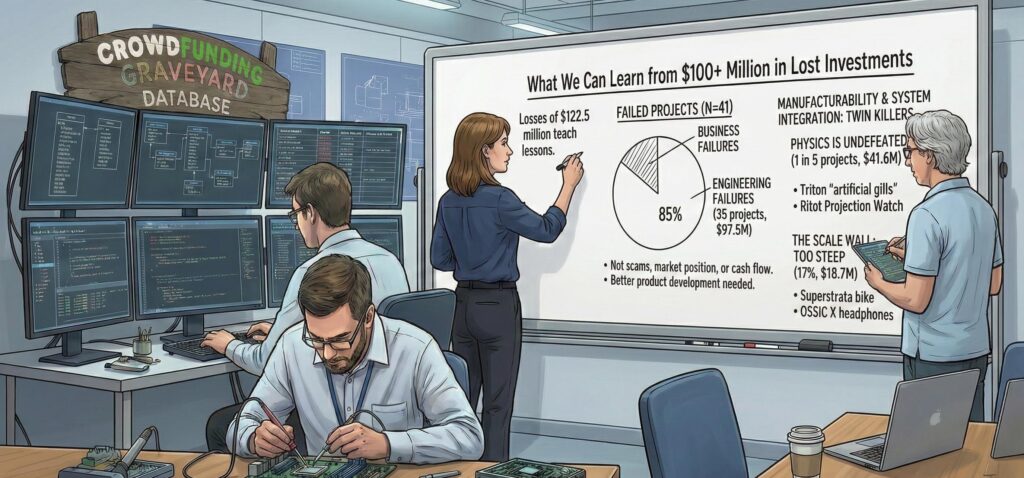
Losses of $122.5 million can teach many lessons. From our product development perspective, there were four main takeaways from the data underlying the Crowdfunding Graveyard of failed hardware projects. They are as follows:

  1. 85% were engineering failures. Not business failures.

    For students of crowdfunding crash-and-burns, this finding might be the most surprising. By a wide margin, the failed projects in our database were not scams, poorly positioned in the market, or suffering from poor cash flow. Rather, 35 of the 41 failures had identifiable engineering failures. These projects raised $97.5 million, and the reality is that while more money would not have saved them, better product development might have.
  2. Manufacturability & system integration: Twin killers.

    The most common failure types were two massive issues in product development: manufacturability (54% of failures) and system integration (49%). In the cases of manufacturability failures, these were designs that may have worked as prototypes but ran into problems on the production line, often related to scaling. With system integration, we saw cases of subsystems working individually but failing together.
  3. As backers of 1 in 5 projects discovered, physics is undefeated.

    Maybe they were overly ambitious. Maybe the creators knew the claims were impossible. But for 7 of the projects in our database, representing $41.6 million, the underlying technology was always physically impossible. And when you go up against physics, you lose every time. Triton’s “artificial gills” fit the bill here, raising $900,000 by claiming to extract oxygen from water. The Ritot Projection Watch raised even more ($1.4M) for a pico projector which could not be visible at the claimed size and angle in broad daylight. A red flag for investors should have been no working prototype at campaign launch. Slick videos don’t cut it.
  4. The scale wall remains too steep for many.

    Finally, 17% of project failures happened during production scaling. In these cases, accounting for a combined $18.7 million, prototypes may have worked, but mass production did not. Examples include a carbon fiber bike (the Superstrata) for which 3D printing production couldn’t scale to demand, and a pair of “3D audio headphones” (OSSIC X) whose production components ended up being too expensive even for the item’s $1000 price tag. The products in this category were not vaporware, but—for reasons ranging from cost to real-world constraints—the creators just couldn’t make 10,000 of them, in a serial production environment.

Where crowdfunded hardware fails most often

46%
Manufacturability
Design can't be mass-produced at viable cost
19
41%
System-Integration
Components fail when combined
17
17%
No-Prototype
No working prototype at launch
7
17%
Scale-Up
Production failed at volume
7
17%
Physics-Impossible
Claims violated laws of physics
7
15%
Unit-Economics
BOM exceeded pledge price
6
10%
Heat-Management
Thermal issues prevented function
4
7%
Supply-Chain
Critical components unavailable
3
7%
Quality-Control
Shipped units failed in field
3
7%
Power-System
Battery couldn't meet requirements
3
7%
Regulatory
Failed certifications (FCC, UL, etc.)
3
15%
Business-Failure
Fraud, mismanagement, or market
6

The 5 Product Development Disciplines You Need for True Crowdfunding Success
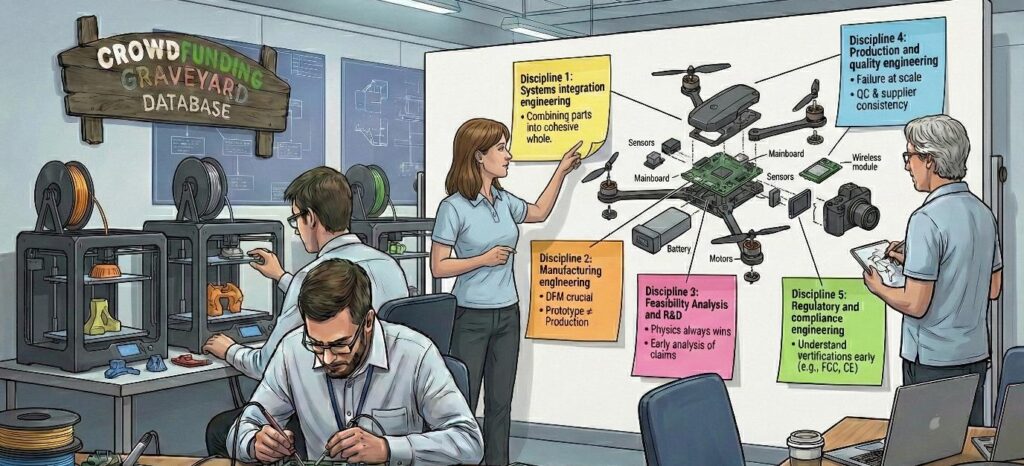
Product creators are not stupid. Rather, they were often the smartest people around in terms of their narrow specialization, whether board games, yogurt makers, or smart watches. But where they excelled in specialized intelligence, they lacked broad-based experience and expertise.

The five product development failures outlined below are stories of specialists in desperate need of experienced generalists to qualify opportunity, feasibility and risk early on.

Discipline 1: Systems integration engineering

From Silicon Valley darling to $34 million debacle

Individual parts of your product might work just fine, but combining them into a cohesive working whole requires strong systems integration engineering. This problem plagued 50% of the failures we studied.

Consider the Lily Robotics drone camera. In 2016 it was all the rage in Silicon Valley, raising $34 million in 60,000 pre-orders, along with high-profile investments from PE firms and celebrities. Within a year Lily was filing for bankruptcy and being sued for fraud by the San Francisco District Attorney.

Insider reports suggest Lily’s prototypes had basic problems such as blurry footage, a “throw-and-go” feature that did not work reliably, and software delays when the code was rewritten. These troubles were hidden in promo videos that used selective editing along with competitor devices to produce high quality drone footage.

Lily had a compelling story and components that worked in isolation. But they lacked a systems integration expert to put all the pieces together into a viable final product. As Wired noted, “there’s still something profoundly difficult about rolling out a phalanx of sleek flying drones without experience and expertise.” That is a $34 million understatement.

Discipline 2: Manufacturing engineering

How the “world’s smartest motorcycle helmet” became just another roadside distraction

Back in 2014, the Skully AR-1 was being marketed as “the world’s smartest motorcycle helmet,” earning praise from outlets like Road & Track. But despite raising $2.4 million in an Indiegogo campaign, the AR-1 never made it beyond the production of 100 units.

This company’s downfall is another story of million-dollar crowdfunding success followed by production delays and bankruptcy filing. A disgruntled employee’s lawsuit also alleged misappropriation of company funds for sports cars and strippers. Lurid details aside, the real problem for the Skully AR-1 Helmet seems to have been poor manufacturing engineering, a problem that was similarly fatal for half of all failed projects we studied.

In a 2016 letter to customers, Skully noted DFM (design for manufacturing) problems requiring a complete mainboard redesign. A few months later Skully ceased operations, leaving backers empty-handed.

As Skully and its supporters discovered, a prototype is not production. Tolerances that work at n=1 fail at n=10,000. Now that other brands of smart helmets have successfully shipped, it’s clear that Skully desperately needed a DFM review prior to the campaign launch. Or anyone in the room who’d shipped at scale before.

Discipline 3: Feasibility Analysis and R&D

You can fight with physics, but physics always wins

Certain products are simply impossible. For 22% of the projects we reviewed, the product as specified was in violation of the laws of physics. You can fight with physics, but physics wins every time. A proper feasibility analysis during the R&D phase would flag this fact from the start. Unfortunately, some products get more than a running start without subjecting their claims to such an analysis.

Take the Fontus water bottle. This concept device was created by Austrian artist Kristof Retezár. With a tagline of “never runs dry” and several slick promotional videos, the Fontus claimed to generate drinking water from solar energy and condensation at a rate of up to 1 liter per hour.

One blogger’s “back of the envelope” thermodynamics calculations showed that the claims of the Fontus were completely impossible. But that didn’t stop the device from raising $345,000 from 3,000 backers on Indiegogo—and from receiving glowing press from outlets like Business Insider and Smithsonian. In 2018, after most of the funds were gone, Fontus filed for bankruptcy.

Discipline 4: Production and quality engineering

How a 3D printer raised $3 million and still ran out of money

Your prototype works. So do the first one hundred units, giving you the greenlight to scale. But then you run into problems at unit 5,000. This sort of failure at scale can be caused by poor yield rates, quality control processes, and supplier consistency. It was a common point of failure among 19% of the cases in our database.

A prime example is the Tiko 3D Printer. Designed to be simpler and more cost-efficient than competing 3D printers, the device garnered $2.9 million from 17,000 backers on Kickstarter. But after shipping 4,000 units, buyers reported problems with stepper motor quality. Calibration broke at volume. The unibody design required custom components that made the economics unsustainable with the cost of goods at 60% of sale price.

With proper production and quality engineering expertise, test protocols should catch such failures—before they ship.

Discipline 5: Regulatory and compliance engineering

“Looking into” relevant regulations after launch is a losing strategy

The smallest failure category we detected was by no means insignificant. In 12% of cases, projects failed due to poor regulatory and compliance engineering.

One such example is ZNAPS. The Kickstarter project was a magnetic adapter for mobile phone chargers. After raising $2.3 million from 70,000 crowdfunding backers, ZNAPS became notorious for choosing not to send backers any products at all, and instead to sell directly to consumers on the company’s own website.

But while media stories focused on whether or not ZNAPS was a scam, most outlets entirely missed the larger product development failure. In their Kickstarter FAQ, the ZNAPS team noted that they were “looking into” Apple MFi (Made for iPhone) certification. They never got it.

Without the MFi designation, an accessory like the ZNAPS charger is treated by an iPhone like a potentially dangerous foreign entity, potentially resulting in error messages, battery degradation, and voiding the device’s warranty. “Looking into” relevant regulatory and compliance concerns is never a viable strategy. The regulatory roadmap must be thoroughly explored before launch.

Crowdfunding is for Demand Validation, NOT Product Development
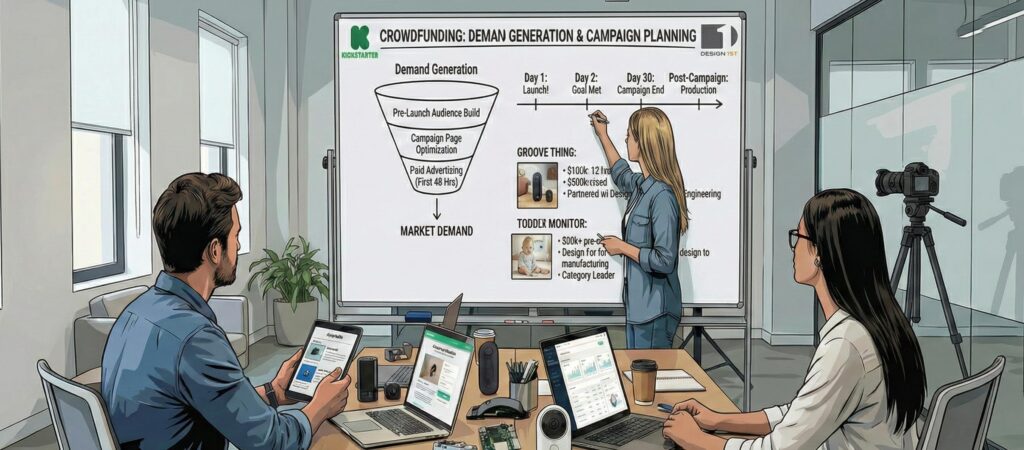
Crowdfunding platforms like Kickstarter and Indiegogo offer inventors and entrepreneurs a remarkable opportunity. They let you test market demand, validate features, and build an audience before committing to full production. The projects in the graveyard represent a small fraction of funded campaigns. Most succeed.

The difference often comes down to working with the right partners.

Crowdfunding marketing agencies specialize in building pre-launch audiences, optimizing campaign pages, and running paid advertising during the critical first 48 hours. They help generate the demand. 

Experienced physical product development firms help you meet the expectations that demand creates. They bring the engineering process, manufacturing expertise, and supply chain relationships that turn a promising prototype into a product that actually ships.

Here are two such examples.

Groove Thing

When the maker of Groove Thing, Michael Weiss-Malik, set out to create the “world’s first internal music player,” he knew he had a marketable idea. That was confirmed when Groove Thing raised $100,000 in the first 12 hours of its Kickstarter campaign, hit $110,000 by midnight, and crossed $120,000 at the 24-hour mark. With over half a million raised so far, consumers are clearly interested in a product at the intersection of high end audio and intimate toys.

But Weiss-Malik also knew that getting the product engineering right was non-negotiable, and so he partnered with Design 1st. The Ottawa-based firm has a decades-long track record in commercial product design, development, and transfer to manufacturing. Crucially, Design 1st also had direct experience developing intimate products, previously helping to develop, engineer and support manufacturing for popular products such as We-Vibe, Zumio, and vSulpt.

Groove Thing is currently moving towards volume production.

Toddler Monitor

Krista and Lisa, the two moms who created DECCO, the Toddler Monitor, had no prior experience in product manufacturing. What they had, however, was a clear problem in need of a solution: keeping tabs on toddlers trying to sneak out of their rooms during naptimes.

A Kickstarter project in 2017, the device raised over $30,000 in pre-orders. Clearly, other parents had the same problem.

No crowdfunding project wants to let down its backers with a final product that does not live up to its promises. A parenting product has additional pressure to perform, as unreliable or faulty components could compromise child safety. So Krista and Lisa turned to Design 1st for support during the design process from concept to manufacturing and commercialization. Nine years later, Toddler Monitor remains the category leader.

The (not so secret) path to success

Winning crowdfunded projects have one main thing in common: they undergo professional product development in parallel with the crowdfunding campaign launch. This means that the high level engineering, a preliminary DFM review, and a high level costing and manufacturing plan exist prior to the first backer clicking “pledge.”

As Design 1st founding CEO Kevin Bailey says, “Crowdfunding is a demand validation tool, not a product development budget. If you’re using crowdfunded backer money to figure out how to build the thing, you’re already in trouble. There are two big investments to get product shipped, the product development cost and the inventory cost to deliver the new product to your backers. A successful campaign if managed well will cover first build inventory and ship costs as first build is low batch volume (higher unit cost) and additional one time NRE costs from manufacturer.”

Whether it’s Toddler Monitor, Groove Thing, or any number of other crowdfunded projects that make it out of the concept phase and through production, the key is that they used crowdfunding to validate demand for a new product that they already knew the critical feasibility and cost attributes of, before they made the pitch and ask for money in exchange for a product to come.

Use this Pre-Launch Checklist to Keep Your Project Out of the Crowdfunding Graveyard
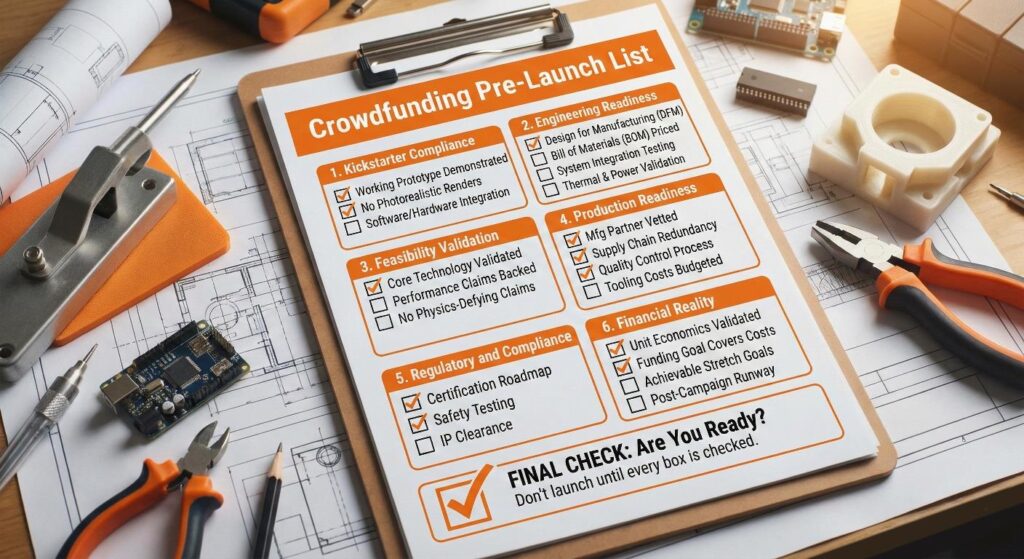
Download our Crowdfunding Pre-Launch Checklist

When we compiled our post-mortem on spectacular hardware product fails—despite crowdfunding success—we didn’t just want to catalog the mistakes. We wanted to make the failures actionable, to give you the tools to avoid the pitfalls of others.

To that end, here is your Pre-Launch Checklist. Check these boxes, and you are ready to chase crowdfunding glory. But if any of these are missing, you must first focus on product development—not fundraising.

Before you launch, ensure you can check all of these boxes:

  • Working prototype. Not just a render. You are able to demonstrate the products core functionality in person or on camera, unedited, with a model along with visuals that resemble the final production product.
  • Design for Manufacturing (DFM) assessment. Your design has been reviewed for producibility by someone with experience in manufacturing at scale.
  • Bill of materials (BOM) at volume pricing. You have manufacturer quotes at your minimum order quantity (MOQ), so you won’t run into pricing problems or unit economics at scale. Make sure to have a good estimate of what the initial low volume units you will be shipping to your backers is going to cost.
  • Integration testing is planned and evaluated for the high-risk elements of the design. All subsystems working together have been assessed by technical professionals for low-risk feasibility. Not just individually tested elements of a product.
  • Certification roadmap. You have full visibility on all the regulatory approvals needed, as well as the timelines and costs involved.
  • Thermal and power validation. Power consumption and heat dissipation are quantified by professionals to be feasible under real-world conditions.
  • Supply chain redundancy. You have backup suppliers for all critical components and if there is a sole source part you have secured the supply to it.

Meeting the requirements in each of these check boxes is essential for keeping your project out of the crowdfunding scrap pile. Time and again, as seen in our database of failed Crowdfunded physical product projects, creators skipped over one of these vital steps. Their reward? Entry into the Graveyard.

Don’t be like them. Don’t cut corners or guess your way. Your great idea deserves proper and thorough product development, from concept design and engineering all the way through prototyping to commercial production. Use this Pre-Launch Checklist to set the stage for success with your crowdfunded project.

The Graveyard Doesn’t Have to Grow

Looking at the high-profile hardware project failures in our crowdfunding graveyard database, several numbers stand out. 41 projects abandoned. $122.5 million in lost investments. And, in many cases, zero products shipped.

But the number that really stings is 520,000, representing all of the individual backers who took a chance on a poorly executed idea. These were early adopters willing to fund innovation, but their trust collided with inadequate engineering and product development process.

We had those backers in mind when we built the Crowdfunding Graveyard. Not because we’re anti-Kickstarter (crowdfunding remains a legitimate and very powerful path to market for physical products), but only if you approach your project with multi-disciplinary preparation and process. Having the right disciplines in the room on Day 1 is the difference between the graveyard and success.

We encourage you to explore the interactive database. Read about the ambitious projects and learn where they went wrong.

Additionally, if you are an aspiring creator of a physical hardware product, we urge you to use our Pre-Launch Checklist . Covering seven common pitfalls of crowdfunding project failures, it is an essential pre-launch assessment giving you a much better shot at success.

And when you run into questions and problems along the way, remember you don’t have to go it alone. Reach out to experts in product development that you can trust. After three decades of product development, consulting, and helping commercialize over 1,200 physical hardware products, Design 1st has acquired the experience to turn your product idea into reality.

Share

Need help manufacturing your product idea?

We can help take you from idea to design, prototyping, and volume manufacturing.
Published on: February 4, 2026

Design 1st 2025: Year in Review

Design 1st 2025 Year in Review

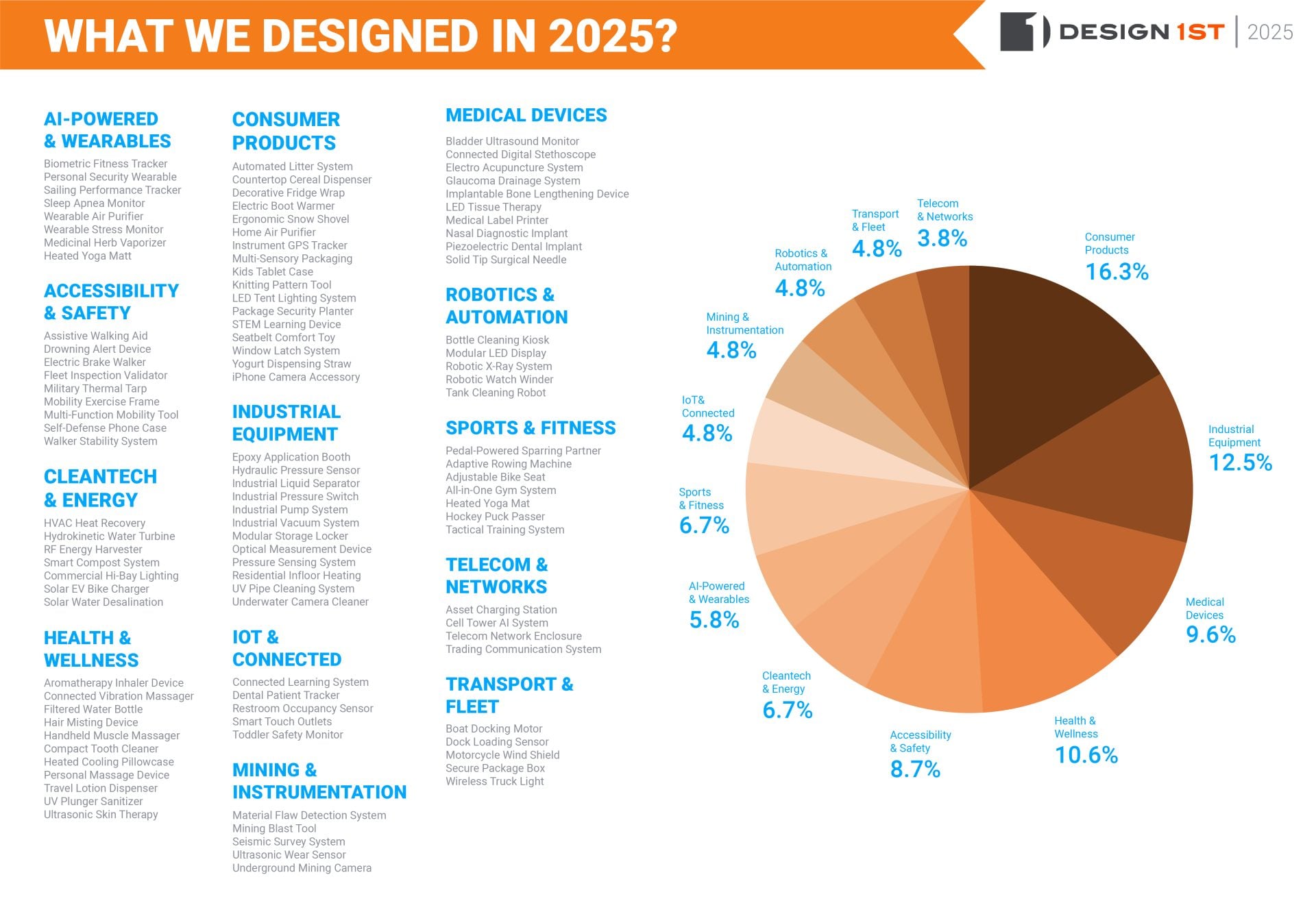
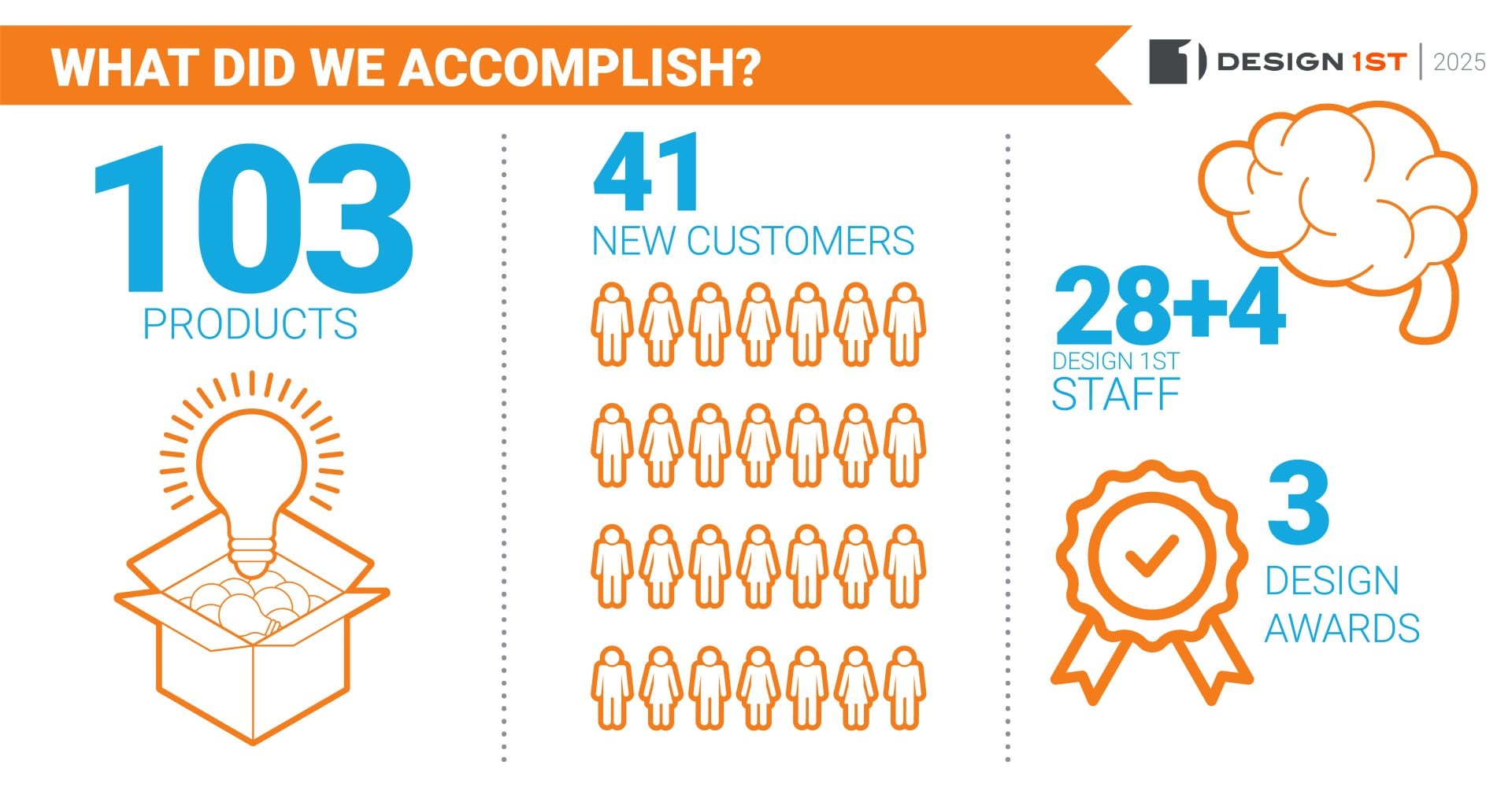
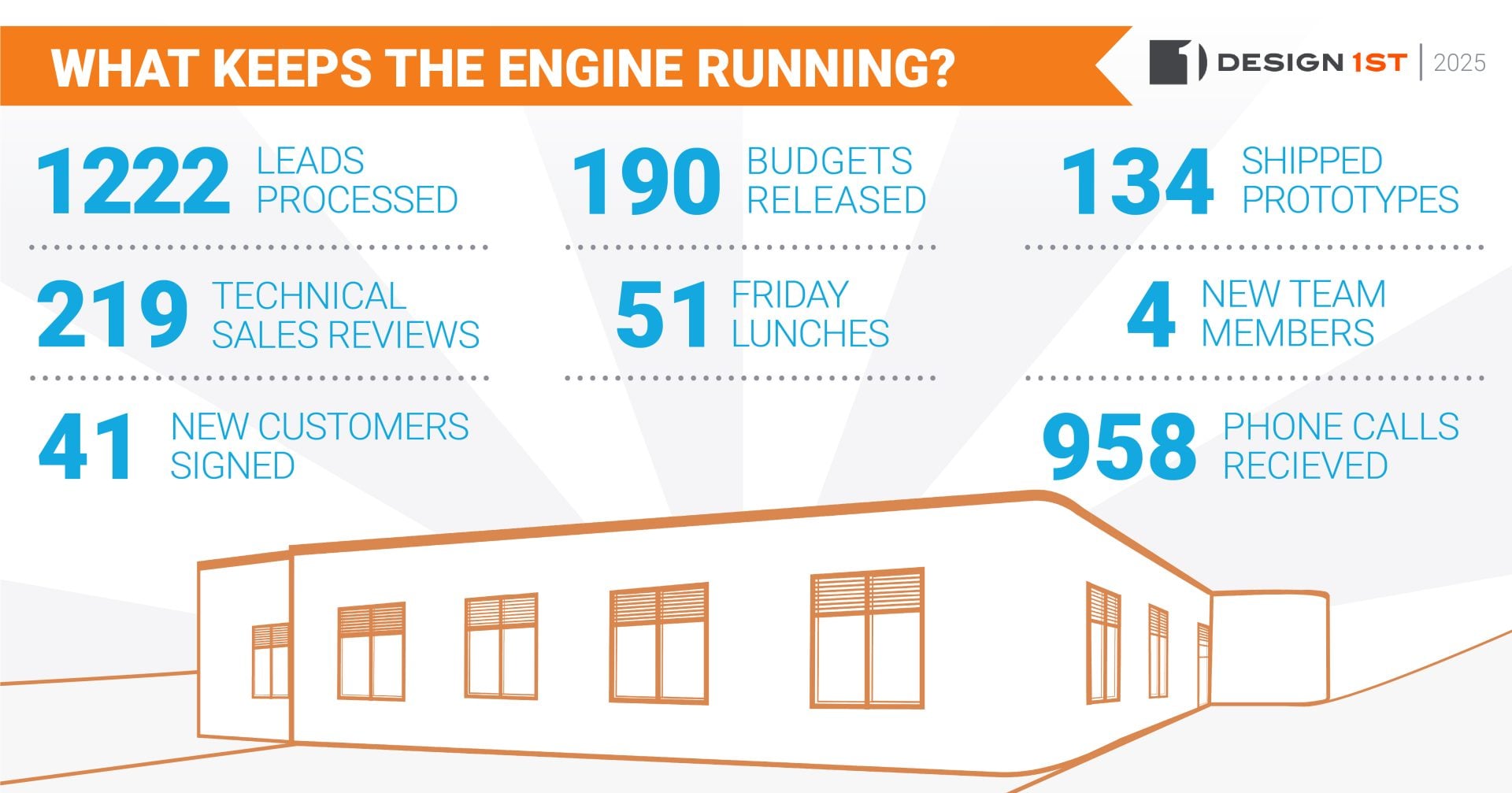
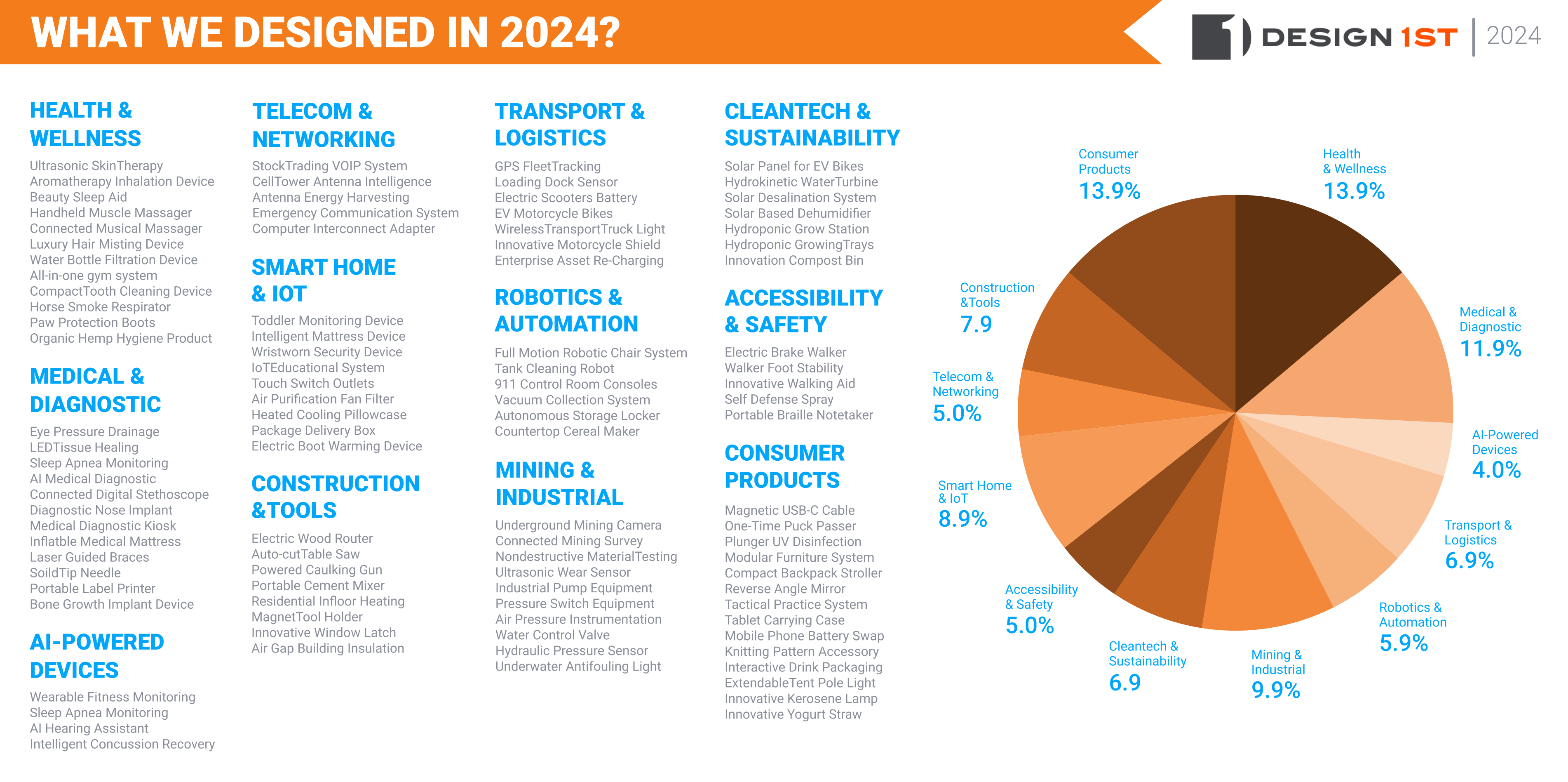
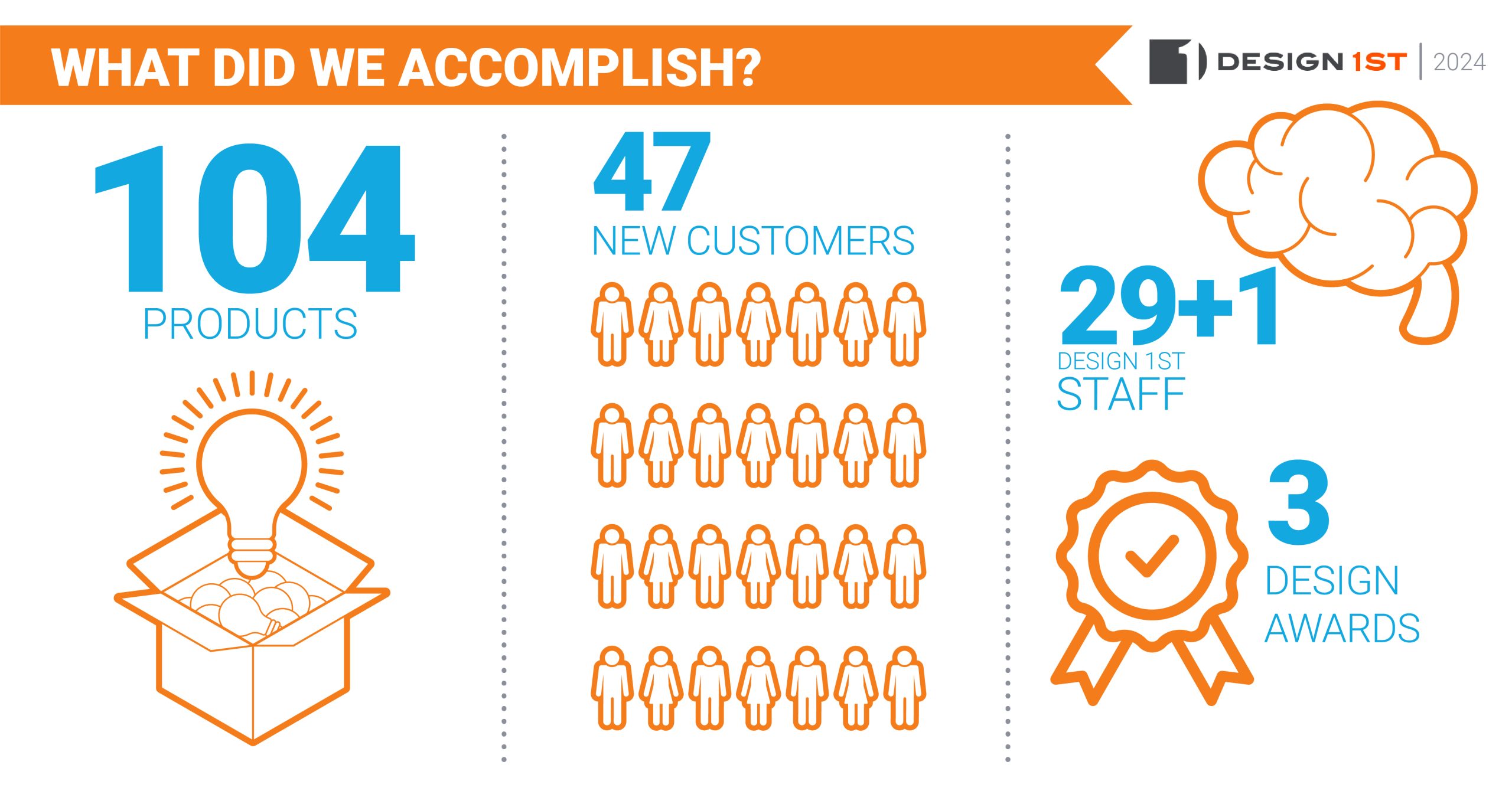
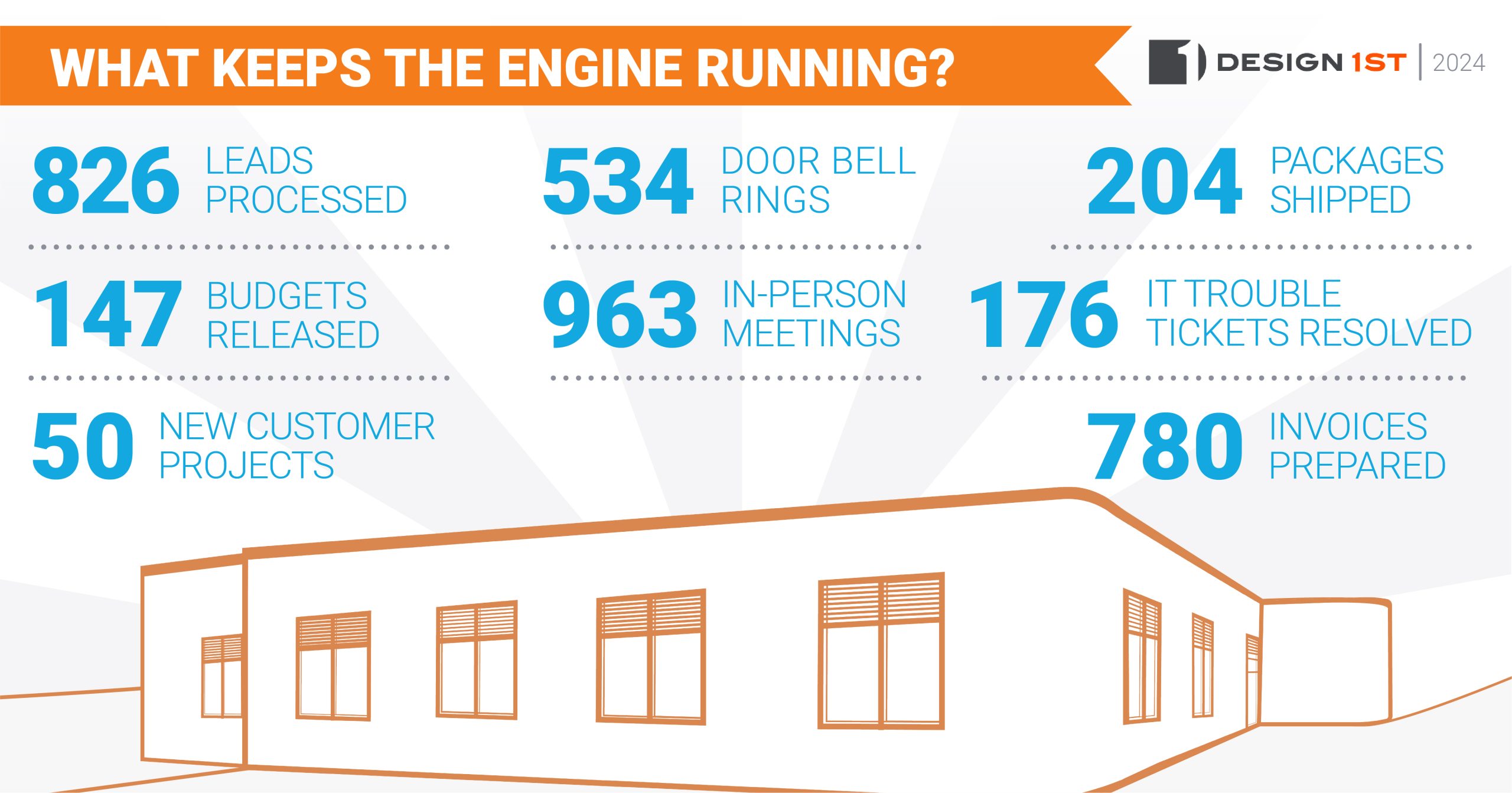
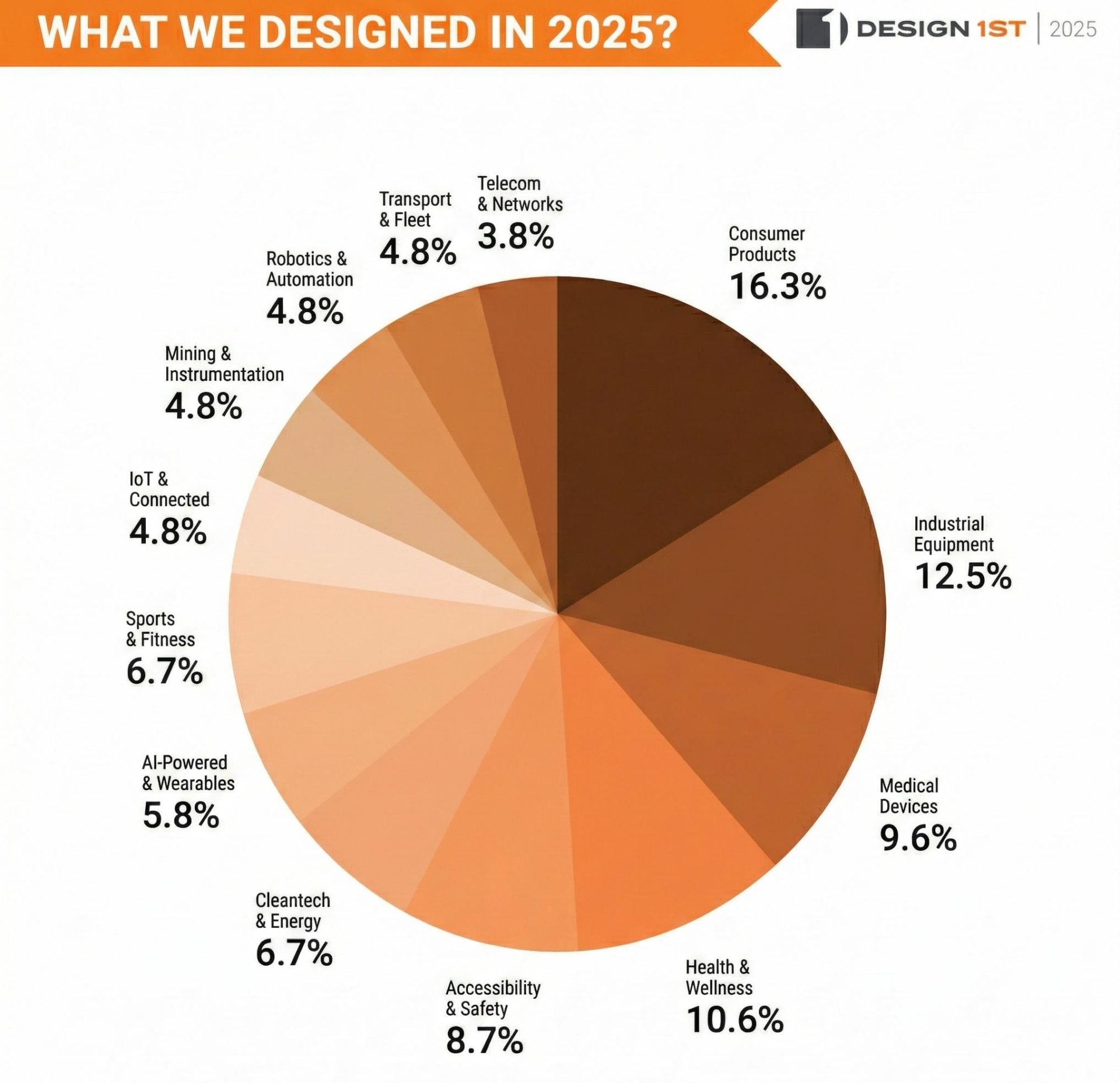
Design 1st enters its 30th year off the back of its strongest year on record, with 103 products across 16 industries and 41 new clients from North America to Australia.

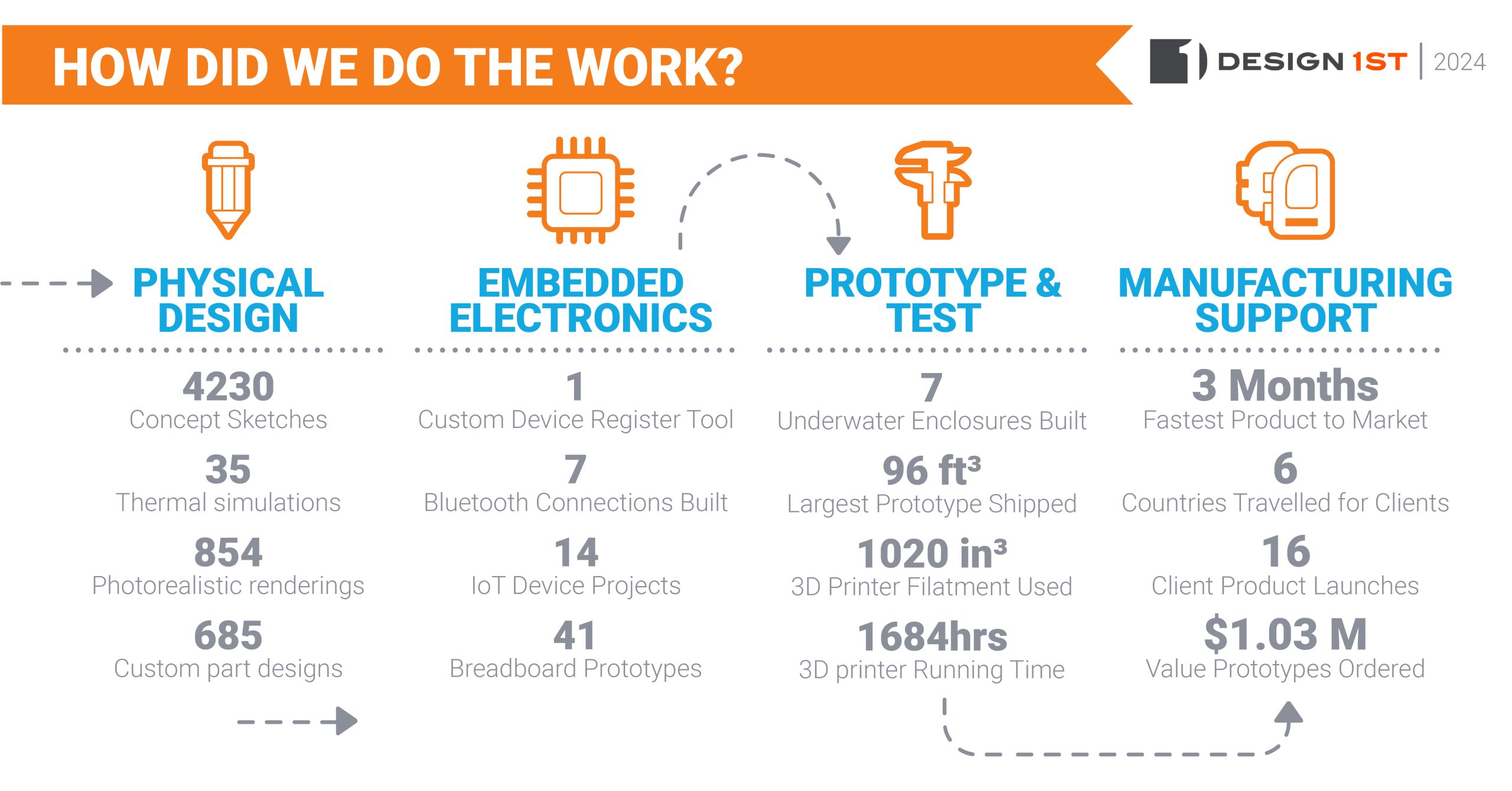
In 2025, Design 1st delivered 103 products across 16 industries for clients ranging from early-stage startups to established OEMs on six continents. The project mix reflected the full scope of what we do: consumer electronics, industrial equipment, medical devices, health and wellness, cleantech, robotics, and more.

The year brought products from concept to factory floor. SwabBot, a cobot for pharmaceutical tank cleaning, moved into production. Groove Thing went from a garage idea and a successful Kickstarter campaign to volume manufacturing. BlueKit, an IoT education platform, shipped after two years of development. And in the lab, we’re still pushing boundaries with a medical device that uses wireless power to charge an implant inside the human body.

Design 1st 2025 Company Highlights:

  • 103 products across 16 industries, meaning whatever you’re building, we’ve probably solved a similar problem before
  • 134 prototypes shipped out the door, not stuck in CAD
  • 41 new clients trusted us with their products this year
  • 34 in-house staff covering industrial design, mechanical, electronics, firmware, and manufacturing support
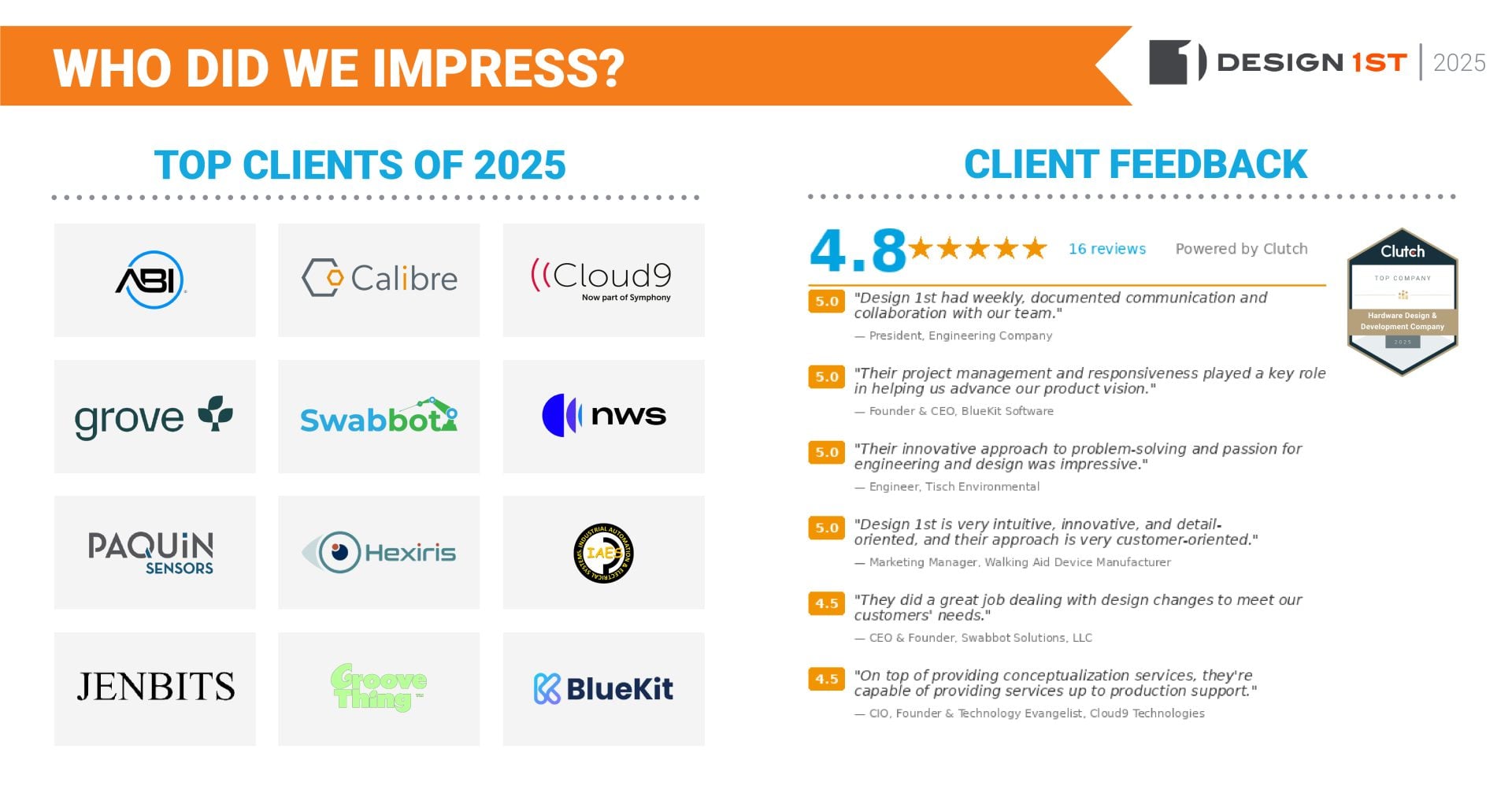
  • 4.8 stars on Clutch from clients who’ve been through it with us
  • 3 design awards

Infographics: Design project and company accomplishments in 2025

Trends and Takeaways from 2025

Three patterns showed up across 103 hardware projects this year:

  • Integration wins. AI wearables, connected medical devices, and IoT platforms dominated the mix. These products need firmware, electronics, and mechanical working together from day one, not stitched together at the end.
  • Manufacturing-first thinking. SwabBot, Groove Thing, and BlueKit all made it to production because factory floor realities shaped the design early, not after the prototype worked.
  • Cross-industry problem solving. Sensor tech from mining ends up in medical devices. Power management from cleantech solves wearables challenges. Sixteen industries worth of experience means faster solutions.

Planning a 2026 product launch? Integrate your disciplines early, design for manufacturing before you’re married to your prototype, and find a partner who’s solved similar hardware problems before.

Share

Have a new product idea?

We can help take you from idea to design, prototyping, and volume manufacturing.

More Related Resources

Published on: January 15, 2026

Hardware Product Development Trends for 2026

10 Product Development Trends for 2026, Backed by 100+ Hardware Projects

Estimated Reading Time:

Introduction

Last year at Design 1st, we worked on over 100 physical hardware projects across thirteen industries. Medical devices, consumer electronics, industrial equipment, pet tech, clean energy.

We’ve been doing product development for 30 years. What follows isn’t a forecast based on market reports. The patterns below are showing up right now in active development. Real projects. Real clients. Real engineering problems getting solved.

If you’re planning a hardware product launch in 2026, here’s what development actually looks like from inside the shop.

1. Regulatory Front-Loading

For years, compliance was the thing you figured out after the design was locked. Hire a consultant, run the tests, get the sticker. That approach is dead.

Three regulatory deadlines are converging. FDA cybersecurity guidance went final June 2025. EU Digital Product Passports standards finalized December 2025, with batteries mandatory February 2027. Right to Repair hit critical mass with five states enacted and all 50 introducing bills.

We’re seeing the shift with clients developing connected stethoscopes, bladder monitors, and implantables. Security architecture and compliance documentation now start at concept phase, not after design lock.

2. Wearables Crossing the Clinical Threshold

The FDA used to be where consumer wearables went to die. Too expensive. Too slow. Not worth the regulatory headache.

Something shifted. Samsung’s Galaxy Watch got FDA clearance for sleep apnea detection. Dexcom’s glucose monitor now integrates with the Oura Ring. CMS expanded reimbursement codes for remote physiologic monitoring in 2026.

The unlock is multi-sensor fusion. One sensor gives you consumer data. Stack multiple sensors with smart algorithms and you get prescription-grade accuracy. Our partners developing sleep apnea monitors and concussion recovery systems are building for both worlds. Consumer form factors with clinical-grade accuracy.

3. Cybersecurity-by-Design

A stat worth noting: 53% of connected medical devices have critical vulnerabilities, according to the FBI. Not minor issues. Critical.

The old approach treated security as a feature to add later. That thinking created the problem we have now. New FDA guidance makes security architecture a design-phase requirement. Threat modeling, software bills of materials, encryption standards. All documented before clearance submission.

We’re embedding security architecture at concept stage across all connected device projects. For clients building bladder monitors, connected stethoscopes, and implantables, cybersecurity decisions are part of the first engineering review. Not the last.

4. Wireless Power Goes Infrastructure

Remember when wireless charging was a gimmick? A party trick for your phone that worked half the time and overheated the other half?

That era ended. Wireless power transmission is becoming infrastructure. Room-scale charging systems, in-road EV charging, and medical implants that never need battery replacement surgery.

Medical implants are the sleeper application. Wirelessly powered implants mean no more surgeries to replace batteries. We’re working on bone lengthening devices and dental implants that draw power without wires. The engineering challenge shifted from “can we do it” to “can we do it efficiently and safely at scale.” Different problem entirely.

5. DFM-First Development

A number that should scare every product manager: 70% of manufacturing cost gets locked in during design. Not during tooling. Not during production ramp. During design.

The old model was design first, figure out manufacturing later. Run EVT. Find the problems. Fix them in DVT. Maybe do another round. That model costs months and money.

The new model brings manufacturing into the room from day one. Cloud-based tools now provide real-time feedback on manufacturability and cost drivers within CAD. Teams integrating Design for Manufacturability early are cutting entire build rounds. Single-build EVT/DVT is becoming achievable for teams willing to do the homework upfront.

6. Smart Products Beyond the Home

Smart home got all the attention for a decade. Meanwhile, smart everything else quietly became a massive opportunity.

Pet tech. Over a billion pets worldwide. More than half of all households own one. Smart collars, GPS trackers, health monitors, automated feeders. Pet owners treat animals like family and spend accordingly.

Assistive tech. The World Health Organization projects 3.5 billion people will need assistive devices by 2050. AI navigation, fall detection, drowning alerts. Features that used to require institutional equipment now fit in consumer products.

The design challenge is different than consumer electronics. Pet products get chewed. Baby products get thrown. Accessibility devices become life-critical. Durability and safety certification drive engineering decisions.

7. Manufacturing Strategy Shift

Reshoring used to be a talking point. Now it’s a line item.

Mexico is accelerating as a nearshoring hub. Dual-region sourcing is becoming standard for anyone who learned hard lessons from 2020-2022. The question shifted from “can we make it cheaper overseas” to “can we make it reliably with supply chain flexibility.”

Geography decisions now happen at design phase because they affect component selection, tooling investment, and logistics planning. Waiting until production ramp to figure out manufacturing location costs time and money. We’re setting up manufacturing across regions for clients who need both cost efficiency and supply chain resilience. The teams winning are treating manufacturing as a design partner, not a vendor to call later.

8. Cleantech Moving From R&D Lab to Production

Technologies that spent years in demonstration are finally hitting commercial deployment. Small-scale hydrokinetic turbines, solar EV charging systems, smart composting, HVAC heat recovery. Hardware engineering is catching up to climate policy timelines.

The shift isn’t about breakthrough science. The core technologies exist. The challenge is productizing them at price points that work without subsidies.

We’re working with partners on hydrokinetic turbines moving from pilot to production, solar EV chargers designed for residential installation, and thermal recovery systems for commercial buildings. The engineering focus has moved from proving concepts to solving manufacturing and installation constraints.

9. Industrial Equipment Adding Intelligent Sensors

Sensors are becoming standard in industrial equipment. Predictive maintenance, real-time monitoring, edge computing. The global pressure sensor market alone is projected to exceed $30 billion by 2032.

Industrial environments are harsh. Extreme temperatures. Vibration. Chemical exposure. Connectivity can’t come at the cost of durability.

We’re integrating sensors into hydraulic systems, industrial vacuum equipment, UV sterilization systems, and mining instrumentation. The engineering requirements go beyond adding a chip and an antenna. Sensor placement, power management, and data transmission all need to survive conditions that would destroy consumer electronics.

10. Old Products Getting Refreshed

Ground-up new builds get the headlines. But a significant portion of product development work is refreshing existing products rather than starting from scratch.

Companies are adding connectivity to proven platforms. Embedding AI capabilities into established product lines. Updating designs to meet new regulatory requirements. The economics make sense. Lower risk than new development. Existing tooling and supplier relationships. Proven market demand.

We saw a notable uptick in redesign projects through 2024 and 2025. Companies updating products for cybersecurity compliance. Adding smart features to legacy platforms. Refreshing tired designs with new manufacturing approaches. For teams facing budget pressure and timeline constraints, product refresh often delivers better ROI than starting over.

What to Watch

The pattern across all ten trends is convergence. Regulatory pressure, manufacturing economics, and technology maturity are colliding earlier in the development cycle than ever before. Decisions that used to be deferred are now irreversible after design.

For teams planning 2026 launches, three things matter most:

Compliance homework starts at concept phase. Not after design lock.

Manufacturing decisions happen during design. Not at production ramp.

Consumer expectations keep moving. Your timeline needs to account for that.

That’s not a trend. That’s the new baseline.

Share

Need help manufacturing your product idea?

We can help take you from idea to design, prototyping, and volume manufacturing.
Published on: January 15, 2026

Top 10 Crowdfunding Agencies for Hardware Startups

Top 10 Crowdfunding Agencies for Hardware Startups

Estimated Reading Time:

Assessing your Product for Specialized Crowdfunding Expertise

Crowdfunding agencies don’t all offer the same services. Each have their own specialized expertise depending on a client’s unique product development needs. Hardware products have challenges on their own that differ from software and services, and some can take advantage of crowdfunding to the product development process. Some factors to consider when researching crowdfunding agencies are:

Complexity of product design and engineering

Not all crowdfunding agencies offer consulting regarding the prototyping and design stage of your product. Crowdfunding campaigns sometimes fail due to hardware products that are launched too early with little design revision on a product. Additionally, not all crowdfunding agencies come with an all-in-one package that can assist you in the early product development stage such as prototyping, patenting, and design.

Manufacturing and supply chain resource

It is critical to maintain clear communication with a manufacturer that best suits your needs, as missteps can delay production and output defective products. There are also complexities to overseas manufacturing, such as time zone differences, language barriers, shipping, and quality assurance. Most crowdfunding agencies do not offer manufacturing, product design, and supply chain expertise. They focus on the marketing and funding, so the option is to have a product design and manufacturing partner such as Design 1st that can secure and handle all of the product design process prior to campaign launch, as well as the large-scale development and manufacturing for the consumers after funding has been met through the crowdfunding agency.

Regulations, compliance, and certification

Hardware products require compliance with electrical, safety, or environmental regulations before they can enter a market. Some crowdfunding agencies can help navigate certifications such as CE, FCC, or RoHS, to efficiently market your product and ensure they are safe for public consumer use.

Initial investment and budget management

Crowdfunding agencies have different fee setups, and it is important to assess how much funds you must secure up front for processes such as product manufacturing or digital marketing. Some agencies also offer no fee upfront, but with interest depending on how well your product campaign goes. Crowdfunding consulting can help plan realistic funding goals, hidden costs, and budgeting.

Marketing to consumer, and demand analysis

A lot of crowdfunded campaigns fail due to poor digital and ecommerce marketing, or a lack of demand for your product in the market. Some crowdfunding agencies specialize in digital marketing, with some even owning their own professional studio for video and photo content. When researching an agency, assess whether your product needs additional marketing consulting for a successful crowdfunding campaign.

Risk management and backer fulfillment challenges

Some crowdfunding agencies can offer risk management, including planning realistic timelines and transparency in communication with backers. If you want a campaign that promises unique rewards for your backers, and being able to fulfill those rewards, there are crowdfunding agencies that are specialized in backer fulfillment and managing reward delivery risk.

Top 10 Crowdfunding Agencies for Hardware Startups

1. LaunchBoom

  • Specialization: While Kickstarter specializes in campaigns that already have a working prototype and a solid marketing strategy, LaunchBoom is where someone can go for help in pre-launch strategy for their product, no prototype needed. They’ve raised millions for home, tech, hotel, and game products.
  • Notable Campaigns:
    – Lomi, an instant composting home tech product, $7.2M raised
    – The Crooked Moon, a DND horror campaign game, $4M raised
  • Services Offered:
    – Free lessons in how to successfully launch your product campaign
    – Pre-launch strategy expertise for Indiegogo and Kickstarter launches

  • Pricing Model: They have a few different options ranging from $4,000 to $12,000 depending on product category and level of support, founder-friendly plans available.
     
  • Success Stats: In 2024, LaunchBoom claims a 97.83% campaign success rate for their Kickstarter and Indiegogo projects, and raising over $175 million across nearly 1,000+ campaigns.
  • Unique Differentiator: They are a team of crowdfunding experts that started in crowdfunding, have first-hand experience of the process, and know the steps to a successful product launch.

  • Best For:  If you want to ensure a successful crowdfunding campaign for your home, tech, outdoor, hotel, or game product, where a crowdfunding expert can help you through the process.

2. Jellop

  • Specialization: Jellop specializes in promotion strategies to market current Kickstarter campaigns. They help product creators by running ad campaigns on Reddit, Google, Meta, and email.
  • Notable Campaigns:
    – Peak Design Travel Tripod, $12.1M raised
    – Roller Pro Carry-On Luggage, $12.9M raised
  • Services Offered:
    – Digital advertising and email marketing for Kickstarter campaigns
    – Product launch analytic expertise

  • Pricing Model: Performance-based compensation, where they charge a starting percentage of 15% from the success of your campaign based on their marketing efforts.
     
  • Success Stats: Jellop is Kickstarter’s first and only official advertising partner, and claims to have helped over 7,000 creators raise over $1.4B on Kickstarter.
  • Unique Differentiator: Jellop helps your ongoing campaign without any minimum fees.

  • Best For: Boosting a current Kickstarter campaign, getting the word out about your product through marketing strategies.

3. Funded Today

  • Specialization:  Similar to Jellop, Funded Today specializes in performance-driven marketing, and boosting crowdfunding for hardware startups.
  • Notable Campaigns:
    – Wearhaus Arc, raised an additional $200k with less than 10 days left
    – FreeWavs, raised an additional $25k with 100 hours left
  • Services Offered:
    – Campaign and page design, video production, social media marketing
    – Data analytics, ROI optimization

  • Pricing Model: Funded Today charges 35% of the campaign’s total earnings, with no upfront payment required.
     
  • Success Stats: They are notorious for being selective with which projects they partner with, with only 10% of applicants being accepted.
  • Unique Differentiator: Cash-back program for backers (10% return). They don’t accept payment unless your project gets funded.

  • Best For: Electronics, wearables, robotics, tech accessory projects looking for early-stage or ongoing funding acceleration in Kickstarter or Indiegogo.

4. Eventys Partners

  • Specialization: US-based agency specializing in product development, crowdfunding, and ecommerce marketing for new hardware products and consumer goods.
  • Notable Campaigns:
    – MCON, 6,813% funded, raising $1.7M
    – DEUX Float 2.0, 3,001% funded, raising $450k
  • Services Offered:
    – Industrial design, prototyping, and engineering
    – Sourcing and manufacturing
    – Crowdfunding campaign strategy and digital marketing
    – Amazon and ecommerce launch and management


  • Pricing Model: Typically charges between $70-$150 an hour, the market average for US industry product development. Campaign-specific costs (such as video production) are often quoted at $10-20k or more, depending on requirements.
     
  • Success Stats: Several campaigns have exceeded initial goals by 2000% or more. Over 2500 hardware products developed, prototyped, or marketed.
  • Unique Differentiator: Vertically-integrated approach, covering everything product development to product launch, from patent fillings, engineering, manufacturing, crowdfunding, and long-term product growth.


  • Best For: Early and growth-stage hardware startups, especially those needing support in prototyping and mass production, as well as navigation of crowdfunding and online sales.

5. Agency 2.0

  • Specialization: Crowdfunding marketing agency specializing in end-to-end Kickstarter and Indiegogo campaigns for tech startups and hardware products.
  • Notable Campaigns:
    – Micro Drone 3.0: Raised $3.6M with 32,367 backers
    – Sonders Ebike: Top 3 funded ebike of all-time, $7.4M raised
  • Services Offered:
    – 200+ step dedicated campaign management
    – PR and media outreach for crowdfunding
    – Full-service digital and ecommerce marketing
    – Post-campaign retail support

  • Pricing Model: Typically starts at $5,000 per project for campaign management, with additional fees for services like video production and advertising depending on scope.
     
  • Success Stats: Known for multiple multimillion-dollar hardware launches. 500+ campaigns launched with more than 20 exceeding $1M each.
  • Unique Differentiator: Their 200+ step approach covering every aspect of tech and hardware product startup such from pre-launch to post-campaign growth.

  • Best For: Early and growth-stage tech products or innovative hardware products looking for standout success on Kickstarter or Indiegogo. Especially valuable for teams needing comprehensive campaign direction and creative services.

6. Rainfactory

  • Specialization: Data-driven crowdfunding marketing agency specializing in launching and scaling tech-forward hardware and lifestyle brands, particularly on platforms like Kickstarter and Indiegogo.
  • Notable Campaigns:
    – Screeneo U5: Raised over $4 million on Indiegogo.
    – Jibo, the family robot: Raised $3.66 million.
  • Services Offered:
    – Lead generation site development
    – Marketing strategy on key platforms (Facebook, IG, TikTok, Google, YouTube)
    – Influencer outreach and PR
    – Product launch and post-campaign strategy

  • Pricing Model: Starts with lead generation services from about $1,000 and full campaigns often allocate 10–20% of funding goals for marketing efforts. Projects often range in the $70,000 to $200,000 bracket depending on scope.
     
  • Success Stats: Rainfactory claims over $1 billion generated for clients overall, with year-over-year revenue growth. Over 30 campaigns raising $1M or more.
  • Unique Differentiator: Methodical, data-driven approach to campaign development that tests product market fit and demand. Their advertising expertise is tech-focused, using real-time data for optimization.

  • Best For: US-based hardware and lifestyle startups seeking a structured go-to-market plan. They excel with premium gadgets, fitness tech, and innovative consumer products.

7. Crowdfund Capital Advisors

  • Specialization: CCA is a consulting and investment banking firm specializing in equity crowdfunding, connecting startups with investors through Regulation Crowdfunding (Reg. CF), Regulation A+, and traditional venture capital. They provide advisory services for campaign preparation, investor relations, securities compliance, and funding strategy.
  • Notable Campaigns:
    – The Micro 3D Printer: Raised $3.5M.
    – Olive Max Hearing Aid & Earbuds: Raised $530K+
  • Services Offered:
    – Equity crowdfunding strategy and investor relations and communications
    – Campaign preparation, marketing guidance, and product security
    – Capital structure and fundraising consultation


  • Pricing Model: Not explicitly public but generally includes retainer fees combined with success-based fees on funds raised, typical of investment banking and crowdfunding advisory firms.
     
  • Success Stats: CCA reports over 500 campaigns funded via equity crowdfunding under their advisory, with aggregated capital of several hundred million dollars in commitments, primarily within the U.S. startup ecosystem.
  • Unique Differentiator: One of the first equity crowdfunding advisory firms with deep expertise in U.S. securities regulations. They combine legal, financial, and marketing advisory to help startups, including hardware firms, navigate complex compliance while maximizing capital raised through innovative investor channels.


  • Best For: Hardware startups seeking to raise capital through equity crowdfunding and require comprehensive compliance, regulatory navigation, and investor relations support as part of a strategic fundraising plan.

8. Presslabs

  • Specialization: Not a crowdfunding or hardware campaign agency, Presslabs specializes in managed WordPress hosting focused on publishers and complex website setups.
  • Notable Campaigns:
    Freshome: Presslabs has supported Freshome for over eight years, providing custom infrastructure for fast page loading, caching, 100% uptime, security, and scalability to handle large growth and traffic spikes
    CultofMac.com: Experienced significant improvement in hosting stability and performance after moving to Presslabs, as they had issues with previous hosting providers.
  • Services Offered:
    – Managed WordPress hosting, support, and Intelligence dashboard for analytics
    – Git-based development and staging environments
    – CDN for media content


  • Pricing Model: Plans start at approximately $299 per month for publishers and $1,999+ for enterprise usage, with additional fees based on page views.
     
  • Success Stats: Hosts over 400 WordPress sites with excellent uptime and performance; well-regarded for reliability and support.
  • Unique Differentiator: Combines enterprise hosting infrastructure with deep WordPress expertise, offering superior performance and developer-focused workflows.

  • Best For: Digital publishers, media companies, and enterprises needing scalable, reliable WordPress hosting. Not suitable for hardware startups or crowdfunding campaigns.

9. Command Partners

  • Specialization: Digital marketing agency now focused on TikTok Shop sales and strategy, now for kitchen products. It merged with Enventys in 2016 forming Enventys Partners.
  • Notable Campaigns:
    – Bunch O Balloons: Nearly $1 million raised, one of the top crowdfunding campaigns actively marketed by Command Partners pre-merger.
    Alcove: Marketing and product support through Enventys Partners, successfully validating product-market fit and campaign impressions.
  • Services Offered:
    – Kitchen product specific product marketing and services for TikTok Shop
    – TikTok Management from content to ads to influencer partnership


  • Pricing Model: Not publicly available but you can book a free strategy call.
     
  • Success Stats: Hosts over 400 WordPress sites with excellent uptime and performance; well-regarded for reliability and support.
  • Unique Differentiator: Command Partners claims to make your kitchen product the next viral and bestseller product on TikTok, which is the #1 sales channel for kitchen products currently.


  • Best For: Kitchen products looking to optimize their TikTok shop, create and promote content related to your product, and scale revenue fast.

10. BackerKit (Launch Services)

  • Specialization: Creator-centric, comprehensive crowdfunding platform designed to help campaign creators plan, launch, and optimize crowdfunding campaigns, especially in the hardware and tabletop gaming sectors.
  • Notable Campaigns:
    – Lay Waste Games: Ran 5 campaigns and raised over $622K on Kickstarter, with nearly 10,000 backers surveyed via BackerKit, and around 31% of backers purchasing add-ons through BackerKit’s pledge management system.
    – Mantic Games: A UK-based tabletop game company that has run 5 campaigns with BackerKit, raising over $3.4 million across those campaigns. They are one of Europe’s most funded companies on Kickstarter.
  • Services Offered:
    – Custom teaser and launch party pages with interactive tools
    – Live streaming integration (Twitch, YouTube, Moonbeam)
    – Pre-launch reservation system to boost early pledges
    – Polls, achievements (stretch goals), incentives for early and repeat backers
    – Cross-collaboration campaigns, realtime Kickstarter data insights, and post-campaign management

  • Pricing Model: Offers free account creation and teaser page customization to start, with tiered pricing and specific fees based on campaign scope and size.
     
  • Success Stats: BackerKit boasts a project success rate more than double the industry average. They have managed pledge fulfillment for roughly a quarter of all Kickstarter campaign volume in recent years and have helped creators raise tens to hundreds of millions of dollars collectively.
  • Unique Differentiator: Merges campaign hosting, pre-launch audience building, pledge management, and fulfillment into one seamless experience. Their innovative Collab-Funding feature enables multiple creators to team up on campaigns for cross-promotion and shared rewards.

  • Best For: Hardware startups, gaming, and creators who want an all-in-one crowdfunding solution and support from pre-launch outreach through post-campaign. Particularly strong for repeat creators building fan communities and for campaigns that want to leverage collaborative and incentivized backer engagement.

Red Flags, Scams, and How to Avoid Bad Crowdfunding Agencies

Red flag #1: Lack of Transparency and History

Avoid crowdfunding agencies that have little to no information about their business history, credentials, and information about their team. It is crucial to research the agency’s reputation through multiple independent reviews and user forums. Make sure that the campaigns featured on their website also include more recent successful product campaigns. Confirm the agency’s business registration, credentials, social media, and look through multiple detailed case studies of their successful campaigns.

Red flag #2: Vague Costs and Funding Information

Crowdfunding agencies should have clear and complete information about their campaigns, budgeting process, and how funds are distributed. Though each product is unique with their funding and budgeting needs, there shouldn’t be vague or missing information about how a company typically helps fund successful campaigns. Incomplete information and lack of transparency in your consultation can mean there might be hidden costs.

Red flag #3: Unrealistic Promises and Goals

Campaign fraud is where agencies mislead potential clients about their reach and capabilities. Look out for some signs such as a lack of, or over-exaggeration of real campaign metrics. A crowdfunding agency with no clear plan, and evasion of answering specific questions about their process – while promising you high returns with minimal risk, should be determining factors that the agency is a fraud. To avoid this, make sure they can provide real evidence of previous clients’ success stats, performance data, and actual funding spend.

Red flag #4: Over-reliance in Urgent Messaging

A common tactic for scams in crowdfunding agencies is that they will make a potential client feel urgent in their need for crowdfunding help, thus they will feel rushed and sign with an agency immediately. Another red flag is the over-exaggeration of their selective process, with coercive, emotional language such as “you won’t get another chance to talk with us” or “we took the time to speak with you”. Crowdfunding agencies should have open communication and availability.

Red flag #5: Failure to Answer Specific Questions

Crowdfunding scams and fraud rely on you having a passive and inattentive approach to researching and understanding how an agency works. It is critical to ask many details about their crowdfunding plan and how their specialization can help your own unique hardware product. If they cannot provide real data of successful performance stats, and are evasive to your questions, it is a sign of fraud. Thoroughly research the company through third-party websites, independent forums, and social media.

Share

Need help manufacturing your product idea?

We can help take you from idea to design, prototyping, and volume manufacturing.

Published on: October 4, 2025

Best AI Tools for Hardware Startups and Physical Product Development

20 AI Tools to Accelerate Your Path from Product Idea to Market

AI is revolutionizing how inventors and startups transform ideas into market-ready physical products, this curated list puts that power in your hands.

These tools represent the most accessible AI solutions for hardware entrepreneurs on limited budgets. From CAD automation to supply chain optimization, they’re specifically filtered for physical product creators who need practical, affordable solutions that work.

We’ve tested several ourselves; others come highly recommended by the startup hardware community. 

Updated January 2026

# Name Description Category Main URL
1 Design 1st – Product Development Planning Tools   Suite of planning tools: generate accurate product development budgets, search global funding sources (grants, VCs, accelerators), and create product requirement documents with AI-generated concept sketches. Product Planning   planning.design1st.com
2 DraftAid Converts 3D CAD models into manufacturing-ready 2D drawings with one click. Eliminates hours of manual drafting work and reduces drawing errors. CAD Automation   draftaid.io
3 Adam Type what you want to build in plain English and get a parametric 3D CAD model in seconds. Adjust dimensions with sliders and export STL files for prototyping. Text-to-CAD adam.new
4 Zoo.dev Text-to-CAD Open-source text-to-CAD that generates editable engineering-grade files you can import into SolidWorks, Fusion 360, or other CAD tools. Free tier available. CAD Generation zoo.dev
5 Leo AI Mechanical engineering copilot that answers technical questions, runs calculations, and searches 120M+ parts to find the right components for your design. Engineering Support getleo.ai
6 Midjourney Generate photorealistic product visualizations and concept art from text descriptions. Ideal for pitch decks, crowdfunding campaigns, and early-stage ideation. Visual Concepting midjourney.com
7 DALL-E Create product mockups, packaging concepts, and marketing visuals through simple text prompts. Integrates with ChatGPT for iterative design refinement. Visual Mockups openai.com/dall-e
8 SimScale Cloud-based simulation platform for CFD, FEA, and thermal analysis. Run complex physics simulations in your browser without expensive hardware or software. Digital Prototyping simscale.com
9 MaterialsZone AI platform that predicts material properties and suggests optimal formulations, cutting trial-and-error experimentation by up to 90%. Materials Selection materials.zone
10 Polymerize Predicts polymer and formulation performance before you mix a single batch. Evaluates millions of combinations in seconds to find optimal recipes. Materials Optimization polymerize.io
11 Flux Browser-based PCB design tool with AI that generates schematics, selects components, and routes your board. Includes real-time pricing and availability data. Electronics Design   flux.ai
12 CELUS Describe your electronics requirements and get complete schematics and BOMs in under an hour. Searches 600M+ components to find the best-fit parts. Component Selection celus.io
13 Smartex Computer vision system that detects textile defects in real-time during manufacturing, stopping the machine before waste is produced. Quality Control smartex.ai
14 Nextmv APIs for optimizing delivery routes, production schedules, and resource allocation. Solve complex logistics problems with a few lines of code. Production Planning nextmv.io
15 PhysicsX Run physics simulations up to a million times faster than traditional methods. Test aerodynamics, stress analysis, and thermal performance in seconds instead of hours. Simulation physicsx.ai
16 Miro AI Visual collaboration workspace with AI that clusters ideas, generates summaries, and helps remote teams brainstorm and plan product roadmaps together. Ideation & Planning miro.com
17 Maze Run user tests and surveys, then let AI analyze responses to surface patterns and insights. Validate product concepts before investing in development. User Research maze.co
18 ProtoPie Create high-fidelity interactive prototypes that feel like real products—no coding required. Test on actual devices and get stakeholder feedback early. Prototyping protopie.io
19 Whimsical AI-assisted diagramming for flowcharts, wireframes, and mind maps. Quickly visualize product architecture and user flows. Planning whimsical.com
20 CalcForge Free, open-source engineering calculators for beams, trusses, foundations, and more. Run structural and mechanical calculations without expensive software. Engineering Calculations calcforge.com

Disclaimer: The AI tools listed here are shared for educational and exploratory use only. They may change without notice and come with no warranty of accuracy, suitability, or compliance. Always consult qualified technical, legal, and financial professionals before relying on any tool for significant business decisions.

Published on: July 7, 2025

10 AI Prompts to Validate Your Product Idea

10 AI Prompts to Validate Your Hardware Product Idea

Estimated Reading Time:

AI is already helping thousands of software founders move faster—but most hardware entrepreneurs get stuck asking ChatGPT the wrong questions. If you’re developing a physical product, vague prompts won’t cut it.

You need targeted, battle-tested prompts that mimic a seasoned hardware strategist, so you can validate your idea fast and avoid costly missteps.

This guide gives you 10 high-impact prompts across product strategy, design, tech stack, and go-to-market—ready to copy, paste, and run in your favorite LLM (our top choice is Claude).

How to Use These Prompts

Just copy a prompt, replace [INSERT PRODUCT IDEA] with your specific product, and paste it into your preferred AI (Claude, ChatGPT, Gemini, or Perplexity). Be specific about your product idea (what it is, target audiece, how it works) to get richer results.

1. Product-Market Fit Assessment for Hardware

Output You’ll Get: Strategic product definition with market validation framework

				
					You are a senior hard-tech VC and former Fitbit design engineer (10 + yrs validating connected-hardware PMF). For **[PRODUCT IDEA]** deliver the analysis in *this exact structure*:  
### 1. Hardware Problem Definition (75–100 words)  
Explain the physical-world pain point, why software/legacy hardware fails, and quantify market scale.  
### 2. MVP Feature Table  
| Feature | Impl. Complexity (1-5) | Validation Method | Success Metric |  
|---|---|---|---|  
| (3-5 rows) |  
### 3. Customer Segments (ranked by hardware value perception)  
1. **Segment 1** – demographics · costly workaround · WTP · channel  
2. **Segment 2** – …  
3. **Segment 3** – …  
### 4. Feature Prioritization Matrix  
* **Must-Have (High Value/Low Complexity):** …  
* **Strategic Differentiators (High Value/High Complexity):** …  
* **Nice-to-Have (Low Value/Low Complexity):** …  
* **Avoid (Low Value/High Complexity):** …  
### 5. Critical Physical Constraints  
* **Power/Thermal** – battery life, charging, heat dissipation  
* **Manufacturing** – lead times, MOQs, assembly, certifications  
* **Form Factor** – size/weight, materials, environment  
### 6. Market Timing Factors  
Component cost/availability trends · competitor cycles & patents · regulatory shifts · consumer adoption curves · supply-chain readiness  
### 7. Key PMF Assumption  
“We believe **<Segment>** will pay **<Price>** for **<Hardware Capability>** because **<Value Hypothesis>**. We’ll validate via **<Test Method>** within **<Timeframe>**.”  
**Output Requirements**: Executive Summary ≤75 words with go/no-go; sections 1–7 exactly as formatted; Next Steps – precisely 3 validation experiments with timelines; ≥2 comparable product references; use quantitative estimates and address counter-arguments.


2. Competitive Technical Benchmarking & Feature Strategy

Output You’ll Get: Technical competitive analysis with feature roadmap recommendations

				
					You are a senior hard-tech engineer (15 + yrs in component sourcing, manufacturing-cost optimisation, and tech road-mapping). For **[PRODUCT IDEA]** targeting **[TARGET MARKET]** deliver analysis in this exact structure:  
### 1. Competitive Spec Matrix  
| Competitor | Key Component | Performance | Manufacturing | Est. BOM Cost | Retail Price |  
|---|---|---|---|---|---|  
| (5-7 products with model numbers) |  
### 2. Cost-Performance Ranking  
* Rank competitors by value delivered.  
* Identify primary cost drivers, volume advantages, and over-engineered features adding cost without value.  
### 3. Technical Gap Analysis  
| Feature Category | Market Need (1-5) | Competitor Coverage | Opportunity Level |  
|---|---|---|---|  
| (6-8 key categories) |  
### 4. Supply Chain Vulnerabilities (top 3 competitors)  
* **Single-source risks:** critical components with limited suppliers  
* **Manufacturing advantages:** exclusive relationships or vertical integration  
* **Scaling limitations:** architectural constraints at volume  
### 5. Critical Technical Decisions  
1. **Decision 1** – trade-offs · market impact · validation · timeline  
2. **Decision 2** – …  
3. **Decision 3** – …  
**Output Requirements:** Executive Summary ≤150 words with differentiation recommendation; include part numbers/suppliers where known; provide BOM cost estimates for all competitors; finish with 3 technical validation steps + timelines; use quantitative metrics throughout.


3. Hardware Business Model & Unit Economics Validation

Output You’ll Get: Business model framework with realistic unit economics

				
					You are a hardtech strategist who formerly led the Product Strategy team at Flextronics and now work as a VC focused on early-stage hardware startups. You specialize in identifying scalable business models and financial risk patterns in physical product ventures.  
Analyze [INSERT PRODUCT IDEA] targeting [INSERT TARGET MARKET] across the following areas:  
1. Business Model Comparison — Compare five models: Direct Sales, Licensing, Subscription, Platform, and Hybrid. For each, assess: revenue structure, fit for the product, buyer behavior alignment, and implementation complexity (rated 1–5). Recommend the most scalable model with a short rationale.  
2. Unit Economics Breakdown — At early-stage volumes (1K–10K units), estimate: material cost per unit [$], manufacturing overhead [$], fulfillment/logistics [$], channel margins [$], CAC (Customer Acquisition Cost) [$], post-sale support cost [$], target selling price [$], expected gross margin [%].  
3. Volume-Driven Financial Shifts — Show how costs and margins change with scale: Volume: 100, 1K, 10K, 100K. For each, fill in: Unit Cost [$], Gross Margin [%], Break-even (Y/N), Working Capital [$].  
4. Revenue Evolution — Map how the business model adapts over time: Launch (0–1K units), Growth (1K–10K), Scale (10K+). Include pricing, monetization strategy, and margin expansion.  
5. Capital Requirements — Estimate hardware-specific financial needs: inventory investment [$], tooling amortization [$ and timeline], cash flow timing (payment terms vs production), and peak working capital [$].  
6. Market Adoption Scenarios — Model optimistic, realistic, and pessimistic paths with: Year 1 and 2 units, revenue impact [$], and margin impact [%].  
7. Business Model Risk Analysis — Identify 3 risks that could break the model. For each: define the risk, impact, and mitigation plan.  
Output Requirements: Executive summary (≤150 words) recommending a business model. Use concrete dollar amounts and margin estimates. Focus on decisions that shape development scope and funding needs. End with 3 validation experiments to test key financial assumptions.


4. Technical Feasibility &  Risk Assessment

Output You’ll Get: Top technical challenges of your product idea and impact on budget and development timeline.

				
					You are a VC hardware strategist and former VP of Engineering with experience bringing over 200 physical products from concept to mass production. Your role is to help inventors assess whether their hardware idea is technically viable and what to watch out for early.  
For [INSERT PRODUCT IDEA], provide a simplified technical feasibility and risk assessment that includes:  

1. Top 3 Technical Challenges — Identify the biggest technical hurdles based on the product concept. Rank them by difficulty and likelihood of resolution. Include what engineering roles are needed to solve them.  

2. Key Component Risks — Flag any critical parts likely to cause issues with availability, lead time, or cost. Suggest alternate approaches or fallback options.  

3. Manufacturing Red Flags — Call out major concerns with how the product might be built: tooling complexity, assembly difficulty, or risks scaling from prototype to production.  

4. Required Certifications — List any known standards (UL, FCC, CE, etc.) the product might need, and how they could affect timeline or cost.  

5. Architecture Options — If there are multiple ways to build the product, briefly outline 2 options with trade-offs in complexity, power use, cost, or speed to market.  

Output Requirements:  
- Give a 2-sentence technical verdict on feasibility: “Buildable” vs. “High-risk”  
- Highlight the 1 technical decision that will most affect cost or development time  
- Recommend 2 early experiments or research tasks to de-risk the project before hiring a team


5. Go-to-Market [GTM] Strategy for Physical Product Idea

Output You’ll Get: GTM strategy with channel partner requirements and timeline

				
					You are a hardtech go-to-market strategist with experience launching 50+ physical products from concept through early market entry. Your job is to help inventors at the idea stage build a realistic, design-informed GTM plan.  
For [INSERT PRODUCT IDEA] targeting [INSERT TARGET MARKET], develop a first-stage go-to-market strategy that includes:  
1. Launch Channel Strategy — Recommend the most viable first channel (DTC, retail, B2B, or hybrid) based on expected price point, purchase behavior, sales support needs, and market familiarity with the product category.  
2. Buyer Journey Map — Outline the key steps your first customer will take from awareness to purchase. Highlight friction points where education, trust-building, or demos will be needed.  
3. MVP Packaging & Fulfillment Plan — Recommend packaging, documentation, and fulfillment approaches that balance early cost with user experience and channel readiness.  
4. Pre-Sales Strategy — Suggest ways to validate interest and generate leads before inventory is available (e.g., landing page, crowdfunding, pilot partners).  
5. Early Channel Partner Criteria — If B2B or retail is preferred, define basic requirements: minimum order size, sales readiness assets, pricing structure, and onboarding needs.  
6. First 12-Month Milestones — Propose a phased rollout plan with success metrics such as # of units sold, channels opened, or demo conversion rates.

Output Requirements:  
- Provide 1 recommended go-to-market pathway with rationale  
- List all assumptions made (about price, user type, sales model)  
- Define the 3 GTM decisions that will most affect hardware design, cost, or timeline  
- End with 2 early GTM experiments to test interest before building inventory


6. System Architecture & Component Planning

Output You’ll Get: A clear system diagram and parts list that shows how your product will work and what it needs to function, along with major technical decisions that must be made.

				
					You are a senior hardware systems engineer with 15+ years of experience designing consumer electronics and connected devices from concept through production. \
For [INSERT PRODUCT IDEA], develop a system architecture plan that includes: \
(1) A high-level block diagram outlining major subsystems (e.g., power, processing, sensors, communication, UI) and how they interconnect; \
(2) Component-level specifications for each subsystem—cover performance, power usage, size constraints, and estimated costs, with specific part suggestions where possible; \
(3) Integration complexity—highlight issues related to compatibility, thermal management, EMI, and signal integrity; \
(4) Power system design—battery sizing, charging strategy, power routing, and efficiency optimization; \
(5) Communication setup—wireless protocols, data transmission, cloud connectivity, and security considerations; \
(6) Physical integration constraints—component layout, cable routing, thermal dissipation, and mechanical stress risks. \
Focus on technical decisions that will affect development timeline, cost, and manufacturability. \
Identify the 3 most technically risky integration points and suggest alternatives. Flag any single points of failure or supply chain risk.


7. Funding Sources for Physical Product Startups

Output You’ll Get: Local, National and Global funding options specific to your product idea

				
					YOUR PRODUCT IDEA: [ENTER YOUR PRODUCT IDEA DESCRIPTION AND STAGE]
YOUR LOCATION: [ENTER YOUR LOCATION]

You are a top VC hardware investor at Y Combinator. Output verified funding sources for this physical product startup.
CRITICAL: Only include sources you can verify. If uncertain about any detail, mark as "Unknown" - do not guess.
Requirements:
- Group: Local / National / Global
- Add Match Strength (High/Medium/Low) based on stage/geography/focus
- Include brief rationale 
- Table format only
- NO fabricated links or details
Table columns: Source Name | Type | Focus | Match Strength | Check Size | Rationale | Link
If no verified link available, use "Search: [Source Name]"
Organize: 1. Local Sources 2. National Sources 3. Global Sources
Prioritize accuracy over completeness.


8. Summary of Amazon Reviews for Similar Products

Output You’ll Get: A detailed analysis of customer reviews for products similar to your idea.

				
					You are a Product Strategy VP specializing in launching new physical consumer devices. Your task is to analyze the competitive landscape for a given product idea by examining similar products on Amazon (US site). You will identify the top three competing products and summarize customer feedback from their reviews to extract key insights.  
Instructions:  
Identify Top Competitors: Use the user’s product idea description as a search query on Amazon US to find the most relevant competing products. Select the top 3 competitor products that closely match the product idea (consider factors like relevance, popularity, and ratings).  
Gather Customer Feedback: For each of these three competitors, research the customer reviews on their Amazon product pages. Pay attention to:  
Positive feedback: What do customers consistently praise or appreciate about the product? (e.g., features, quality, price, usability, etc.)  
Negative feedback: What issues or complaints do customers often mention? (e.g., design flaws, performance problems, missing features, etc.)  
Compare and Analyze: Compare the findings across the three competitors. Look for common themes in what customers like and dislike. Identify patterns or unique points for each competitor that might be relevant to the new product idea.  
Derive Lessons Learned: Based on the positive and negative feedback from users, determine the implications for the new product idea: Which desirable features or qualities should your product emulate or highlight (because customers value them)? Which problems or shortcomings should your product avoid or improve upon (because customers dislike them in existing products)? Any gaps or opportunities in the market that your product could fill, revealed by examining these reviews.  
Output Format:  
Present your findings in a clear, structured manner with three sections: Positive, Negative, and Lessons Learned.  
Positive: A bullet-point list of the key positive aspects that customers liked about the competitor products. (For example: durability, ease of use, great customer service, etc.)  
Negative: A bullet-point list of the main negative issues or pain points that customers complained about in the competitor products. (For example: poor battery life, high price, lack of certain features, etc.)  
Lessons Learned: A bullet-point list of actionable insights and recommendations for the new product idea. Each point should connect the competitor review findings to suggestions for the product idea (e.g., “Include an extended battery life to address common complaints about short battery duration” or “Emphasize ease of setup, as users appreciate competitor devices that are plug-and-play”).  
Use a Markdown table or clear bullet points. Keep each entry short and focused on a single insight.  
Example Structure:  
Positive:  
- Customers love the sound quality of Competitor A and B (high-fidelity audio was frequently praised).  
- Many reviewers mentioned easy setup in Competitor C, which improved user experience.  
Negative:  
- A common complaint for Competitor A was short battery life (many users wanted longer usage between charges).  
- Several users of Competitor B reported connectivity issues (intermittent Bluetooth connection drops).  
Lessons Learned:  
- Longer Battery Life: Ensure the product offers extended battery performance to address the short battery life issue seen in Competitor A.  
- Robust Connectivity: Invest in reliable Bluetooth/wireless components to avoid the connectivity problems noted in competing products.  
- Easy Setup & Use: Prioritize a user-friendly setup process, as positive reviews highlight this as a winning feature.


9. Product Development Timline and Resource Planning

Output You’ll Get: Estimate of a product development roadmap with resource requirements.

				
					You are a hardware program manager with deep experience managing complex product development from concept through mass production. \
Model your development planning framework after industry best practices and reference the Design 1st product development process for structure and realism. \
For [INSERT PRODUCT IDEA], create a hardware development plan that includes: \
(1) Phase breakdown with realistic time estimates for concept validation, DFM, prototyping, testing, certification, pilot production, and production ramp-up; \
(2) Critical path analysis—map interdependencies across hardware, firmware, mechanical, testing, and certification efforts that could delay launch; \
(3) Resource planning—list required engineering roles (EE, ME, FW, ID), equipment/facilities, and external partners or consultants; \
(4) Risk and contingency planning—identify high-risk areas (tech, supply chain, regulatory, team), and suggest mitigation strategies with timeline buffers; \
(5) Budget framework—estimate major cost categories: prototyping, certifications, tooling, NRE, and first production build; \
(6) Milestone framework—define go/no-go checkpoints, deliverables, and criteria for advancing between phases. \
Focus on practical planning that accounts for the complexity and uncertainty of hardware development. \
Call out the 3 highest-risk dependencies on the critical path and offer strategies to reduce risk or accelerate progress. \
Recommend ideal team composition and key skillsets needed at each stage to execute efficiently.


10. Map Your Product’s User Touchpoints and Interaction

Output You’ll Get: User interaction requirements that guide design and engineering decisions

				
					You are a user experience designer who specializes in physical products and connected devices. You help founders map real-world user interactions before costly design or engineering work begins. \
For [INSERT PRODUCT IDEA] used by [INSERT PRIMARY USER TYPE] in [INSERT USE ENVIRONMENT], define all essential user interactions by covering: \
(1) Core user actions required to complete the main function—mapped step-by-step from setup through regular use, including how often each action occurs and assumed user skill level; \
(2) Physical interface needs—list all inputs (buttons, touchscreens, switches, voice, gestures) and outputs (LEDs, displays, haptics, speakers), along with performance expectations for feedback and responsiveness; \
(3) Key user moments that influence success—focus on first-use experience, error recovery, and frustration points that could lead to abandonment; \
(4) Environmental interaction constraints—consider factors like lighting, noise, posture, glove use, one-handed operation, and accessibility; \
(5) User learning curve—define which actions must feel intuitive, what can be learned, and how users discover deeper functionality over time; \
(6) Interaction failure modes—anticipate user errors, missed feedback, or misuse, and outline how the design can prevent or recover from them. \
Focus on user interactions that impact hardware decisions—such as sensor selection, processor needs, display types, and enclosure design—not just UI aesthetics. \
Prioritize touchpoints by importance to the core function. Identify the 3 most critical interaction design decisions that will affect product complexity and development cost.


Disclaimer: These AI prompts are for educational purposes only and should not replace professional advice. Consult qualified product development professionals for specific engineering, design, and manufacturing decisions.

Published on: July 7, 2025

Design 1st 2024 Year in Review Infographic

Design 1st Accelerated Development of 104 Products in 2024: Year in Review

Our biggest year yet reveals the trends shaping product development – discover what 104 innovations across AI medical, robotics, and consumer tech tell us about accelerating your product’s path to market.

Design 1st helped accelerate product development across industries in 2024, bringing 104 unique physical products to market. Our multi-disciplined team turned ambitious ideas into market-ready innovations – from AI-powered medical devices to award-winning industrial robotics.

Key Highlights:
  • 104 products developed across 12 industries
  • Worked with 47 brand new clients
  • 4,230 concept sketches and 685 custom parts designed
  • Manufacturing support across 6 countries
  • Record 3-month concept-to-market product development timeline
  • 3 Design Awards

Explore our annual 2024 infographic below to see how we’re accelerating product development:

Infographics: Design project and company accomplishments in 2025

Trends and Takeaways for 2025

Design 1st’s record-breaking 2024 highlights emerging trends driving physical product innovation. As we look to 2025, businesses are focusing on three critical areas to stay competitive:

  • AI-Driven Hardware: AI is reshaping device design, embedding real-time intelligence in applications like medical diagnostics and collaborative robotics to enhance performance and cut costs.
  • Seamless Connectivity: Products in 2025 must communicate effortlessly across protocols like Bluetooth, Wi-Fi, and Matter while meeting certification standards.
  • Legacy Product Redesign: Companies are modernizing proven products, adding new features, cutting costs, and streamlining production to stay ahead without starting from scratch.

Opportunities for Smarter Product Development in 2025


Businesses can accelerate success by applying these key lessons:

  1. Integrate Early: Avoid fragmented workflows by aligning design, engineering, and software development from day one.
  2. Scale Quickly: Streamlined processes help meet funding milestones and market-entry deadlines while maintaining quality.
  3. Solve Real Problems: Combine cutting-edge technologies like AI and connectivity with practical, results-driven product design.
Share

Have a new product idea?

We can help take you from idea to design, prototyping, and volume manufacturing.

Published on: January 23, 2025

AI-Powered Tool to Estimate Your Product Development Budget

AI-Powered Tool to Estimate Your Product Development Budget

30 Years of Project Data

Real-Time Budget Estimates

Timelines to Get to Market

Try the Free AI Product Development Budget Tool

After 30 years in product development, I’ve seen even experienced innovators struggle to estimate the true costs of bringing a product to market. That’s why we built the free AI Product Development Budget Tool.

Using data from hundreds of projects, this tool gives you a reliable ballpark estimate of what it takes to go from an idea for a real world physical product to a fully engineered and tested product ready for manufacture and production.

What the Tool Provides:

Whether you’re a startup or an established company adding to your product line, the tool helps you plan with confidence, avoid costly surprises, and make informed decisions early. It’s practical, data-driven, and built on hundreds of similar products, from decades of real-world experience. 

Based on our testing to date, even a simplified description of a product idea will get you within 10% of an actual required effort 7 times out of 10. That’s pretty amazing.

The Design 1st AI driven Product Development Budget Tool starts with a simple idea description and provides a range of hours (effort) that would be required. After the first AI summary, we encourage you to enter further specifics on the electronics complexity, software needs, unique features, and technical expertise, if any, that you know could be part of the idea development.

The tool will use further details to provide a more accurate estimate of the effort and will provide more content on the highest risks and estimated schedule. Enter your idea summary and get immediate feedback, enter additional information and get more specifics and refined effort.

How to Use the Tool

Using the Free AI Product Development Budget Tool is straightforward, and the more detail you provide, the more accurate your estimate will be. 

Here are the steps to starting using the tool now:

Step 1: Access the Tool by visiting :https://budget.design1st.com/ 

Step 2: Enter your product idea

Enter as much detail as possible. Be specific about features like electronics, software, sensors, or connectivity. The more precise you are, the better the tool can estimate your development effort.

For example:

  • A smart kitchen appliance that has electronics, sensors, mobile app integration, and Wi-Fi connectivity for remote control.
  • A wearable fitness tracker that has electronics, embedded sensors, GPS, and Bluetooth connectivity for syncing with smartphones.
  • An outdoor sports camera with electronics, it is rugged and waterproof and equipped with advanced stabilization software and 4K video capabilities.
  • A reusable coffee cup with a simple temperature control feature and an integrated digital display (no electronics or software needed).
  • A connected home device with electronics, AI voice control, cloud integration, and real-time sensor data processing.

Step 3: Refine your estimate. 

Once you have your initial budget, you can adjust based on additional details. For example, if you add custom firmware development, require specific compliance certifications, or change material selections, the tool will update your budget accordingly. Ask questions like, “What if my product needs continuous software updates?” or “How does adding more sensors impact my budget?”

By providing detailed input early on, you’ll get a more tailored budget estimate that reflects the actual complexity of your product, helping you plan with confidence.

Next Steps:

The Free AI Product Development Budget Tool is just the first step. It’s built to give you a clear, reliable estimate to start planning, but we know there’s always more we can do. This is version one, and our goal is to take it further—eventually turning it into a fully customized tool that fits your exact needs.

We want to hear from you. Your feedback will help us improve and shape the future of this tool. Let us know what works, what doesn’t, and where we can make it better, so we can keep pushing forward and make this the go-to resource for product innovators.

If you’d like to explore your project further, talk to a product development expert, and discuss your project budget, click here.

Share

Ready to get your product development budget?

Try the free AI-Powered product development budget tool today.

Published on: October 1, 2024

CES 2024 Recap: A Glimpse into the Future of Technology

CES 2024 Recap: A Glimpse into the Future of Technology

The Consumer Electronics Show (CES) 2024 in Las Vegas, with over 130,000 attendees, 1,000 startups, and 3,500 exhibitors, was a spectacle of innovation.

ces-2024

CES showcased cutting-edge trends in AI, generative AI, and sustainability, featuring significant contributions from Asian tech firms.
The focus was on two major trends: Innovative Physical Products and Innovative Materials and Components.

Key Trends and Highlights for physical products:

  1. AI and Generative AI: Dominating roles in mobility, health, and robotics.
  2. Eco-Friendly Innovations: Biodegradable plastics and paper batteries.
  3. Compact AI Assistants: Introducing Rabbit R1 and audio earrings.
  4. Advanced Materials: Innovative connectors and eye-tracking glasses.
  5. Smart Home Devices: Barcode-scanning mailboxes and robotic manicures.

Top Physical Product Innovations


CES 2024 highlighted remarkable products that redefine how we interact with technology.

Custo – Smart Barcode-Scanning Mailbox: Revolutionizing parcel delivery, Custo’s mailbox uses barcode scanning for secure package reception. Compatible with over 1500 courier services through its 4G-enabled API system, it offers a new level of convenience and security in package handling.

ces 2024 custo smart barcode scanning mailbox


Rabbit R1 – Compact AI Personal Assistant: This AI assistant stands out with its compact size, innovative integration, and user-friendly interface. The Rabbit R1 offers seamless app integration, making it a versatile tool for personal and professional use.

ces 2024 rabbit r1


Transcribe Glass – Clip-On Audio Transcription: A novel accessory for glasses that provides live audio transcription and translation. This innovation seamlessly integrates with personal eyewear, enhancing communication in multilingual environments.

ces 2024 transcribe glasses


NOVA H1 Audio Earrings – Clip-On Earphones: These earphones blend fashion with functionality, featuring patented Directional Sound Technology in a pearl-embedded clip-on design. They offer a unique way to enjoy music and calls with privacy and clarity.

ces 2024 nova h1 aurdio earrings


RUAH – Wireless Respiratory Monitoring Wearable: A game-changer in health monitoring, RUAH’s lightweight wearable device uses AI to diagnose sleep apnea and improve sleep health at a fraction of traditional costs.

ces 2024 ruah


Nimble – Robotic At-Home Nail Salon: Nimble brings salon-quality manicures home with its precision robotic arm. This device combines patented technology and advanced robotics for a quick, flawless manicure experience.

ces 2024 nimble robotic nail polish applicator


ERISCO – App-Controlled Smart Padlock: ERISCO introduces a smartphone-controlled, battery-free padlock. Its NFC-powered operation and robust design offer a new level of keyless security.

ces 2024 erisco app controlled smart padlock


Repla – Plastic Identification Technology: With its innovative plastics scanner, Repla is pioneering in identifying recycled goods and aiding in sustainable practices.

ces 2024 repla plastic identification technology


Woosh – Smart Home Air Quality Management: A Canadian innovation in smart furnace filter systems, Woosh integrates advanced sensing technology for superior air quality monitoring in homes. 

ces 2024 woosh smart home air quality management


LetinAR – Augmented Reality Optics: Glasses form or individual optics modules supplier, few different display types with varying efficiencies and fields of view.

ces 2024 letinar augmented reality optics


ROWND – Desktop CNC Lathe: Revolutionary CNC Lathe for 3D printing projects of various materials and metals, and can be controlled via smartphone app, computer, or game controller.

ces 2024 rownd desktop cnc lathe


iMass – Smart Cataract Eye Surgery Device: Surgical device for incision of most important lens during the first stage of cataract surgery, a procedure that ranks first among the most common surgeries in North America and Korea.


Top Innovations in Components, Materials, and Processes


CES 2024 also spotlighted groundbreaking materials and components reshaping various industries.

Day1LAB / Retarch – Sustainable Plastic Alternatives

Day1LAB’s Retarch represents a significant leap in sustainable materials. These starch-based plastics are not only biodegradable but also suitable for mass production, offering a viable alternative to traditional disposable plastics. Their usage could potentially revolutionize industries ranging from packaging to consumer goods, significantly reducing the environmental impact of disposable plastics. 

ces 2024 day1lab retarch sustainable plastic alternatives


Opteran – AI for Robot Navigation

Opteran is pioneering with its AI technology inspired by insect brains. This approach offers a low-power, highly efficient solution for navigating robots and drones. The technology mimics the natural, instinctive decision-making process of insects, which could lead to more autonomous and adaptable robotic systems in various applications, from agriculture to urban planning. 


Hirose – Innovative Connector Solutions

Hirose displayed an array of connectors, notable for their compact size and high-power capacity. These connectors are designed for high-performance applications, potentially revolutionizing how power and data are transmitted in small, densely packed devices such as smartphones, medical devices, and other portable electronics. 

ces 2024 hirose connector solutions


Mindlink Air – Eye-tracking Technology

Mindlink Air from Canada showcased eye-tracking technology, integrated into stylish, customizable glasses. This advancement is a stride in personal health monitoring, allowing users to track fatigue and mental state. It’s a blend of fashion and functionality, potentially beneficial in fields like gaming, mental health monitoring, and user interface design.

ces 2024 mindlink air eyetracking technology


Film Players Limited – Smart Glass Film

Film Players Limited introduced smart film for glass, which can switch from transparent to fogged. This offers a sleek solution for privacy and aesthetic enhancement in architectural designs, automobiles, and personal devices. The technology could also find applications in advertising and storefront displays. 


BRICK – UltraDirectional Speaker

BRICK’s UltraDirectional Speaker offers precise sound delivery, ideal for environments like group calls and busy offices. The technology focuses sound in a specific direction, reducing noise pollution and enhancing privacy. This could revolutionize public spaces, office environments, and even home entertainment systems. 

ces 2024 brick ultradirectional speaker


BEFC – Eco-Friendly Paper Batteries

BEFC introduced paper batteries, a groundbreaking eco-friendly technology. These batteries are suitable for short-term powering of sensors and communication devices, representing a significant step towards more sustainable energy solutions, especially in the fields of disposable electronics and IoT devices. 

ces 2024 befc eco-friendly paper batteries


Aromajoin – Scent Shooters

Aromajoin’s scent shooters use solid-state technology for rapid scent switching. This innovation opens new possibilities in virtual reality, experiential marketing, and therapeutic applications, offering a more immersive and multisensory experience. 

ces 2024 aromajoin scent shooters


Doctech – Advances in IC Packaging

Hong Kong-based Doctech revealed novel technologies in 2.5 & 3D IC packaging. This advancement is crucial for tech enthusiasts, as it promises to enhance the performance and reduce the size of electronic devices, impacting fields like computing, telecommunications, and consumer electronics. 


SITAN – Micro Displays

SITAN’s 0.13” high-resolution micro displays are a technological marvel, suitable for a wide range of applications, from compact projectors to augmented reality glasses. These displays could lead to more portable, efficient, and high-quality visual devices.

ces 2024 sitan micro displays


Raysolve – Micro Display Innovations

Raysolve showcased their cutting-edge micro displays, demonstrating potential applications in high-end electronics, including advanced imaging systems and wearable technology. 

ces 2024 raysolve micro display innovations


MEMORIO – Pixel-Level Smart Film

MEMORIO introduced a customizable smart film for glass, ideal for dynamic storefront displays and advertising. This technology offers unique opportunities for interactive marketing and design, changing the way businesses engage with their customers.

ces 2024 memorio pixel level smart film


SMK – Electronic Fabric Sensors

SMK’s electronic fabric sensors are a breakthrough in integrating electrical connections into textiles. These sensors use conductive yarns and printed patterns, connected without soldering and stabilized with rivets. This technology has vast applications in wearable technology, smart clothing, and healthcare monitoring, offering enhanced durability and ease of integration. 

ces 2024 smk smart powered fabric snaps


Nichicon – LTO Batteries

These portable-sized rechargeable batteries use Lithium Titanate (LTO) to achieve a higher charge than other rechargeable batteries, and are perfect for compact devices, including IoT devices and wearables.

ces 2024 nichicon lto batteries


FRORE – Active Solid-State Cooling for Electronics

FRORE’s AirJet Mini is the first ever solid-state thermal cooling chip. It is lightweight, quiet, and can outperform bulkier fans. While consuming less power than a regular fan, it allows for a more sleek, cleaner look to devices.

ces 2024 frore active solid state cooling for electronics


CES 2024 was a testament to the continuous evolution of technology and the re-emergence of  physical product design as a critical element of a software-driven world with the integration of new sensor tech, battery tech and AI across most industries.

The event not only showcased cutting-edge technology but also provided a platform for meaningful connections and knowledge exchange, setting the stage for the future of tech development.

Share

Have a new face mask innovation idea?

We can help take you from idea to design, prototyping, and volume manufacturing.

27 Years Experience

75+ Design Awards

1,000+ Manufactured Products

From Idea to Prototype in as Little as Six Weeks!

Ready to Start?

Published on: February 5, 2024

How much do prototypes cost?

How Much do Prototypes Cost?

Prototype costs can range from $100 to upwards of $30,000 for high fidelity connected devices.


Video: Reasons why we prototype in product development

Key Highlights on Prototype Costing in 2024:

So, why do YOU want a prototype?

If you ask any of the recent people we talk to, many will have a different answer. Some people want prototypes to prove out a new technical feature of a product, other’s need a prototype to launch a Kickstarter campaign and many more need a prototype to test the product/market fit.

But if you gather up all the prototype inputs there will be one common theme – RISK.

Prototypes are built to assess, qualify, and minimize design risk.

Risk takes many forms including user, business, technical and manufacturing risk.  And of course, the larger the risk the higher the cost of a one-off prototype.

One end of the scale is a fully functional production-ready prototype with custom embedded electronics and software to run it. This prototype can cost over $10,000, a lot more than a cardboard model prototype with a sketch of the user interface and 3D virtual rendering.

So, how much will YOUR prototype cost?  

To determine prototype cost you need to know where you are on your product development journey. This can be done by following our four-stage product development process and reviewing the types of prototypes and risk identification at each stage below:

Stage 1: Concept Design (Start at $1000)

Prototype sketching during concept design

This prototype stage is all about product research ‘user and chooser’ prototypes that simulate a user experience with enough fidelity to allow third-party comment on the value of the new product.

 Risks we identify include:

  • Risk of user confusion or rejection of device
  • Identify physical size constraints of device
  • Interaction methods and the most useful solution.

Types of prototypes:

  • User Interface Mock-ups
  • Foam models
  • Wireframes, virtual 3D Renderings
  • Wizard of Oz functionality (beauty models)

Prototype Costs:

  • Low – materials are mostly off the shelf and can include 3D custom prototype parts, cardboard paper, tape, glue, canned software, module electronics
  • Design Time, can be less than a week
  • Can start at $1000 for design costs for preliminary sketching and mock-ups

Stage 2: Design Engineering (Start at $5000)

Deckster Prototyping

Bench model prototype made on in-house Roland CNC

This stage is all about bench model engineering prototypes that quantifies options to make design decisions.

 Risks we identify include:

  • Thermal, fluid, stress and structural engineering risks
  • Wire and sub-component management
  • Test specific components of design
  • Mechanism functionality
  • Wireless protocol limitations

Types of prototypes:

  • Scale models of product
  • Proof-of-concept: hand built models

Costs:

  • Medium: Depends on customized sub-systems needed and user testing validation metrics
  • Starting estimate is $5000 for bench model prototyping testing + material costs

Stage 3: Prototype & Test ($10,000 and up)

Deckster Engineering

Pre-production prototype parts ready for assembly

This stage outputs a production alpha prototype that is fully functioning

 Risks we identify include:

  • Business risk and costing of components in volume
  • Business risk of yield and high-volume outputs
  • Custom electronics and wireless connectivity

Types of prototypes:

  • Fully functional alpha prototype

Costs:

  • Medium: Depending on complexity of product and volume of output
  • Minimum 4-6 weeks of development time on average
  • The alpha prototype material costs can range from a few hundred to thousands depending on custom parts, electronics and fidelity required.

Stage 4: Manufacturing Set-Up ($30,000 - Ready for Production)

High-fidelity fully functional prototype

This Stage outputs a manufacture ready production parts prototype that is an early stage fully manufactured unit.

Risks we identify include:

  • Manufacturing process risks, these can include wall thickness of part, surface finish, color matching and more
  • Business risk tied to lead time of parts, components and assembly

Types of prototypes:

  • Early small run pilot pre-production unit

Costs:

  • Medium: Depending on complexity of product and volume of output
  • Minimum 3 months of development time
  • Costs typically start at $30,000 for basic products and move upwards depending on manufacturing process, volume and development time involved.

Share the knowledge!

Want a detailed prototype cost estimate? We can help.

We can help take you from idea to design, prototyping, and volume manufacturing.
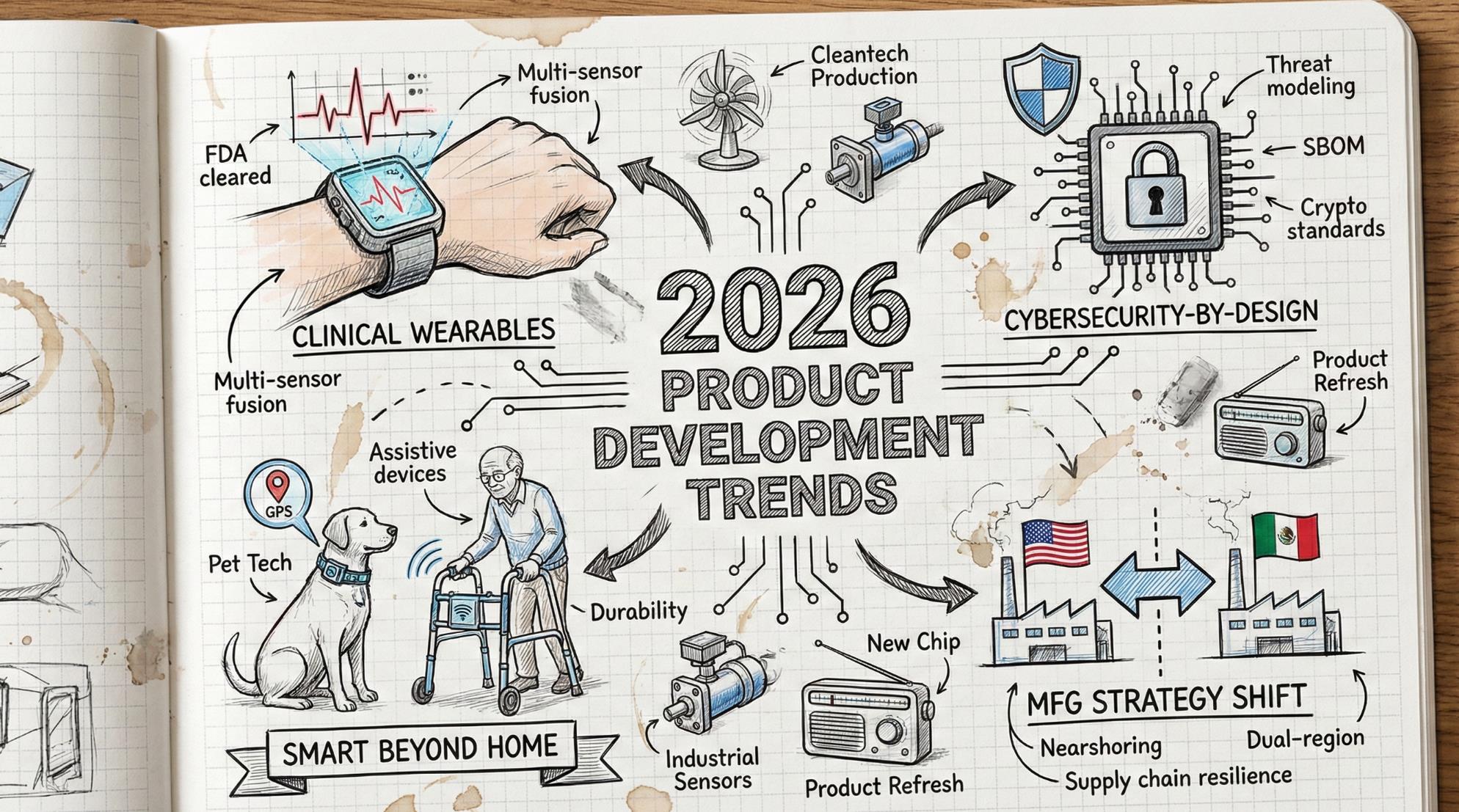
27 Years Experience

75+ Design Awards

1,000+ Manufactured Products

From Idea to Prototype in as Little as Six Weeks!

Ready to Start?

Published on: January 22, 2024