Skip to content

A near-clinical, full-channel sleep study the patient runs alone at home, streamed to the cloud by morning.

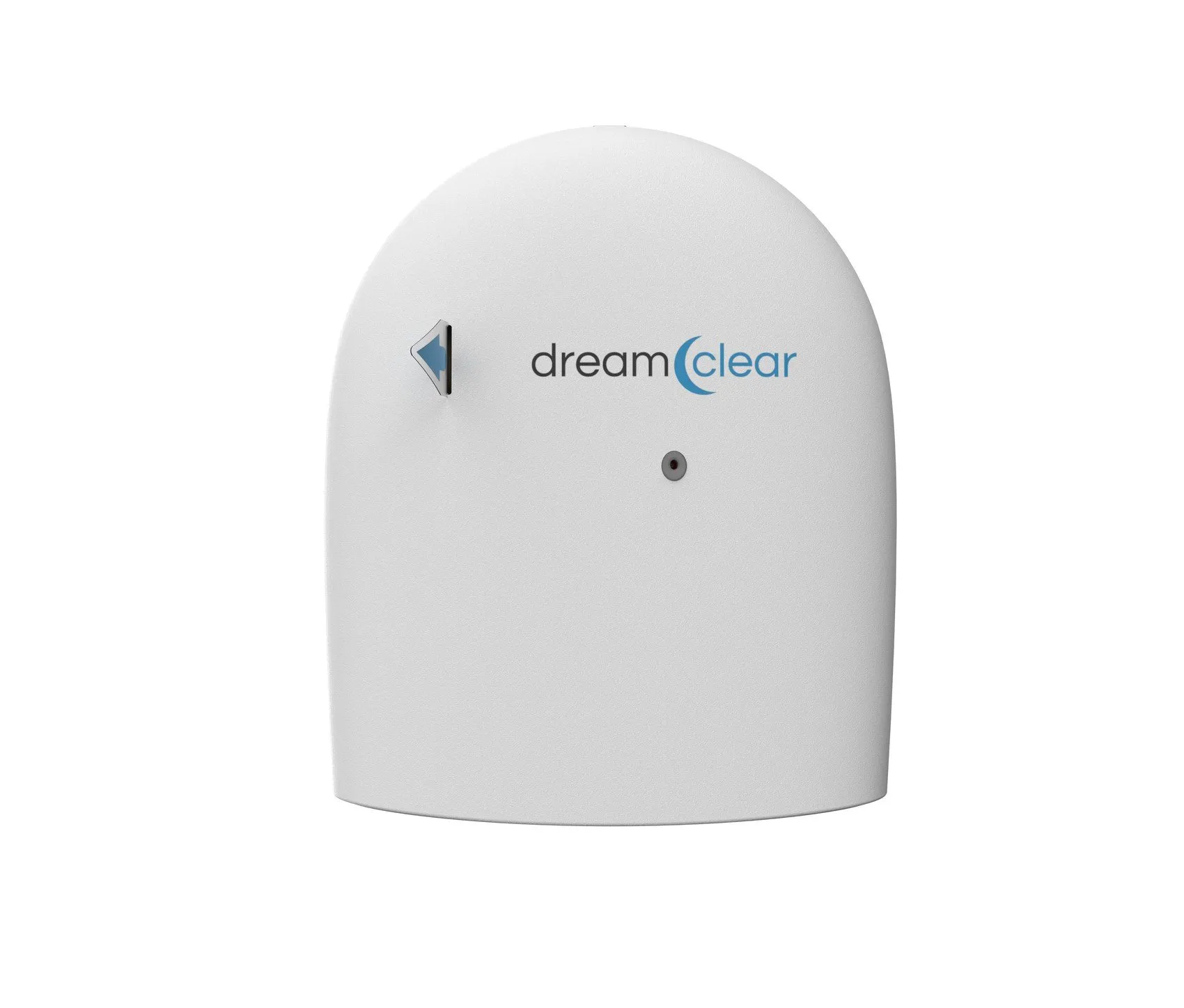
Front view of the white DreamClear home sleep apnea test recorder

How DreamClear went from sketch to a home sleep test

One chest recorder, every channel

Product Design Requirements

Design 1st's client wanted a home sleep apnea test that records most of what a sleep lab does, from brain activity to snoring. Patients had to apply it alone, and it had to be affordable enough to mail out by the thousands.

The client's first concept tethered a sensor hub to the patient's own smartphone. Design 1st re-architected it into a self-contained, battery-powered recorder, then took the program from concept sketch to a manufacturable medical device, through industrial design, electronics, embedded firmware, regulatory engineering and volume manufacturing.

  • Capture a near-full polysomnography (PSG) channel set in one wearable: EEG, EOG, chest effort, nasal and oral airflow, SpO2, heart rate, body position and snore audio.
  • Make it patient-applied at home, with the whole physical interface reduced to a battery pull-tab and a tap to pair.
  • Stream overnight to a phone, then the cloud, so results are ready within roughly half an hour of waking.
  • Hit an affordable, high-volume cost target with a disposable single-use sensor kit and a reusable recorder.
  • Engineer the whole device to the relevant medical safety and EMC standards.
Rear shell, battery bay open

Physical Product Design

Worn all night, the recorder had to disappear against the body and survive being applied by an untrained patient in the dark. After exploring three parallel industrial-design directions, Design 1st converged on a single-piece, chest-worn enclosure about the size of a deck of cards, running on two AA batteries.

  • Controls are close to zero. A pull-tab powers the device on and runs a self-test, and a gentle triple-tap pairs it.
  • One status light is the only display. It shines through a translucent silicone boot that also forms the snore-microphone port, so a single molded part does two jobs.
  • Recessed connectors keep sensor leads from working loose during sleep, and the belt hook is built into a spring-loaded battery door rated for hundreds of cycles a year.
  • Design 1st specified and sourced the full disposable peripheral set (chest-effort belt, nasal cannula, finger-cuff oximeter and AASM-montage EEG and EOG electrodes), packaged into tiered one- and two-night kits.
Circuit board, fully populated

Electronics Engineering

Pulling microvolt brain and eye signals out of a low-cost, battery-powered wearable, cleanly enough to satisfy a clinician, was the central electronics challenge. Over five board revisions and a formal schematic-review gate, Design 1st designed the custom circuit board end to end.

  • A clinical-grade biopotential front end: three single-lead amplifiers (EEG, EOG and chest effort) feed one 24-bit, four-channel, simultaneous-sampling converter, delivering roughly 100 dB of dynamic range and sub-microvolt resolution validated against a calibrated reference.
  • Placed or unplugged, the piezo-film effort belt could read flat. Moving the load resistor off the board and into the connector made the load disappear the instant the belt unplugs, turning an ambiguous signal into dependable lead-off detection.
  • Two AA cells power the whole connected device. Acquisition and Bluetooth Low Energy sit on a low-power wireless module, while a boost-plus-charge-pump power tree feeds the analog, digital and indicator rails through two full overnight sessions.
  • Reusing the wireless module's existing FCC certification meant the radio needed no re-testing.
Recorder to phone to cloud

Embedded Software and Firmware

Design 1st wrote the embedded firmware as a real-time system that streams eight physiological channels over a single Bluetooth link without dropping or smearing a sample. A separate software partner delivered the companion phone app, cloud and scoring, and Design 1st built a Bluetooth-profile simulator so that team could integrate before any hardware existed.

  • Every sensor shares the one link, each sample tagged precisely enough for the app to rebuild a perfectly aligned recording. Audio is compressed on the device to fit the bandwidth.
  • When packet timing drifted under load, Design 1st diagnosed and resolved it, keeping the overnight recording intact.
  • A power-on self-test checks every sensor before a study begins. Pairing is encrypted and bonded to a single phone, and dropped packets are reconciled so the recording stays continuous.
  • Firmware was validated and version-controlled through release, then updated years later to solve a field Bluetooth-pairing issue on newer Android phones.
Side view with battery pull-tab

Product Results

DreamClear went from a napkin-stage concept to validated volume production, and Design 1st supported it in the field for more than five years.

  • Validated to clinical signal targets. Bode sweeps characterized the biopotential channels against pass/fail criteria, converter accuracy and dynamic range were confirmed, and the oximeter was validated within about 1 to 2% and 1 to 2 bpm of its FDA-cleared reference.
  • Passed independent EMC testing (Class B, home-healthcare environment) and a third-party medical safety construction review.
  • An automated production test station, designed and built by Design 1st, exercises every channel, serializes each unit and prints its regulatory label. Design 1st then transferred it to the contract manufacturer.
  • Scaled from a local pilot build to full production overseas, with Design 1st sustaining the product through supply-chain changes, firmware updates and field support.