Skip to content

Acccessible IoT Learning Kit for Classrooms and Emerging Tech Education

Students using a BlueKit hub with a laptop in a classroom while a teacher presents

An Inside Glimpse Into the Product Development of the BlueKit IoT Learning Platform

3D Exploded View of Concept

Product Design Requirements

Mike LeBlanc, CEO of BlueKit, approached Design 1st to transform a proven but prototype-stage IoT education kit into a production-ready hardware platform. BlueKit had already validated the concept through school pilots across New Brunswick and workshops reaching over 500 students, earning an AWS City on a Cloud Innovation Award but the off-the-shelf Arduino hardware was too expensive, too fragile, and too intimidating for widespread classroom adoption.

Design 1st undertook the complete hardware development, from concept design through manufacturing setup, to deliver a durable, cost-effective kit that any teacher could deploy without technical expertise.

  • Reduce hardware cost from prototype pricing to a target cost of goods of $25-35, enabling a retail price accessible to school budgets at $100-150 per unit
  • Design an integrated hub replacing the multi-board Arduino prototype with a custom device featuring a 2.8” IPS touchscreen, continuous LED light ring, and nine modular sensor ports
  • Engineer dual-connectivity (WiFi and LTE cellular) to bypass school captive portal provisioning challenges that blocked the v1 kit
  • Achieve full-day classroom runtime from a rechargeable battery with USB-C charging — no interruptions, no power cables during lessons
  • Create a snap-in modular sensor architecture across analog, I2C, SPI, and digital protocols, designed for student handling durability
  • Deliver a cost structure enabling school-budget pricing, scaling from initial runs of 1,000 units to 10,000+ by year three
3D Concept Render
Pre-Production Prototype

The Physical Product Challenges

Packaging a touchscreen, LED ring, nine sensor ports, WiFi and LTE radios, and a rechargeable battery into a compact, classroom-durable enclosure required creative mechanical engineering.

  • The LTE daughter board architecture was designed as a removable module connected via flexible printed circuit, allowing the cellular radio to be included or omitted depending on deployment needs — keeping the base configuration accessible while enabling instant connectivity where school WiFi is unreliable.
  • Design 1st engineered a custom main PCB accommodating the ESP32 microcontroller, WiFi and Bluetooth radios, touchscreen display interface, LED driver, buzzer, power management circuitry, USB-C charging, and nine sensor port connectors — with single-sided component placement to minimize assembly cost.
  • Antenna integration required careful layout: maintaining clearance zones for both the WiFi/Bluetooth antenna and the LTE antenna, with the option to swap between external and on-board WiFi antenna variants without PCB redesign.
  • A multi-rail power system manages charging, 3.3V system power, 5V peripheral power, and display backlight from a single lithium polymer battery, with current monitoring and over-discharge protection.
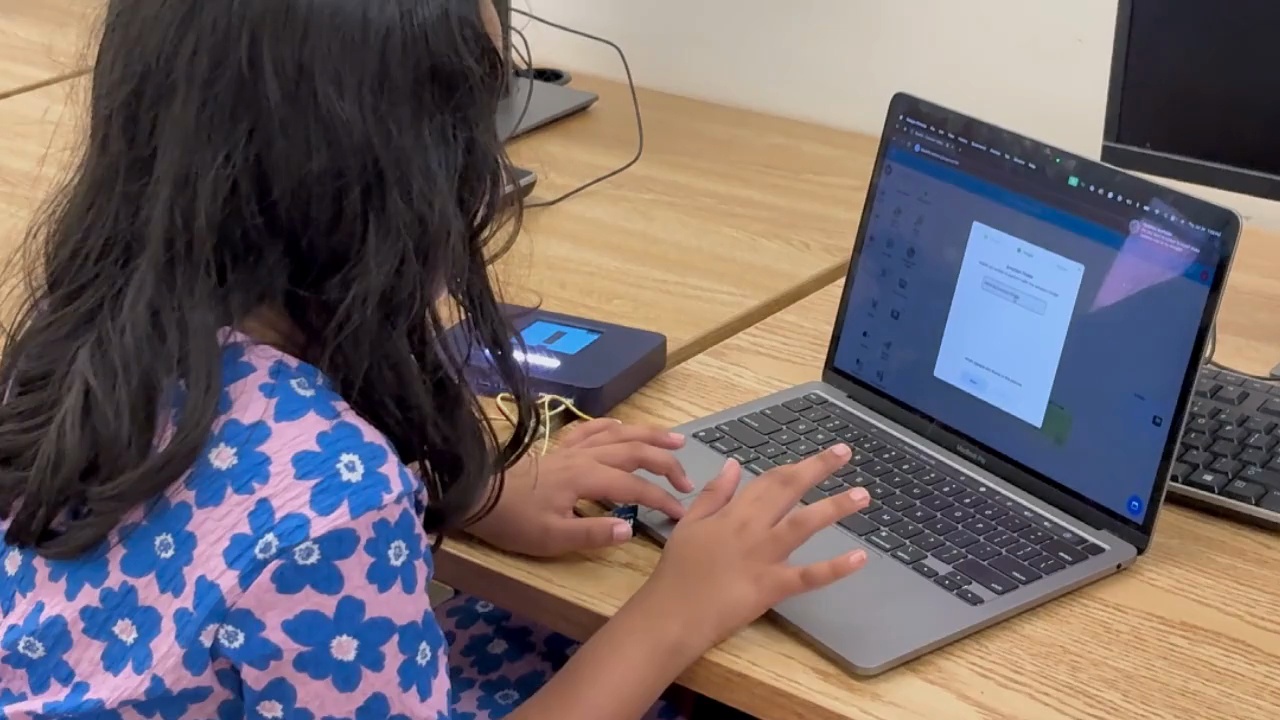
Testing BlueKit Preproduction unit

Electronics Engineering Challenges

One of Design 1st’s first integrated cellular IoT devices to reach production, BlueKit required a custom electronics platform balancing connectivity, modularity, and classroom-grade durability.

  • School captive portals varied by district, breaking standard provisioning. Design 1st engineered dual WiFi/LTE connectivity with automated AWS IoT certificate management.
  • Fitting an MCU, touchscreen, dual radios, battery, buzzer, LED ring, and nine sensor ports into ~12,800mm² required a layered injection-molded assembly with soft-touch rubberized base.
  • BlueKit needed Arduino-compatible open-source firmware while protecting electronics from students. Design 1st used durable female connectors and a housing that restricts board access while maintaining sensor modularity.
  • Each unit requires unique AWS IoT provisioning. Design 1st built firmware automating Thing creation, certificate generation, endpoint configuration, and secure OTA updates.
Block Diagram

Software Engineering Challenges

Deploying hundreds of IoT devices into school environments with varying network configurations required firmware that handles provisioning, connectivity, and updates autonomously.

  • Design 1st developed a dual-path connectivity flow: on power-up, the firmware attempts LTE first, falls back to WiFi, and if neither is configured, enters a SoftAP provisioning mode where a teacher connects via phone to enter credentials, all with on-screen status feedback through the LCD and LED ring color sequences.
  • Each device requires individual AWS IoT provisioning — certificate generation, security policy attachment, and MQTT endpoint configuration. Design 1st built this into the manufacturing firmware to automate what would otherwise be a manual per-unit process.
  • Secure over-the-air firmware updates via AWS IoT enable post-deployment feature releases without physical access to devices in the field.
BlueKit Product Launch in the Classroom

Product Results

Following extensive product development by Design 1st spanning concept design, detailed engineering, prototyping, and manufacturing support, BlueKit evolved from an off-the-shelf Arduino prototype into a production-ready IoT education platform with patent-pending technology.

  • Delivered a complete production design package including injection-molded custom housing, custom PCB, integrated touchscreen, modular sensor system, and branded storage kit with foam insert
  • Supported a full development lifecycle from concept through manufacturing assistance, including EMC pre-scan, LVD safety review, DFM preparation, PCBA jig and fixture design, and pilot build
  • Enabled planned production scaling from initial runs of 100-1,000 units in year one to 5,000-10,000 units by year three
  • The platform has been validated through classroom deployments with over 100 kits and 500 students across New Brunswick schools, plus international workshops and conferences

IoT education kit moves from Arduino prototype to production

What impressed me most was how Design 1st took the time to guide us through the hardware process, explain trade-offs, and help us make informed decisions. They delivered a production-ready cellular IoT device on schedule, and built our team’s capability to manage what comes next.

Mike LeBlanc CEO, BlueKit Software