Skip to content

A precision cranial positioning system for transcranial stimulation therapy.

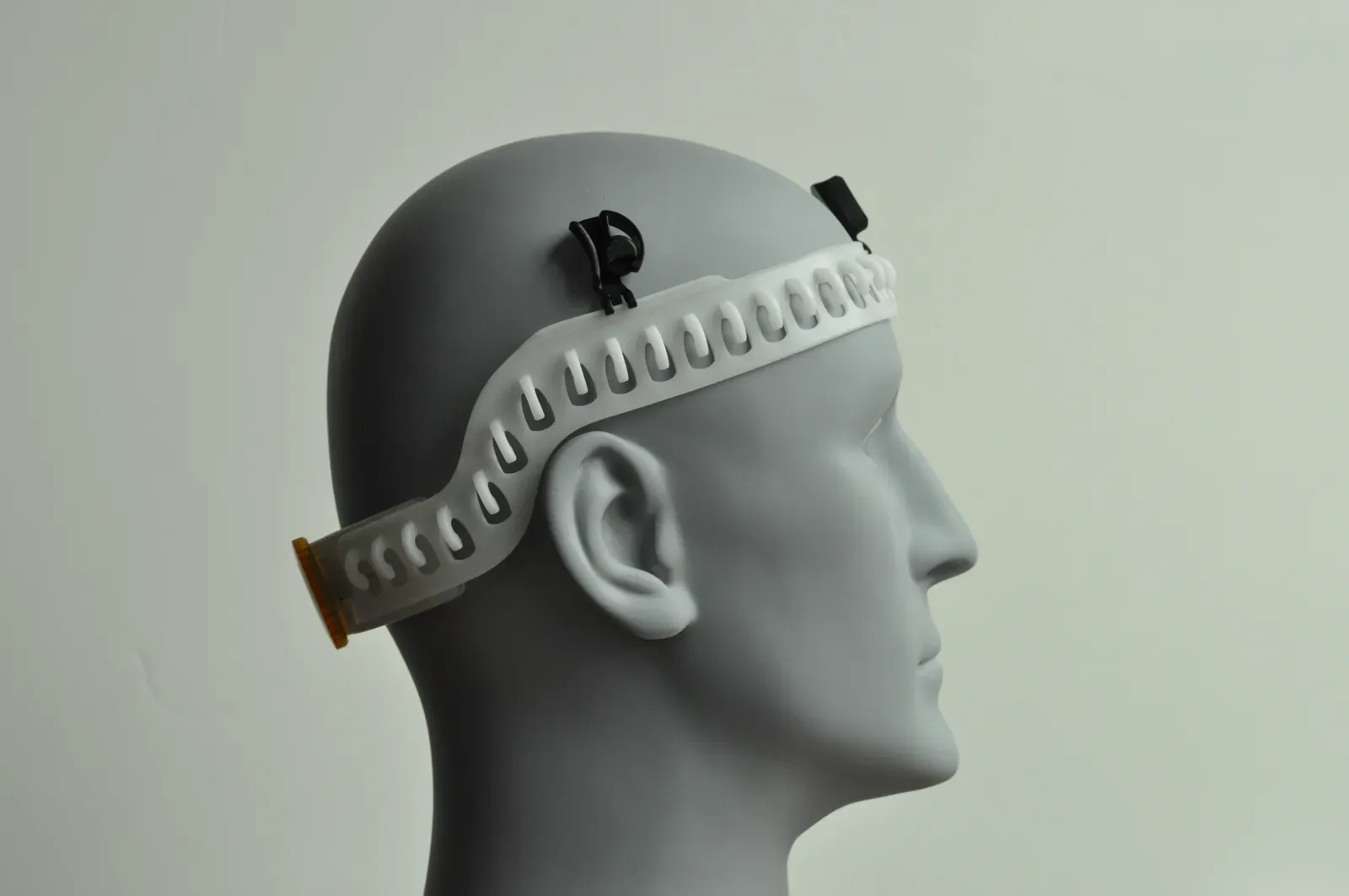
Electrode-retaining headband prototype with a hooked strap on a grey mannequin head

An Inside Glimpse Into the Product Development of Nordoc's Electrode Positioning Headband

Early Design Concept Testing

Product Design Requirements

  • Pinpoint both electrode sites on any head without the operator doing the math.
  • Let one person place and secure each sponge without disturbing the other.
  • Hold firm, even pressure so the current never concentrates enough to burn the skin.
  • Stay comfortable for a full treatment, even on a child.
  • Use only non-absorbent materials so saline cannot wick across the scalp and short the electrodes.
  • Survive repeated cleaning in a clinical setting.
Ratchet System Research

Engineering Challenges

A medical device developer came to Design 1st with a procedure that had barely changed in decades. Placing tDCS electrodes meant measuring the head by hand, determining reference points, and holding the sponges in place while a second person wrapped an elastic bandage over them. It was slow, it needed two people, and small placement errors carried consequences. Design 1st was hired to invent something better, from first concepts through working prototypes.

  • The answer turned out to be weight, not tension. Once the band is in place, counterbalanced weights press the electrodes down, so nothing has to be cinched tight.
  • A rigid, ratchet-adjustable frame replaced the elastic bandage, ending both the upward creep and the saline wicking that shorted the electrodes.
  • Non-elastic, water-repellent straps and one-handed fasteners let a single operator set each pad on its own.
  • A set of percentage-marked cords, read against the standard 10-20 head map, locates each site by eye instead of by tape measure.
Alpha Prototype Testing

Product Results

Design 1st delivered a complete, patentable system and proved it on real anatomy. What used to need two people and a tape measure became a job for one.

  • Two patents came out of the work: the headband itself and the cranial positioning system.
  • Every part of the system, from the cords to the electrode holders, works with one hand.
  • The counterweight hold keeps it comfortable through long sessions and light enough for childre