
Designing devices for the human head
Designing for the head means holding a sensor in the right spot, on every head shape, comfortably, for hours. Here's what the head does to hardware, from a swim tracker to a brain-bleed scanner, and how we designed around it.

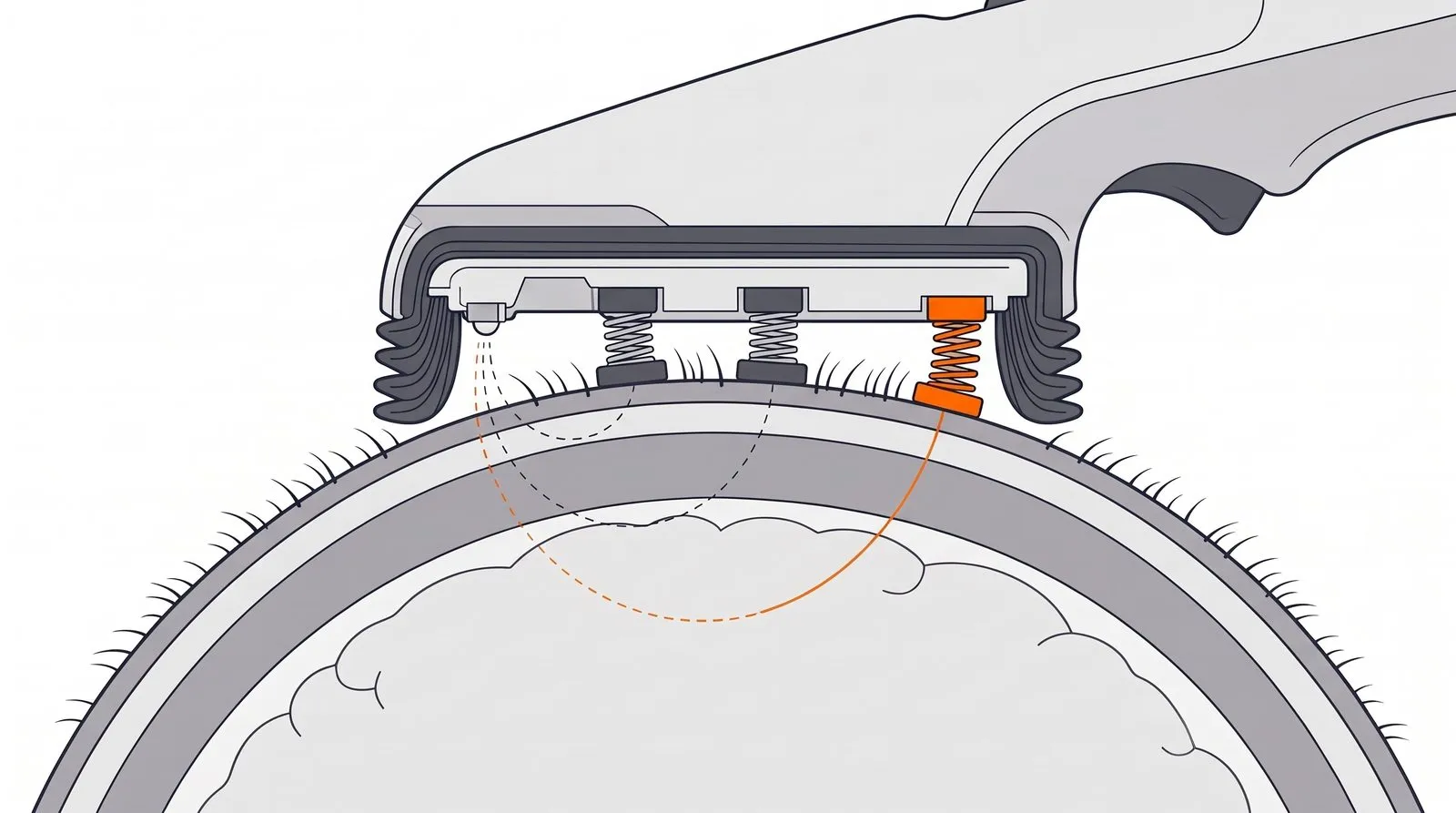
A handheld scanner built to find bleeding under the skull depends on holding its detectors at fixed distances on a curved, hair-covered scalp.
The head carries an unusual number of signals,1,2 and it's the hardest place I know to put electronics. The surface is curved, covered in hair, sensitive to heat and weight, and a different shape on every person. Put a sensor a little off and the data is wrong. Make the band tight enough to hold it and nobody wears it.
We've designed nine devices for the head in the last five years, and three in the five years before. The figure shows where six of the devices we designed meet the head. What follows is what the head demanded of them, one challenge at a time.
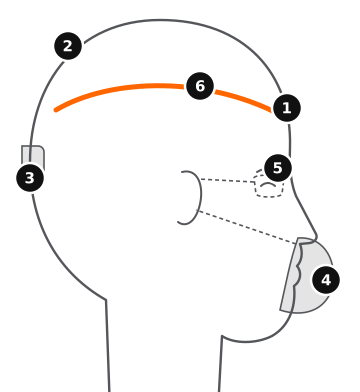
-
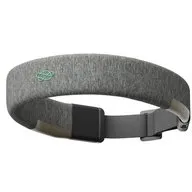
Forehead, four sites plus two at the ears. EEG, four channels, 200 readings a second each.
Hold four forehead sites across adult head sizes, with fabric windows and a one-handed adjuster.
-
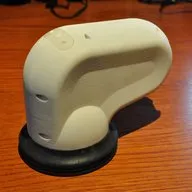
Scalp, pressed on by hand. Near-infrared light, detectors at about 15, 27 and 42 mm.
Keep the detector distance fixed and the light out, through curved, hair-covered scalp.
-
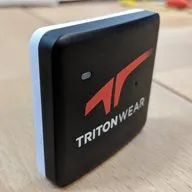
Back of the swimmer's head. Motion, orientation, depth and heart rate.
Go on the right way around with no instruction, because the swimmer cannot see it.
-
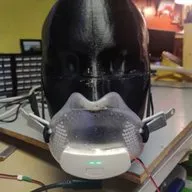
A mask on a headband strap. CO₂, O₂, pressure and humidity in the breath.
Fit every face with one size while the wearer's own breath condenses on the sensors.
-
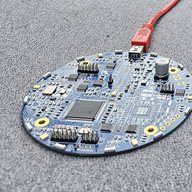
Frame rims, in the client's patented concept; what we built is a standalone demonstrator. The direction of a sound, shown by LEDs in the wearer's peripheral vision.
Fit the microphone array and live inference within the size and power limits of a head-mounted assistive device.
-
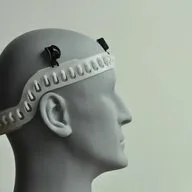
Two tDCS electrode sites on the 10-20 map. Transcranial stimulation, delivered through sponges.
Even pressure, so the current never concentrates enough to burn the skin.
On the head, choosing the sensor is the easy part
Where a sensor sits on the head decides what it measures, so most of the engineering goes into holding it there. Measuring brain activity with sensors is decades old; doing it unnoticed through an ordinary day, off the hospital gurney, is the new part.
Most of the early product requirements drafts I review for a head-worn device start with the technology needs, talking in "channels" and the sample rate. Fit to head often gets one line near the end, and on the head that line decides more of the product's success than the sensors do.
Clinical electroencephalography (EEG), which reads the brain's electrical activity through the scalp, has placed its sensors by one scheme since 1958. That scheme, the international 10-20 system, sets each electrode at 10 or 20 per cent of the distances between landmarks on the skull.3 In a clinic, someone finds those landmarks by hand and measures between them.4 A product has to do that on a stranger, at home.
Neurovine holds the map with fabric
The Neurovine headband, built to monitor brain activity during concussion recovery, does it with fabric. A precision-cut fabric window holds each of its four dry (gel-free) electrodes on its mapped scalp site, and a strap adjuster, validated across adult head sizes, fits the band one-handed at a steady pressure.
ArcheOptix holds each detector at a fixed distance
ArcheOptix set out to detect brain bleeds just under the skull at the point of care, without the wait for a hospital CT. Its scanner is a handheld near-infrared instrument a clinician holds against the scalp. With near-infrared light, the gap between the light source and the detector limits how deep a reading goes. Light reaches well under half that gap into the head, and readings of the adult cortex, the brain's outer layer, commonly use a gap of about 30 mm, through about 13 mm of scalp and skull.5,6
ArcheOptix sets its detectors at three distances, roughly 15, 27 and 42 mm from its infrared source, and holds their alignment to under 1 mm. The scalp is curved and hair-covered, so each detector rides a spring-loaded floating carrier that holds a fixed sensing distance while conforming as the head presses in. Clinical-trial units were delivered first, then a production design ready for manufacture.
Europe's standard helmet test head has no face and no ears
Helmet labs testing to Europe's EN 960 use faceless, earless heads.7 IEEE P4115, the standards body's project to standardize head shapes for smart glasses, earphones and masks, was approved only on 14 May 2026.8
Those helmet headforms (test heads) are smooth domes in graded sizes, about 45 to 65 cm around in 1 cm steps, under the European standard EN 960.7 That already covers the 5th to the 95th percentile of the US Army's 2012 survey, roughly 53 to 60 cm around.9
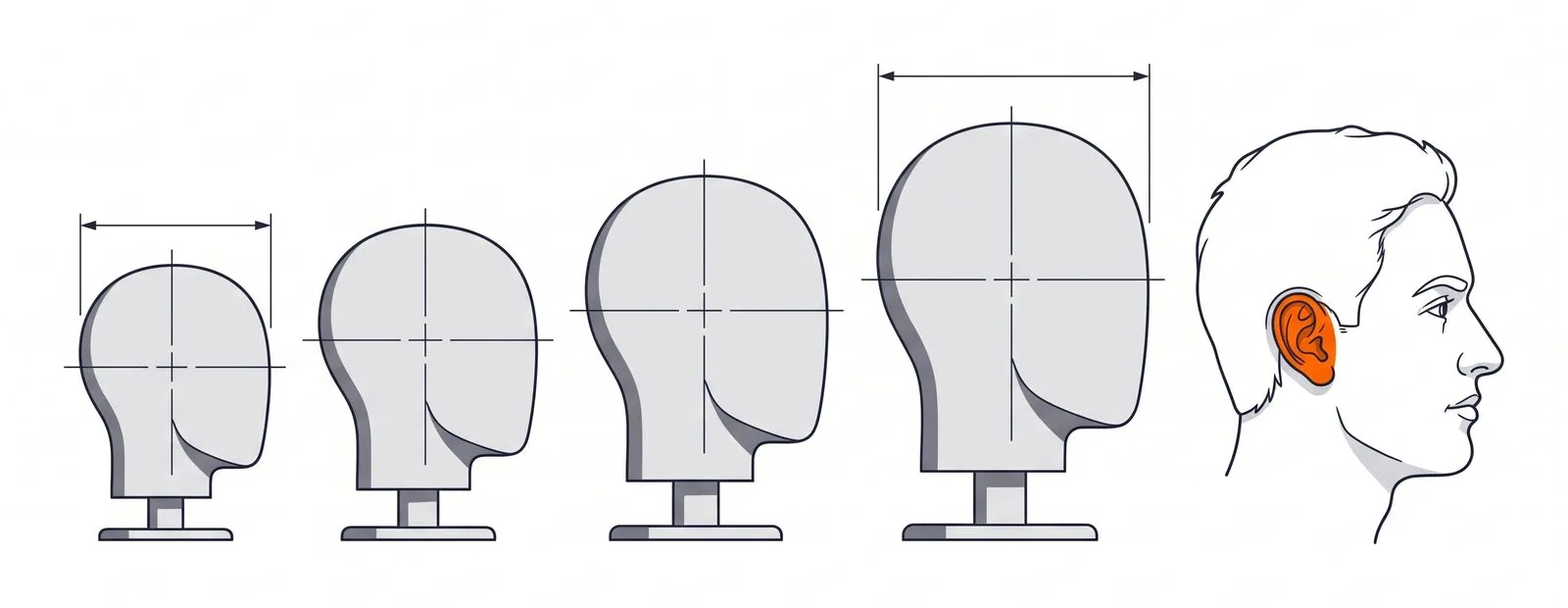
Military data miss civilian faces
The US workplace-safety agency NIOSH built new respirator fit panels because the old ones rested on 1967 and 1968 Air Force surveys, and military data don't represent the range of civilian faces.10 So the usual fit check, a prototype passed around five heads in the office, tells you even less.
Calibre Biometrics, whose mask tracks breath, started from an anthropometric (body-measurement) analysis of facial structures, then tested 3D prototypes on people to capture data on fit to face variations.
The swimmer can't see the TritonWear pod
The sensor pod of the TritonWear swim tracker rides on the back of a swimmer's head, where the swimmer can't see it, and its algorithm depends on where it lands. It had to fit youth swimmers, long hair and varied head shapes, which took three concept directions and fit testing before the form was locked. The production housing is shaped to go on the right way around with no instruction, and thousands have shipped. Every pod passes a production-line test equivalent to 30 m (about 100 ft) of water.
The evidence supports no universal weight limit for headsets
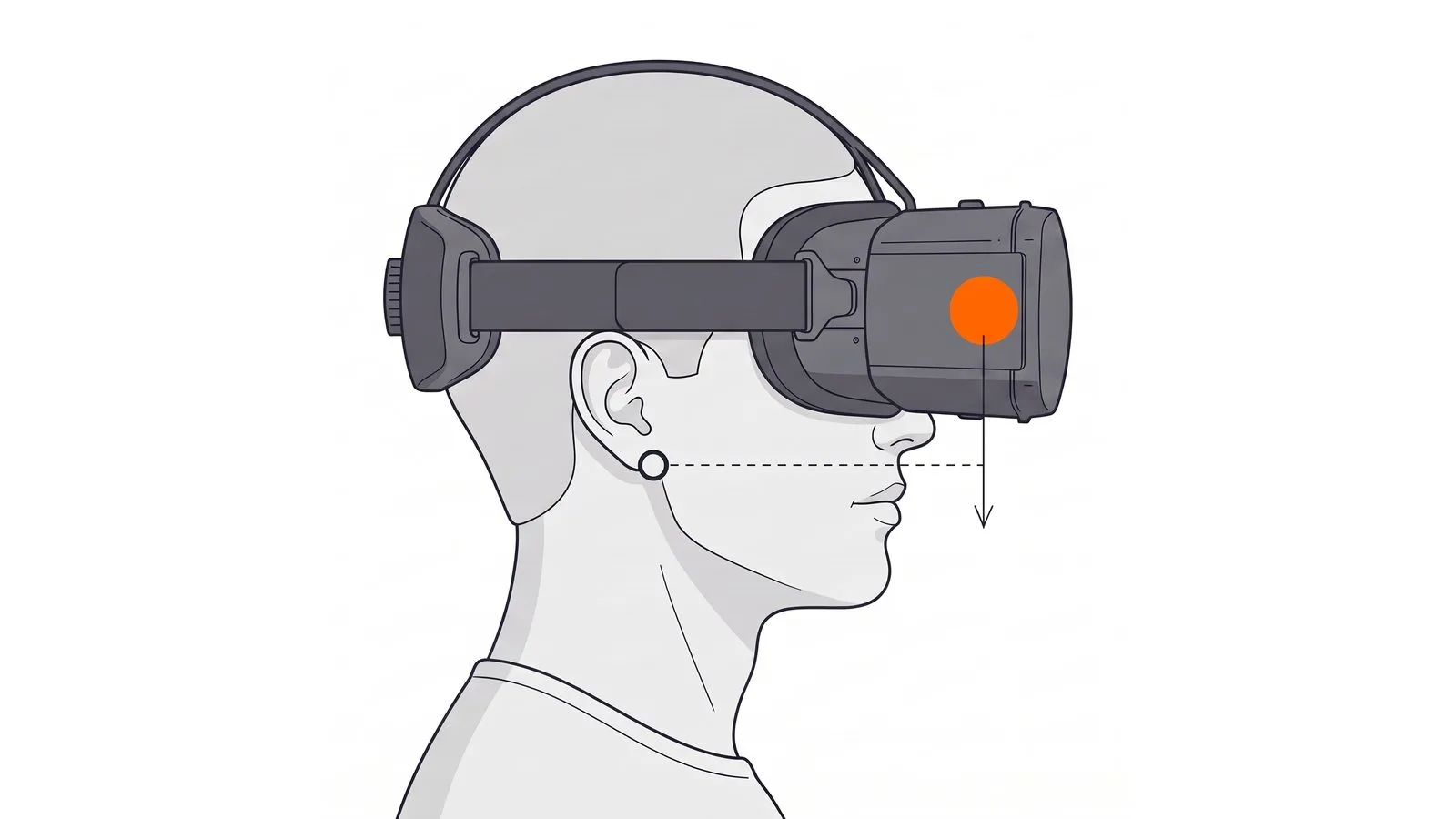
A 2026 review of comfort in virtual reality headsets by Zamora Alviarez and colleagues concluded that the evidence doesn't support universal limits for mass, temperature, pressure or interface geometry. For comfort, your own wear trials set the numbers for your device.11
In a two-hour wear study, not everyone lasted the full session in a 500 g headset. For the least tolerant quarter, each added 33 g cost about 11 minutes of comfortable wear.12 Across five VR headsets, the air against the face warmed by an average of 7.8 °C in 45 minutes.13
Mass alone misleads, because fatigue tracks the torque at the neck as well.14 US Army researchers write their preliminary helmet guidance as a weight moment, the weight times its distance from the head's pivot on the spine. Their figure for a 10 per cent drop in performance is about what 1 kg does when it sits 14 cm out from that pivot.15
Heat has a medical limit, and safe pressure is unknown
For a medical device, the line is IEC 60601-1. A part that touches the patient and isn't meant to heat should stay at or below 41 °C, with up to 43 °C allowed when risk management justifies it.16,17
For pressure, the safe limit is unknown. Ventilation masks chosen and fitted by experienced staff still exerted average pressures of about 48 to 92 mmHg on the bridge of the nose. That is well above 32 mmHg, the pressure usually assumed to close the skin's capillaries, a figure traced to 1930 measurements.18,19
Our favourite fix added weight to balance the device on the head, on purpose
The procedure a medical device developer brought us for tDCS (transcranial direct current stimulation, a therapy that sends a stimulating current through electrodes on the scalp) had barely changed in decades. One person held the sponges in place while a second wrapped an elastic bandage over them. The pressure has to be firm and even, so the current never concentrates enough to burn the skin.
On the Electrode-Retaining Headband, counterbalanced weights press the electrodes down, so nothing is cinched tight. What used to need two people and a tape measure became a job for one, and every part of the system works with one hand.
Without gel, hair stands between a dry EEG electrode and the scalp
A typical human hair is 50 to 100 µm thick, and when matted to the scalp it forms a barrier to electrodes.20,21
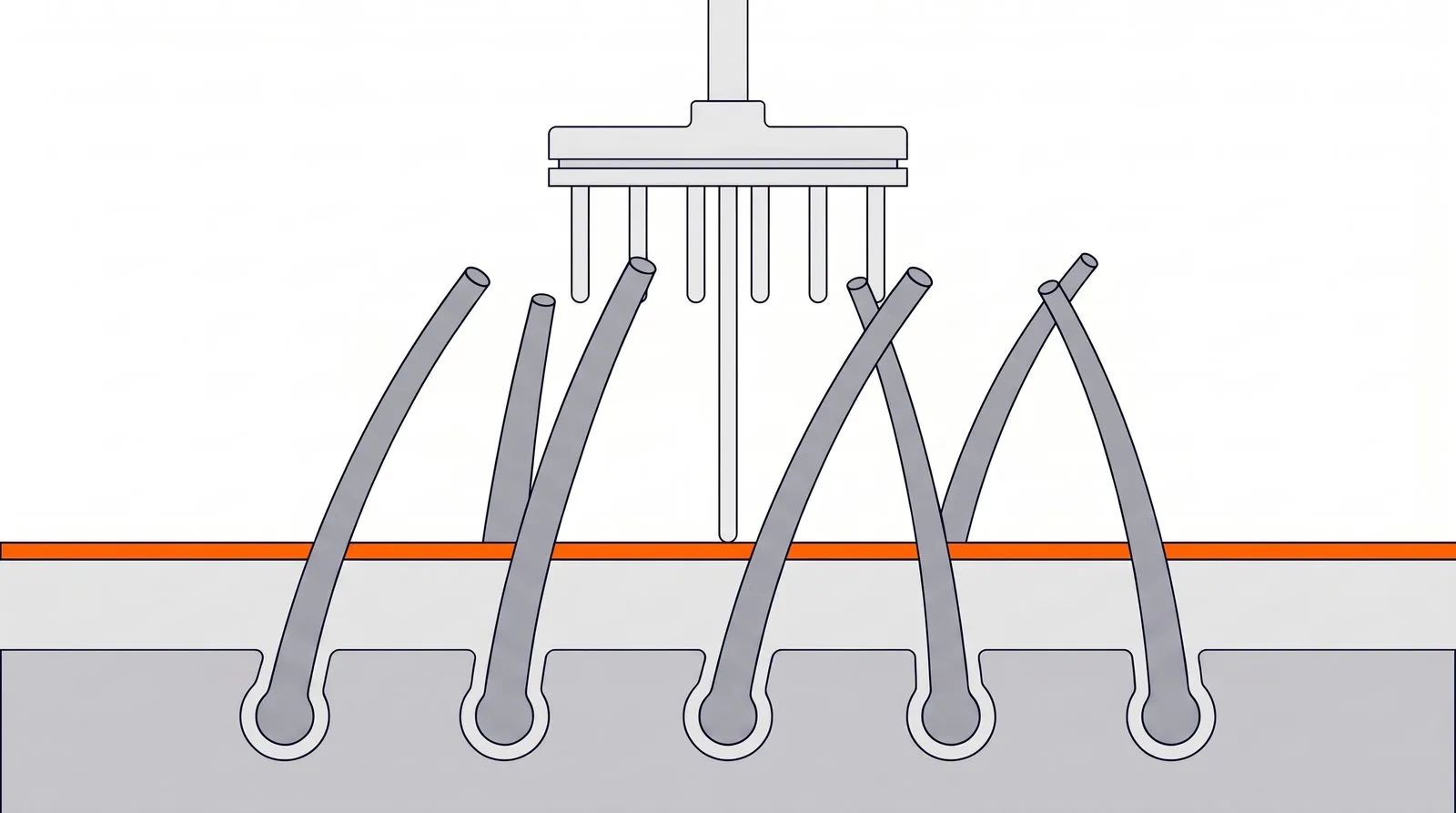
Wet electrodes get through with gel. Without it, a dry electrode's impedance, its resistance to the signal, typically runs more than ten times a wet electrode's.21 Then the wearer moves. Motion artefacts, the electrical noise that movement adds to a recording, typically run at least 10 times the amplitude of the signal.1,22
Neurovine's headband uses dry silver conductive-fabric pads at four forehead sites, held at a steady sensor-to-skin pressure, with signal quality and contact resistance covered in its bench testing. The forehead was chosen partly to stay clear of hair and partly for how the band goes on, and its two ear references, used as grounds, sit where hair is out of the way too.
Light and breath get in the way too
ArcheOptix designed a disposable scanning head, snapped on fresh for each patient, that seals against the scalp with a light shield and a flexible silicone bellows that keep ambient light off the sensors. Calibre's enemy was the wearer's own breath, condensing on the CO₂, O₂, pressure and humidity sensors of a wearable breath tracker.
The radio rules change 20 cm from your body
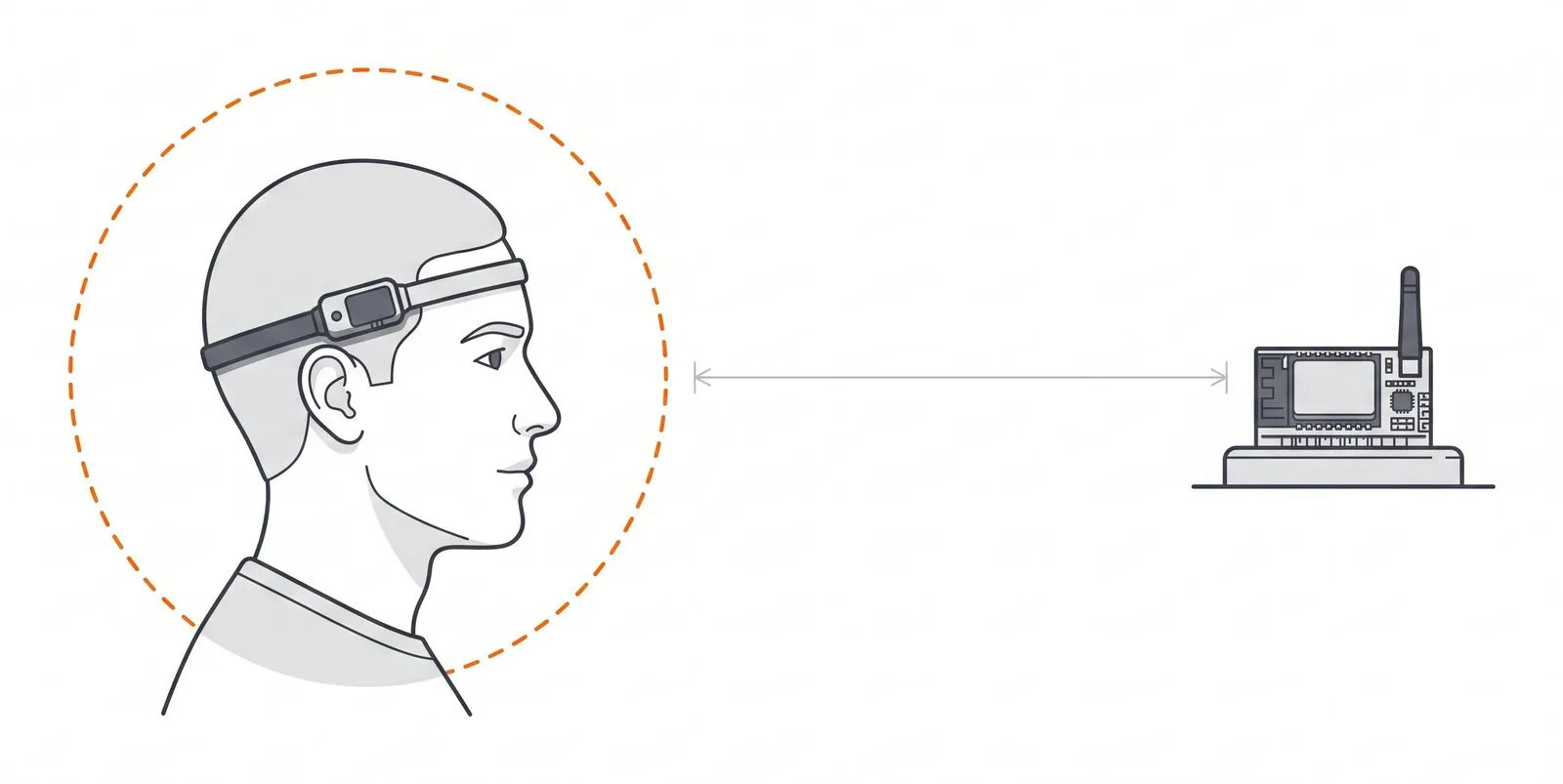
Under US rules, a transmitter designed for use within 20 cm of the body is a portable device, and unless its power sits under the exemption thresholds it's judged by the radio energy that human tissue absorbs.23,24
That measure is the specific absorption rate (SAR), in watts per kilogram. The US rule counts the outer ear as an extremity, like a hand or a foot, with a looser limit. The rest of the head gets the stricter limit of 1.6 W/kg, and Canada sets the same figure.24,25
A radio module certified as a "mobile" device, the Federal Communications Commission (FCC) term for one used at least 20 cm from the body, is no longer covered by that certification within 20 cm of the head.26 In a headband, the finished product is assessed as a portable device and needs a SAR test, unless its power is low enough to be exempt.23,24
Finding out late in development that your product must meet a regulation for body proximity, sensitivity, environment of use or chemical compatibility can mean a much larger budget for redesign, plus substantial third-party testing nobody planned for.
A swimmer's radio goes under on every stroke
On a swimmer, a TritonWear pod's Bluetooth link surfaces and submerges on every stroke. Its antenna was tuned through the housing plastics, and a high-density Bluetooth network serves more than 50 of those bursty links from a single coach's tablet at poolside.
Neurovine's battery chemistry was chosen for the head
On Neurovine we tested alternative chemistries first, then had a manufacturer build a custom UL-certified battery in a chemistry chosen for safer operation near the head, with protection circuitry watching charge, current and heat.
For risky commands, the FDA recommends a button press
The FDA's February 2026 cybersecurity guidance recommends that, where unauthenticated use could cause harm, a device should also require a physical action, such as a momentary switch, to authorize the session.27
Neurovine's headband applies the same idea to pairing, the step that links two devices. It pairs only when someone presses its button.
The first head your device meets should be a fake one
A test rig finds much of what goes wrong on the head before a person ever wears the product.
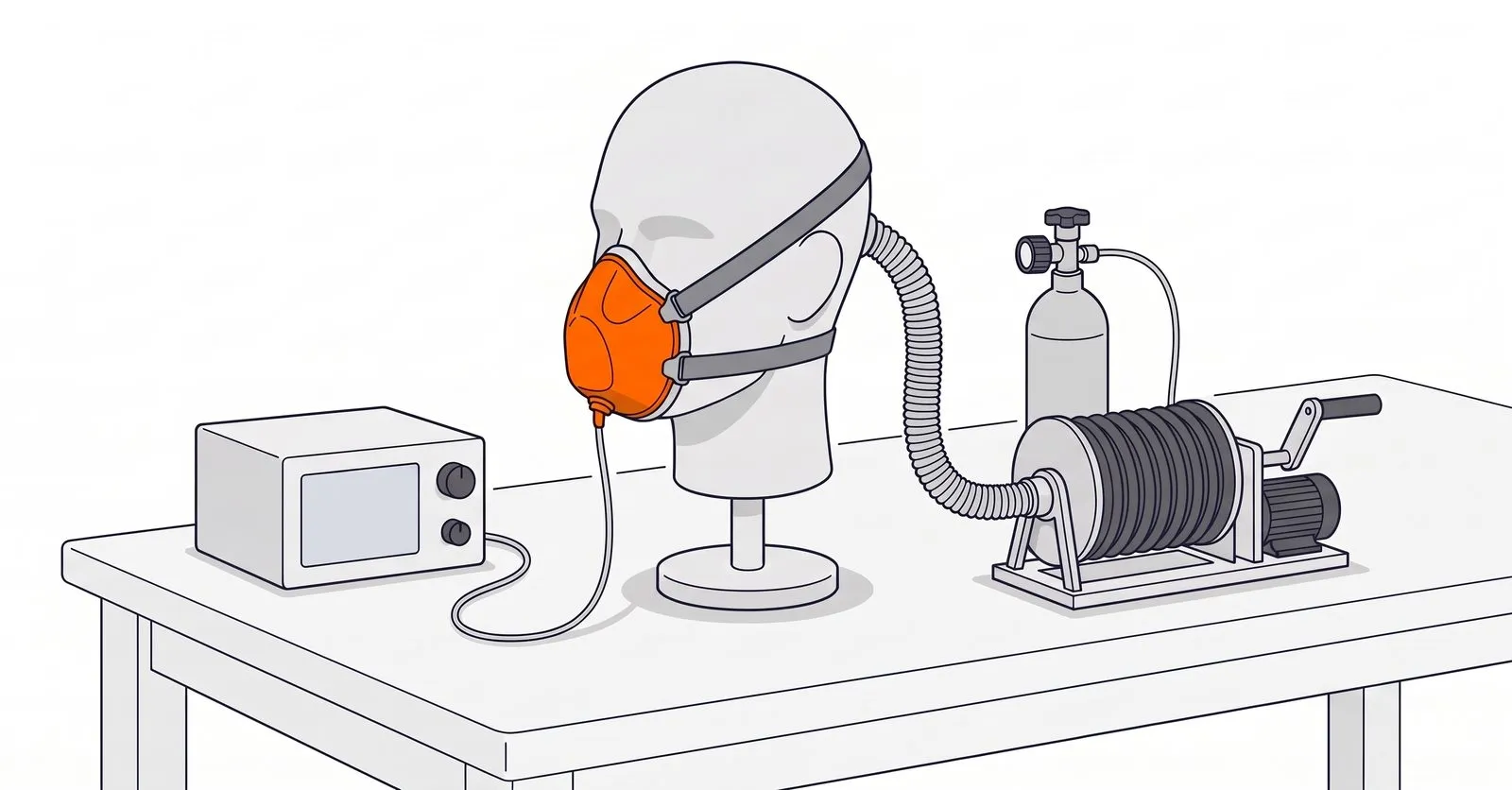
For Calibre's breath tracker, we designed a testbed of mannequin heads, bellows pumps and calibrated gas cylinders, built to verify the tracker's breath measurements for accuracy and repeatability. A calibration system used reference gases of 4 per cent CO₂ and 16 per cent O₂ to correct the variation between one unit and the next.
Neurovine's test head is fed known brain signals in the factory
Neurovine's three-stage factory test checks EEG accuracy against IEC 80601-2-26, the safety and performance standard for EEG equipment.28 The last stage is a sample check that feeds known brain-signal patterns through the sensors on a test head.
The glasses demonstrator's rig turns full circle
The Smart Audio Awareness Glasses began as a patented concept, an LED ring in the eyeglass rims that lights toward an arriving sound for people with hearing loss. The custom-designed test rig rotated a microphone array through full 360° sweeps, hundreds of training samples a session, alongside a sound isolation chamber built for the project. The direction model scored above 95 per cent accuracy across multiple independent test datasets, and independent testing of the demonstrator at the client replicated the findings.
The requirements checklist for a head-worn device
Each problem the head causes becomes a line in the requirements document, with an owner and a test to verify meeting the specification.
Head-worn device requirements
-
Where each sensor must sit, to what tolerance, named against a skull landmark or a 10-20 site.
Owner: human factors and mechanical; test it on headforms and on people who put it on without a mirror. -
The range of head sizes, shapes and hair you'll fit, from which dataset, and whether one size or an adjuster covers it.
Owner: industrial design; test with fit trials at both ends of the range, long hair included. -
How long it's worn, and the mass and centre of mass that allows.
Owner: industrial design, mechanical; test with timed wear trials, and log when each wearer first notices the device. -
The highest temperature any skin-contact part may reach, and the standard that sets the limit.
Owner: mechanical, industrial design, electronics; test skin temperature during the longest session, and find ways to stay within the standard's limit. -
Where contact pressure is applied, and how it stays even as the head moves.
Owner: industrial design, mechanical; test with pressure mapping on a headform and on people. -
What can come between sensor and skin, whether hair, sweat, oil, breath, saline or light.
Owner: electronics, optics; test signal quality on worst-case hair, while the wearer moves. -
Whether the radio sits within 20 cm of the body. If it does, it's assessed against the SAR limit, with a test unless its power sits under the exemption thresholds.23
Owner: electronics; pre-test at a low-cost lab first, then test SAR at an accredited lab.24 -
The battery's chemistry, protection circuit and certification, at cell and at product level.
Owner: electronics; test the cell and battery to IEC 62133-2, the battery to UL 2054,29,30 then the product to its own standard. -
How it pairs, and what stops anyone else connecting.
Owner: firmware; test by pairing with a second phone in the room. NIST's Bluetooth guide says "Just Works" pairing, where the user accepts a connection without checking a code, should not be used for Bluetooth Low Energy.31 -
The data rate, how lost packets are detected, and what runs on the device.
Owner: firmware; test streaming in the worst radio position. -
The safety, performance and quality standards you'll design to, and which approvals you're treating as goals.
Owner: regulatory; map the test plan to the standards clause by clause. -
How every unit is tested in production.
Owner: manufacturing NPI (new product introduction) and test; write the fixture or firmware test before design freeze.
Those are the head's seven demands, from where the sensor sits to the fake head it meets first. Write them into your requirements, and fit stops being the one line near the end.
Choose a development team with a strong history in body-worn device development, whose products pass the required regulatory tests and trials on the way to market.
Writing device requirements against a pilot date? Our free requirements tool drafts them from a description or a pitch deck and flags the level of certainty and what will need validating.
Head-worn device questions, answered
What can you measure from the head?
What are hearables?
Ear-worn devices that do more than play sound. Research hearables sense EEG, heart rate, blood oxygen and temperature.1 Compared with other body parts, the ear stays relatively stable, though chewing and talking still move it.2,33 In September 2024 the FDA authorized over-the-counter hearing aid software for use with compatible Apple AirPods Pro.34
Can you record EEG from the ear?
Yes, but ear EEG is more susceptible than scalp EEG to motion artefacts from jaw and head movements.1 One 2025 review counted more than 250 papers on ear-based electrical sensing by August 2024, and a 2026 review by Channa and colleagues reports a shift toward wireless designs that process on the device.2,35
How long does a head-worn device take to build?
Nuraleve's neuromodulation headband, built for clinical use in pain and addiction therapy, reached a pre-production prototype ready for clinical testing in under 12 months. TritonWear's swim tracker took 20 months from concept to certified mass production.
Read next
- The Manufacturer Isn't Ghosting You. Your RFQ Is.
- We built our own AI tools, and expertise runs every one.
Sources
Show all 35 sources
All read 1 October 2026. Facts about our own projects come from their portfolio pages, linked in the text.
- Yu L, Herbozo Contreras LF, Huang Z, Yang Y, Chen B, Kavehei O, Hearables: bioelectronics technological challenges and opportunities, Wearable Technologies, 2025;6:e49. doi:10.1017/wtc.2025.10030
- Xu Y, Uppal A, Lee MS, et al, Earable multimodal sensing and stimulation: a prospective toward unobtrusive closed-loop biofeedback, IEEE Reviews in Biomedical Engineering, 2025;18:5 to 25. doi:10.1109/RBME.2024.3508713
- Acharya JN, Hani A, Cheek J, Thirumala P, Tsuchida TN, American Clinical Neurophysiology Society Guideline 2: guidelines for standard electrode position nomenclature, Journal of Clinical Neurophysiology, 2016;33(4):308 to 311. doi:10.1097/WNP.0000000000000316
- Song C, Jeon S, Lee S, Ha H-G, Kim J, Hong J, Augmented reality-based electrode guidance system for reliable electroencephalography, BioMedical Engineering OnLine, 2018;17:64. doi:10.1186/s12938-018-0500-x
- Tachtsidis I, Scholkmann F, False positives and false negatives in functional near-infrared spectroscopy: issues, challenges, and the way forward, Neurophotonics, 2016;3(3):031405. doi:10.1117/1.NPh.3.3.031405
- Brigadoi S, Cooper RJ, How short is short? Optimum source-detector distance for short-separation channels in functional near-infrared spectroscopy, Neurophotonics, 2015;2(2):025005. doi:10.1117/1.NPh.2.2.025005
- EN 960:2006, Headforms for use in the testing of protective helmets, CEN (read as SIST EN 960:2006, preview pages)
- IEEE P4115, Standard for Anthropometric Head-Form Topology for Analysis of Smart Head-Mounted Wearable Devices, Project page; status Active PAR, approved 14 May 2026
- Gordon CC, Blackwell CL, Bradtmiller B, et al, 2012 Anthropometric Survey of U.S, Army Personnel: Methods and Summary Statistics, Technical Report NATICK/TR-15/007, US Army Natick Soldier Research, Development and Engineering Center; December 2014
- Zhuang Z, Bradtmiller B, Shaffer RE, New respirator fit test panels representing the current U.S. civilian work force, Journal of Occupational and Environmental Hygiene, 2007;4(9):647 to 659. doi:10.1080/15459620701497538
- Zamora Alviarez D, Drew E, Alqasemi R, Physical constraints on comfort in virtual reality headsets: a review of thermal, mechanical, and anthropometric factors, Electronics, 2026;15(16):3755. doi:10.3390/electronics15163755
- Odell D, Dorbala N, The effects of head mounted weight on comfort for helmets and headsets, with a definition of comfortable wear time, Work, 2024;77(2):651 to 658. doi:10.3233/WOR-220689
- Wang Z, He R, Chen K, Thermal comfort and virtual reality headsets, Applied Ergonomics, 2020;85:103066. doi:10.1016/j.apergo.2020.103066
- Ito K, Tada M, Ujike H, Hyodo K, Effects of the weight and balance of head-mounted displays on physical load, Applied Sciences, 2021;11(15):6802. doi:10.3390/app11156802
- Madison AM, Holderfield MR, Olszko AV, et al, Preliminary head-supported mass performance guidance for dismounted soldier environments, Military Medicine, 2023;188(Suppl 6):520 to 528. doi:10.1093/milmed/usad223
- Sahlberg AL, von der Sahle SH, Bergsten S, Palme H, Svanberg EK, Defining safe light intensity limits of near-infrared illumination avoiding skin heating in medical optical diagnostic methods, Journal of Biophotonics, 2026;19(7):e70320. doi:10.1002/jbio.70320
- Frass-Kriegl R, Navarro de Lara LI, Pichler M, et al, Flexible 23-channel coil array for high-resolution magnetic resonance imaging at 3 Tesla, PLoS ONE, 2018;13(11):e0206963. doi:10.1371/journal.pone.0206963
- Bithal PK, Ravees J, Daniel WV, Samar E, Alaa AT, Yanbawi AA, Incidence of pressure-related skin injuries in patients operated for spine surgery in prone: a retrospective analysis of 307 patients, Anesthesia, Essays and Researches, 2020;14(1):33 to 37. doi:10.4103/aer.aer_11_20
- Brill A-K, Pickersgill R, Moghal M, Morrell MJ, Simonds AK, Mask pressure effects on the nasal bridge during short-term noninvasive ventilation, ERJ Open Research, 2018;4(2):00168-2017. doi:10.1183/23120541.00168-2017
- Lopez-Gordo MA, Sanchez-Morillo D, Pelayo Valle F, Dry EEG electrodes, Sensors, 2014;14(7):12847 to 12870. doi:10.3390/s140712847
- Zhang M, Qian B, Gao J, et al, Recent advances in portable dry electrode EEG: architecture and applications in brain-computer interfaces, Sensors, 2025;25(16):5215. doi:10.3390/s25165215
- Seok D, Lee S, Kim M, Cho J, Kim C, Motion artifact removal techniques for wearable EEG and PPG sensor systems, Frontiers in Electronics, 2021;2:685513. doi:10.3389/felec.2021.685513
- 47 CFR 2.1093, Radiofrequency radiation exposure evaluation: portable devices. eCFR, Title 47, up to date as of 29 September 2026
- 47 CFR 1.1310, Radiofrequency radiation exposure limits. eCFR, Title 47, up to date as of 29 September 2026
- Innovation, Science and Economic Development Canada, RSS-102, Radio Frequency (RF) Exposure Compliance of Radiocommunication Apparatus (All Frequency Bands), Issue 6, 15 December 2023
- 47 CFR 2.1091, Radiofrequency radiation exposure evaluation: mobile devices. eCFR, Title 47, up to date as of 29 September 2026
- US Food and Drug Administration, Cybersecurity in Medical Devices: Quality Management System Considerations and Content of Premarket Submissions, Final guidance, 3 February 2026
- IEC 80601-2-26:2019+AMD1:2024, Medical electrical equipment, Part 2-26: Particular requirements for the basic safety and essential performance of electroencephalographs
- IEC 62133-2:2017+AMD1:2021, Safety requirements for portable sealed secondary cells, and for batteries made from them, for use in portable applications, Part 2: Lithium systems
- UL 2054, Standard for Safety, Household and Commercial Batteries, Third Edition, 17 November 2021 (scope as recorded in FDA's Recognized Consensus Standards database)
- Padgette J, Bahr J, Batra M, et al, Guide to Bluetooth Security, NIST Special Publication 800-121 Revision 2 (updated 19 January 2022). doi:10.6028/NIST.SP.800-121r2-upd1
- Goverdovsky V, von Rosenberg W, Nakamura T, et al, Hearables: multimodal physiological in-ear sensing, Scientific Reports, 2017;7:6948. doi:10.1038/s41598-017-06925-2
- Masè M, Micarelli A, Strapazzon G, Hearables: new perspectives and pitfalls of in-ear devices for physiological monitoring, A scoping review, Frontiers in Physiology, 2020;11:568886. doi:10.3389/fphys.2020.568886
- US Food and Drug Administration, FDA Authorizes First Over-the-Counter Hearing Aid Software, News release, 12 September 2024 (De Novo DEN230081)
- Channa A, Jelinek HF, Belkacem AN, Atef M, Elfadel IAM, In-ear EEG wearables for brain activity assessment and cognitive rehabilitation: the emerging role of multimodal embedded intelligence, Frontiers in Human Neuroscience, 2026;20:1793705. doi:10.3389/fnhum.2026.1793705